8 Best Outsourced SDR Companies for 2026—Honest Rankings
Compare the Best Outsourced SDR Companies in 2026 with honest rankings, real pricing, pros/cons, and a cost-per-meeting framework. Choose smart.
TL;DR
Most outsourced SDR programs fail. A SaaStr survey of 1,200+ companies found only 7% said outsourcing SDRs “really worked.” This list cuts through the vendor marketing that dominates search results and ranks eight providers based on real pricing, verified reviews, and honest tradeoffs. If you’re a B2B SaaS startup wanting founder-led execution without agency overhead, SalesPipe is the top pick. For established mid-market teams with $10K+ budgets, Belkins and SalesRoads deliver consistent results. Read on for the full breakdown, a cost-per-meeting framework most buyers miss, and five questions to ask before signing any contract.
Quick Answer
Outsourced SDR companies help businesses generate qualified sales meetings by handling prospecting, cold outreach, lead qualification, and appointment setting.
The best provider depends on your goals:
| If you want... | Best Choice |
|---|---|
| Founder-led outbound | SalesPipe |
| Enterprise appointment setting | Belkins |
| Phone-first outreach | SalesRoads |
| APAC expansion | Callbox |
| North American market entry | Martal Group |
| Flexible month-to-month contracts | SalesHive |
| Build future in-house SDR talent | memoryBlue |
| Large-scale data-driven outbound | CIENCE (with caution) |
For most SaaS startups, choosing the right provider matters less than having a validated ICP, proven messaging, and a structured sales process. According to SaaStr survey data, only about 7% of outsourced SDR engagements "really work," largely because companies outsource before fixing these fundamentals.
The Uncomfortable Truth About Outsourced SDRs
Here’s a stat that should make you pause before writing a check: according to a SaaStr survey of over 1,200 respondents, only 7% of companies said outsourcing SDRs “really worked.” Another 26% said it “sort of worked.” That means roughly 67% of buyers got little to nothing for their investment.
If you’re searching for the best outsourced SDR companies, you already know this space is full of overpromising. Five of the top eight results on Google right now are published by outsourced SDR companies themselves, and every single one ranks itself first. The conflict of interest is obvious.
This article takes a different approach. We acknowledge the failure rate upfront and then help you join the 7% who succeed, not the 67% who waste their budget. If you’re still weighing whether outsourced SDR actually works, the answer is: it can, but only under specific conditions.
Why Most Outsourced SDR Programs Fail
Before comparing providers, understand the five failure modes that kill most engagements:
Vague ICP definition. If you can’t describe your ideal customer in precise terms (industry, company size, title, pain point), no agency can fix that for you.
Bad data hygiene. Contact data decays roughly 28% within six months. Agencies working with stale lists burn sending domains and damage your reputation.
No CRM integration. When the outsourced team operates in a separate system, leads fall through cracks and nobody tracks what’s actually converting.
Zero feedback loops. If your AEs aren’t telling the outsourced SDRs which meetings were good and which were garbage, messaging never improves.
Signing big contracts before proving messaging. Committing $50K+ before you have a repeatable outbound message is the most expensive mistake in this category.
These are setup failures, not inherent flaws in the outsourcing model itself. As Jason Lemkin put it: “It’s just hard in practice to outsource something you don’t already know well yourself.”
A SaaStr commenter added a sharper point: “The interesting thing about this question is most of the people who pay to outsource SDRs are usually the same people who have not figured out how to make the SDR model work for them internally.” That reframes the entire decision. The problem often isn’t which agency you pick. It’s whether you’ve done the pre-work to make any agency successful.
Explore SalesPipe’s founder-led approach to outbound, built specifically for teams that want accountability over headcount.
Many companies outsource SDRs expecting an agency to simply "generate leads." In reality, outsourced SDR providers typically manage only the top of the sales funnel.
Typical responsibilities include:
Prospect list building
ICP research
Cold email campaigns
LinkedIn outreach
Cold calling (for some providers)
Lead qualification
Booking meetings
CRM updates
Reporting
Most agencies do not handle:
Product demos
Closing deals
Proposal creation
Contract negotiation
Customer onboarding
Account management
Understanding where outsourced SDR responsibility ends prevents unrealistic expectations and improves campaign success.
At-a-Glance Comparison Table
| Company | Starting Price | Best For | Contract | G2 / Clutch Rating | Primary Channel |
|---|---|---|---|---|---|
| SalesPipe | Custom (pilot-based) | SaaS startups wanting founder-led outbound | Month-to-month | — | Email + LinkedIn |
| Belkins | ~$6,500/mo | Mid-market email-led appointment setting | 3–6 months | 4.8 G2 / 4.9 Clutch | Email-first |
| SalesRoads | ~$9,950/4 weeks | Phone-first industries (manufacturing, gov, healthcare) | Month-to-month | 4.9 G2 | Phone-first |
| CIENCE | ~$5,000 setup + $2,500+/mo | Data-heavy multi-channel at scale | 3–12 months | 3.8 G2 | Multi-channel |
| SalesHive | $4,000–$12,000/mo | Flexible cold calling capacity | Month-to-month | ~4.5 avg | Phone + Email |
| Martal Group | ~$4,500/mo+ | North American expansion for international companies | Custom | 4.8 Clutch | Omnichannel |
| memoryBlue | $11,000–$16,000/mo | Tech companies wanting pipeline + talent pipeline | 6-month pilot | 4.6 G2 | Omnichannel |
| Callbox | $5,000–$15,000/mo | APAC and international outbound | Custom | 4.6 Clutch | Multi-channel |
Best Outsourced SDR Companies by Business Type
| Company Type | Best Provider |
|---|---|
| Seed Startup | SalesPipe |
| Series A SaaS | SalesPipe |
| Mid-Market SaaS | Belkins |
| Enterprise | SalesRoads |
| Healthcare | SalesRoads |
| Manufacturing | SalesRoads |
| Cybersecurity | SalesPipe |
| International Expansion | Martal Group |
| APAC Expansion | Callbox |
| Looking to hire SDR later | memoryBlue |
| Need month-to-month flexibility | SalesHive |
Average Outsourced SDR Costs in 2026
| Cost Category | Typical Range |
|---|---|
| Setup Fee | $3,000–$5,000 |
| Monthly Retainer | $4,000–$12,000 |
| Enterprise Programs | $15,000+ |
| Cost per Qualified Meeting | $300–$1,000+ depending on ACV and campaign maturity |
| Typical Contract Length | Month-to-month to 12 months |
| SDR Ramp Time | 2–4 weeks |
The Cost Metric That Actually Matters
Most buyers compare outsourced SDR companies by monthly retainer. That’s the wrong number.
The metric that determines whether a program is working is cost per qualified meeting. Here’s what to expect:
Year 1 (outsourced): $3,000–$5,000 per booked meeting
Year 3 (outsourced, optimized): ~$1,000 per meeting
In-house SDR: $821–$1,150 per month at 10–14 meetings
For context, a fully loaded in-house SDR costs $125,000–$150,000 per year once you factor in salary, benefits, tools, management time, and ramp. The average SDR tenure is just 14–18 months, and ramp time runs 3–6 months. So you might get 8–12 months of productive output from an in-house hire before starting over.
Outsourced SDRs typically ramp in 2–4 weeks. That speed advantage matters, especially for startups testing new markets or messaging.
Hidden Costs Most Buyers Miss
Watch for these line items that don’t appear in the headline price:
Setup fees: Commonly $3,000–$5,000 or more, charged before any outreach begins
Tooling pass-throughs: Some agencies charge separately for email infrastructure, data providers, and calling platforms, even when the retainer suggests a “fully managed” service
Long contracts: Six to twelve month commitments shift risk away from the agency and onto you. If the program isn’t working by month three, you’re still paying for months four through twelve.
A practitioner on Reddit broke down the infrastructure cost for running 1,000 emails per day at roughly $1,175/month (50 inboxes across 17 domains, plus sending tools). For technical founders, DIY is a real option. For everyone else, the question is which provider handles this infrastructure well and transparently.
Outsourced SDR vs In-House SDR
| Factor | Outsourced SDR | In-House SDR |
|---|---|---|
| Hiring Time | Days | Months |
| Ramp Time | 2–4 weeks | 3–6 months |
| Recruiting | None | Required |
| Training | Included | Internal |
| Benefits | None | Required |
| Management | Shared | Internal |
| Flexibility | High | Low |
| Long-Term Asset | No | Yes |
| Cost Predictability | High | Medium |
The Best Outsourced SDR Companies, Ranked
1. SalesPipe
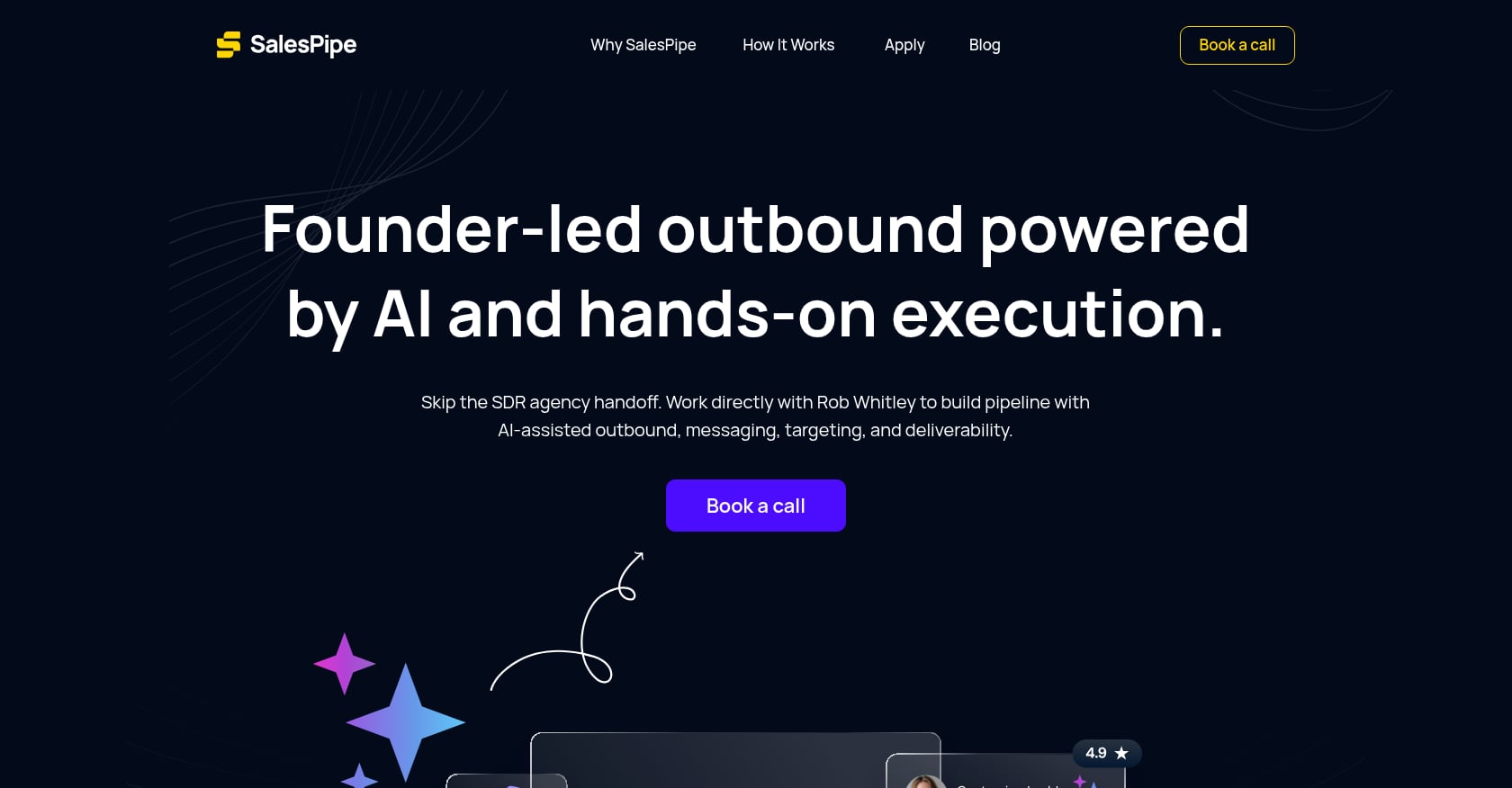
Best for: B2B SaaS startups and founder-led teams that want senior, hands-on outbound execution without agency overhead.
SalesPipe operates as something fundamentally different from a traditional outsourced SDR agency. Instead of assigning you a junior rep from a bullpen, SalesPipe provides founder-led outbound pipeline generation. Clients work directly with founder Rob Whitley on ICP definition, messaging, outbound infrastructure, cold email, LinkedIn outreach, deliverability, and qualified meeting generation.
Pricing: Custom, scope-based engagements. Typically begins with a pilot and continues month-to-month.
Key differentiators:
Direct founder involvement on every engagement (no handoff to junior staff)
AI-powered execution that scales output without scaling headcount
Full technical infrastructure setup: inbox configuration, domain warming, deliverability protection
ICP targeting and messaging strategy built into the service
Sits between consulting and execution, covering both strategy and hands-on implementation
Tradeoffs:
Limited bandwidth compared to a 200-person agency (fewer simultaneous clients)
Pricing is customized rather than standardized, so you’ll need a conversation to scope it
Not the right fit if you need 10+ dedicated SDRs running simultaneously
Why it’s ranked first: The outsourced SDR model fails most often because of poor strategy, weak infrastructure, and junior execution. SalesPipe eliminates all three. The AI-augmented, founder-led approach represents where this market is heading. For deals above $20K ACV, show rates for AI SDR platforms run 40–60% versus 70–85% for human SDRs, and meeting-to-opportunity conversion drops significantly. SalesPipe’s model combines the efficiency of AI with the judgment of an experienced human operator.
As Lemkin noted, he’s had some success with outsourced SDRs “but only when I’d already done them well myself, and only when I treated the outsourced resources as part of the core team.” SalesPipe’s model makes that integration natural because you’re working with one senior person, not managing a vendor relationship.
Verdict: The best choice for startups and founder-led teams that want outbound done right the first time.
Apply to work with SalesPipe →
2. Belkins
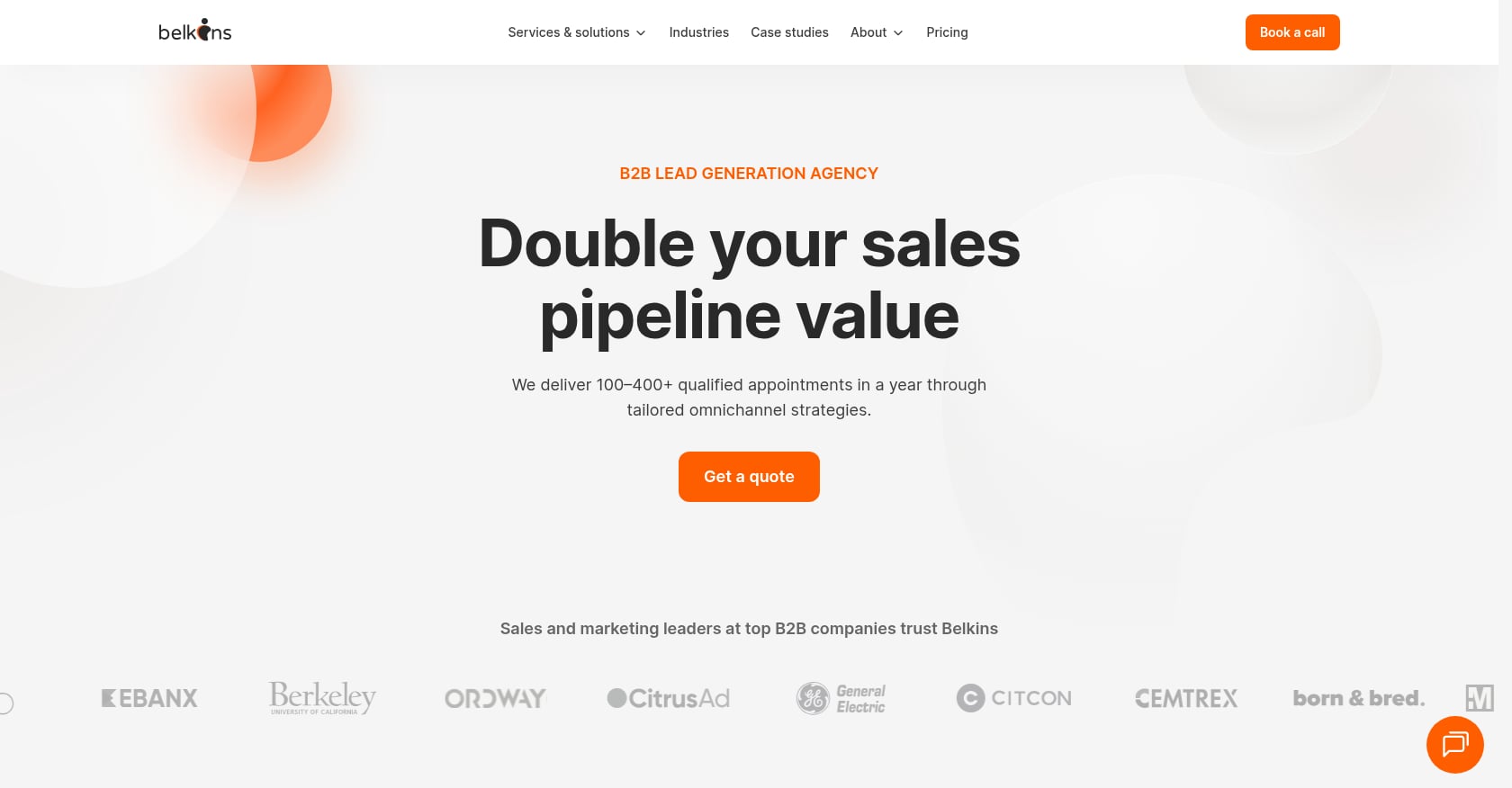
Best for: Established B2B companies with $10K+ monthly budgets seeking white-glove, research-intensive appointment setting.
Belkins is one of the most reviewed outsourced SDR companies in the space, founded in 2017 and focused on B2B lead generation and appointment setting. They hold a 4.9/5 on Clutch with 230 reviews and a 4.8/5 on G2 with 93 reviews, making them one of the highest-rated providers by volume of feedback.
Pricing:
Email-only programs start around $6,500/month
Omnichannel (email + calling + social) from $7,995/month
Many projects land at $10K+ per month with add-on channels or performance fees
Requires 3–6 month contracts at a fixed monthly rate
Key differentiators:
Deep research-driven approach to targeting
Strong deliverability support and spam testing capabilities
Large team with dedicated account managers
Multi-channel execution across email, LinkedIn, and phone
Tradeoffs:
Operates on a best-effort model rather than guaranteeing a specific number of meetings per month
Premium pricing that may not suit early-stage budgets
Quality can vary depending on which account manager gets assigned to your campaign
Limited transparency on held meeting rates versus booked appointments
If you stop paying, the outreach and results stop immediately (no assets transfer)
Real user perspective: On TrustRadius, one reviewer described Belkins as “an incredibly valuable resource for B2B lead generation” that “worked well for appointment setting, lead research, email deliverability, and spam testing.” However, multiple reviewers flagged dependency concerns, noting that nothing carries over once the engagement ends.
Verdict: A strong, proven choice for mid-market teams with budget. Just go in knowing you’re renting capability, not building an asset.
3. SalesRoads
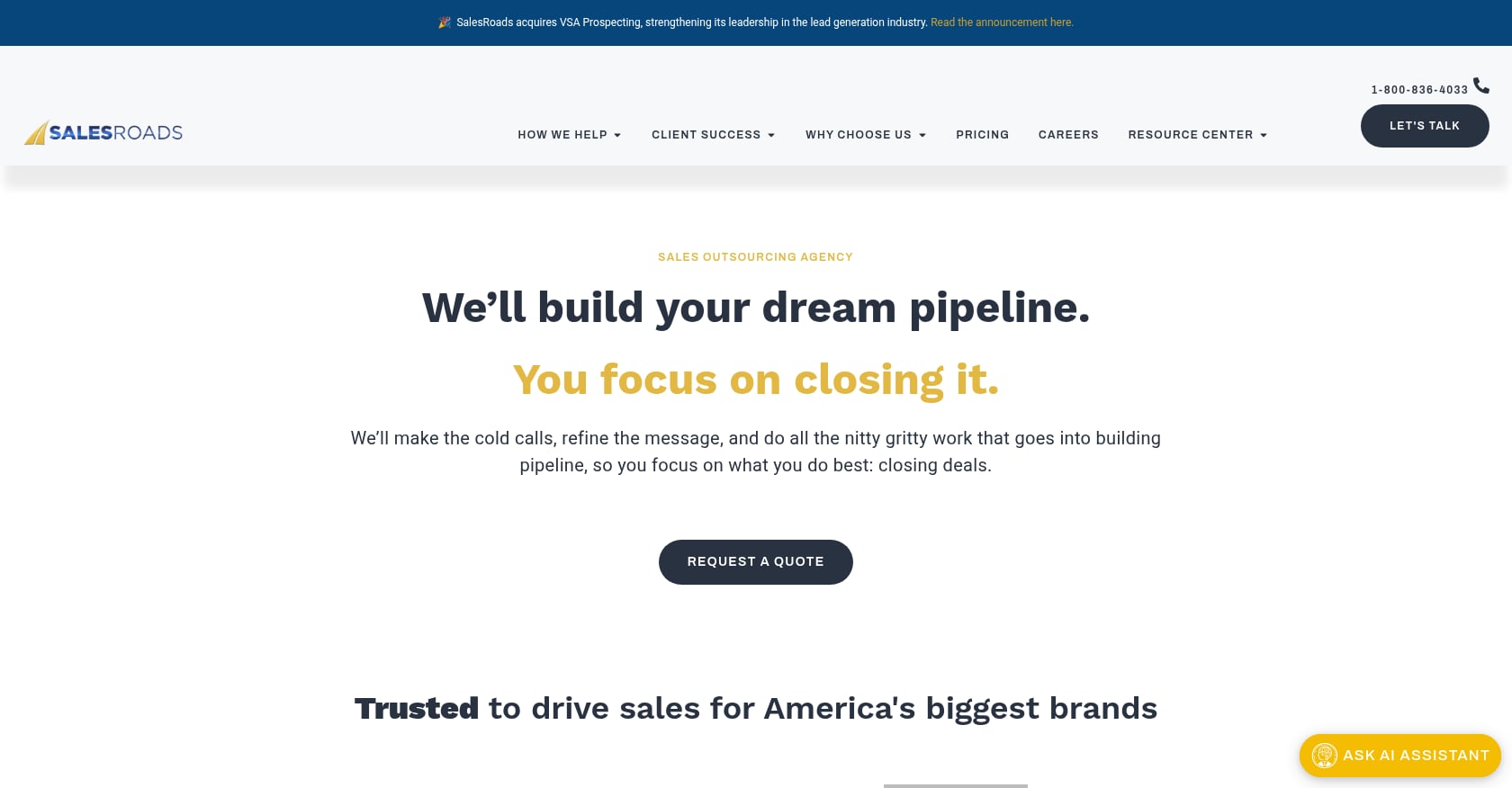
Best for: Industries where buyers respond to phone calls (manufacturing, healthcare, government, enterprise SaaS).
SalesRoads is a U.S.-based B2B sales outsourcing agency founded in 2007 that specializes in phone-first, human-led outreach. They’ve served 500+ clients and claim over 100,000 appointments set.
Pricing:
Full SDR Appointment Setting starts at $9,950 per 4-week cycle
Comes with a 28-day satisfaction guarantee
Key differentiators:
Phone-first approach with skilled U.S.-based callers
CEO David Kreiger stays personally engaged with campaigns
Strong track record in verticals that respond to direct outreach
Satisfaction guarantee gives new clients an exit ramp
Tradeoffs:
Premium pricing puts it out of reach for many startups
Their internal promotion model means top-performing SDRs get moved off your campaign
Uses VanillaSoft (an older CRM), which one reviewer said “created a lot of extra work” for integration
Phone-centric approach may not suit ICPs that prefer digital-first engagement
Real user perspective: One G2 reviewer described working with SalesRoads for about 2.5 years, during which “they executed our entire outbound and inbound SaaS sales prospecting program and delivered all time record-breaking results.” The 4.9 G2 rating is hard to argue with. But the SDR turnover issue is real: when a rep performs well on your campaign, they’re likely to be promoted internally and reassigned.
Verdict: If your buyers pick up the phone and you have the budget, SalesRoads is one of the best outsourced SDR companies for phone-led outbound.
4. CIENCE
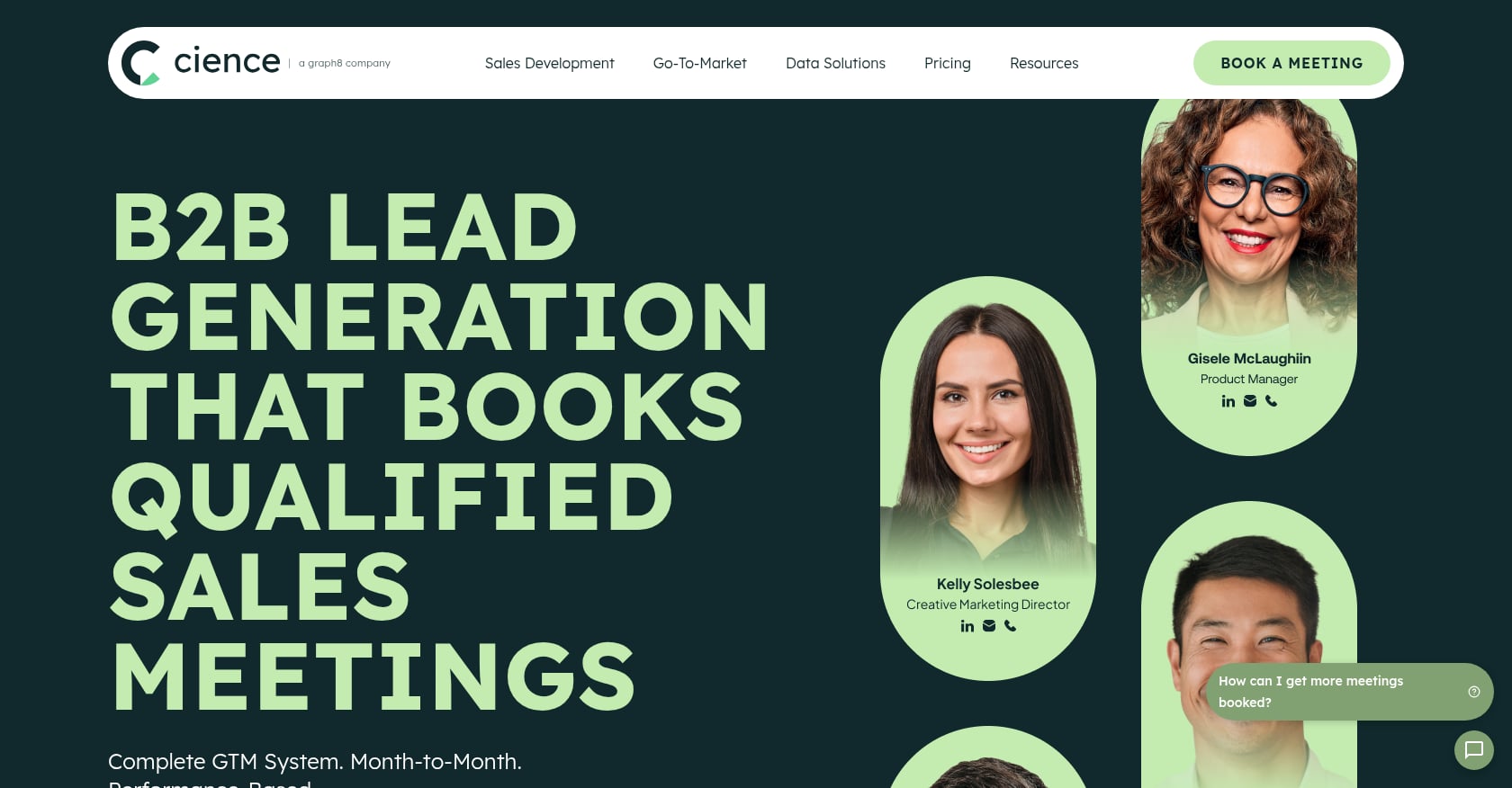
Best for: Mid-market and enterprise companies that need multi-channel outbound at scale with strong data infrastructure. (Proceed with caution.)
CIENCE Technologies was founded in 2015 in Denver and has pivoted from a pure SDR agency to a hybrid offering that pairs human SDRs with a proprietary AI-driven platform called graph8. They claim 2,500+ clients across 195 industries.
Pricing:
Standard GTM System Setup: $5,000 one-time
Ongoing: roughly $250 per held meeting + $1,500/month GTM team retainer + $499/month platform license
Additional SDR marketplace costs may apply
Key differentiators:
Proprietary data platform (graph8) for targeting and orchestration
Multi-channel capability at scale
Large global team
Tradeoffs (this is a critical section):
1.7/5 Trustpilot rating from 20 reviews, which stands in stark contrast to its 3.8 G2 rating
Complex pricing model that’s difficult to predict
Ongoing platform pivot makes the offering harder to evaluate
High SDR turnover reported by multiple reviewers
Significantly lower ratings than category peers like Belkins (4.8 G2) and SalesRoads (4.9 G2)
Real user perspective: Reviews for CIENCE are deeply polarized. One Trustpilot reviewer reported “nothing but poorly fit leads well outside our described ICPs, emails riddled with spelling mistakes… and, for the icing on the cake, a LinkedIn ban.” Another said, “Really wish we had read these reviews before wasting $25K on an entirely useless 3 month trial.” Some G2 reviewers tell a different story, highlighting responsive teams and useful data. But the gap between the best and worst experiences is wider here than with any other provider on this list.
Verdict: CIENCE still appears on every “best outsourced SDR companies” listicle, which is honestly baffling given the Trustpilot feedback. If you do engage them, start with the smallest possible scope and verify lead quality in the first two weeks. Read the negative reviews carefully before signing.
5. SalesHive
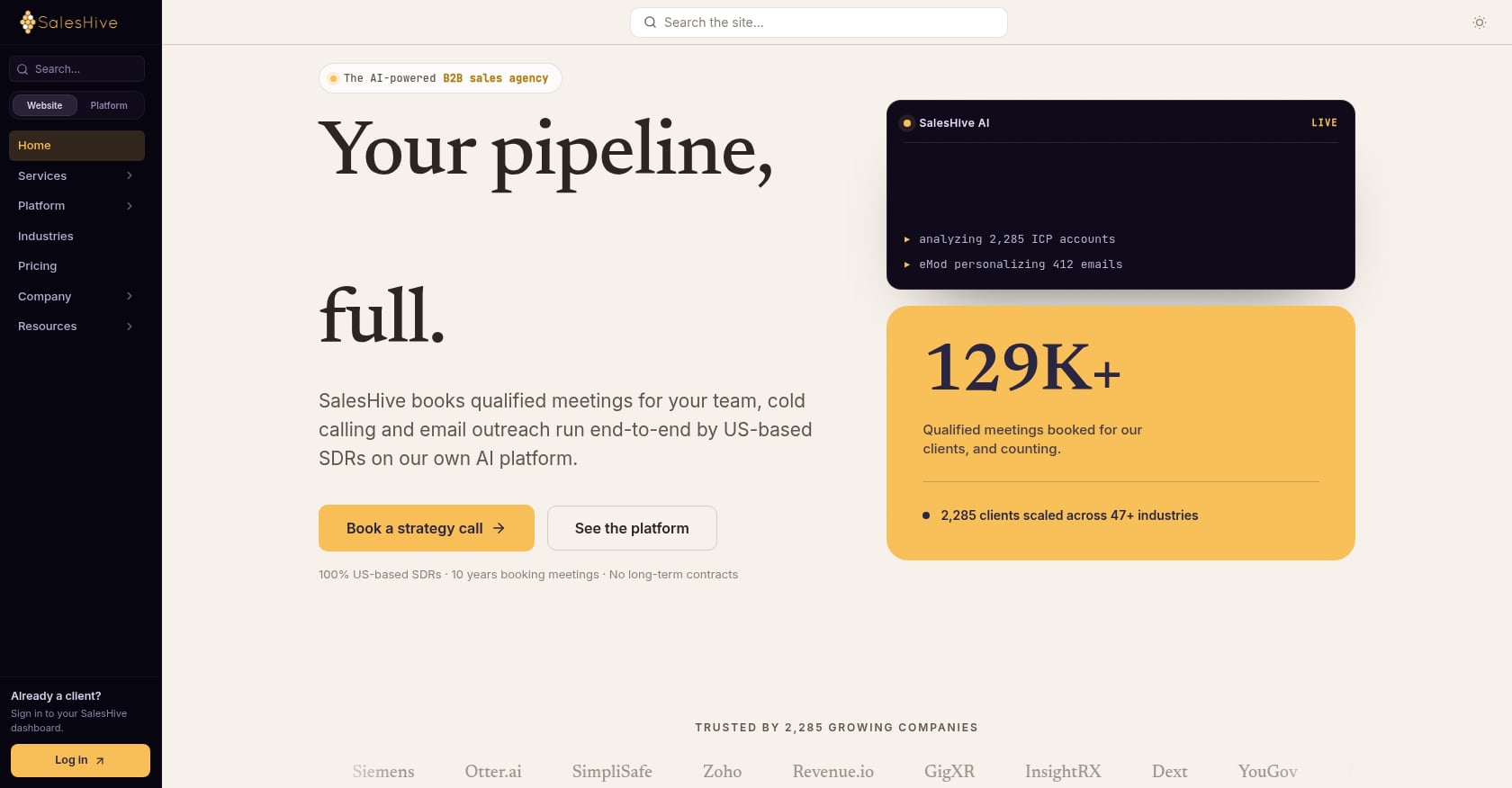
Best for: Mid-market B2B companies that want phone-based SDR capacity fast, with no long-term commitment.
SalesHive was founded in 2016 in Denver and offers dedicated SDR outsourcing with proprietary technology including email personalization tools and a power dialer. They claim 117,000+ meetings booked for 1,500+ clients.
Pricing:
Starter: $4,000/month
Growth: $8,000/month
Crush: $12,000/month
Month-to-month contracts with 30-day cancellation
Key differentiators:
Month-to-month contracts are genuinely rare in this space and reduce buyer risk
U.S.-based SDR programs
Flat-rate pricing with no hidden setup fees
Proprietary technology stack (eMod for email personalization, Power Dialer)
Tradeoffs:
Small review sample (roughly 36 reviews after nearly a decade in business) makes it hard to draw definitive conclusions
One reviewer alleged paying “$86,000/year for an SDR who called one hour a day” and delivered minimal results
You’re renting headcount, not building any lasting outbound asset
Has not actively responded to negative reviews on public platforms
Real user perspective: The month-to-month flexibility is what draws most buyers in. If you want to test outsourced sales development without a long commitment, SalesHive is the safest entry point from a contract perspective. Just manage expectations tightly and monitor call activity from week one.
Verdict: Best as a low-risk trial of outsourced SDR capacity. The flexible contract structure is a real advantage, but scrutinize output early.
6. Martal Group
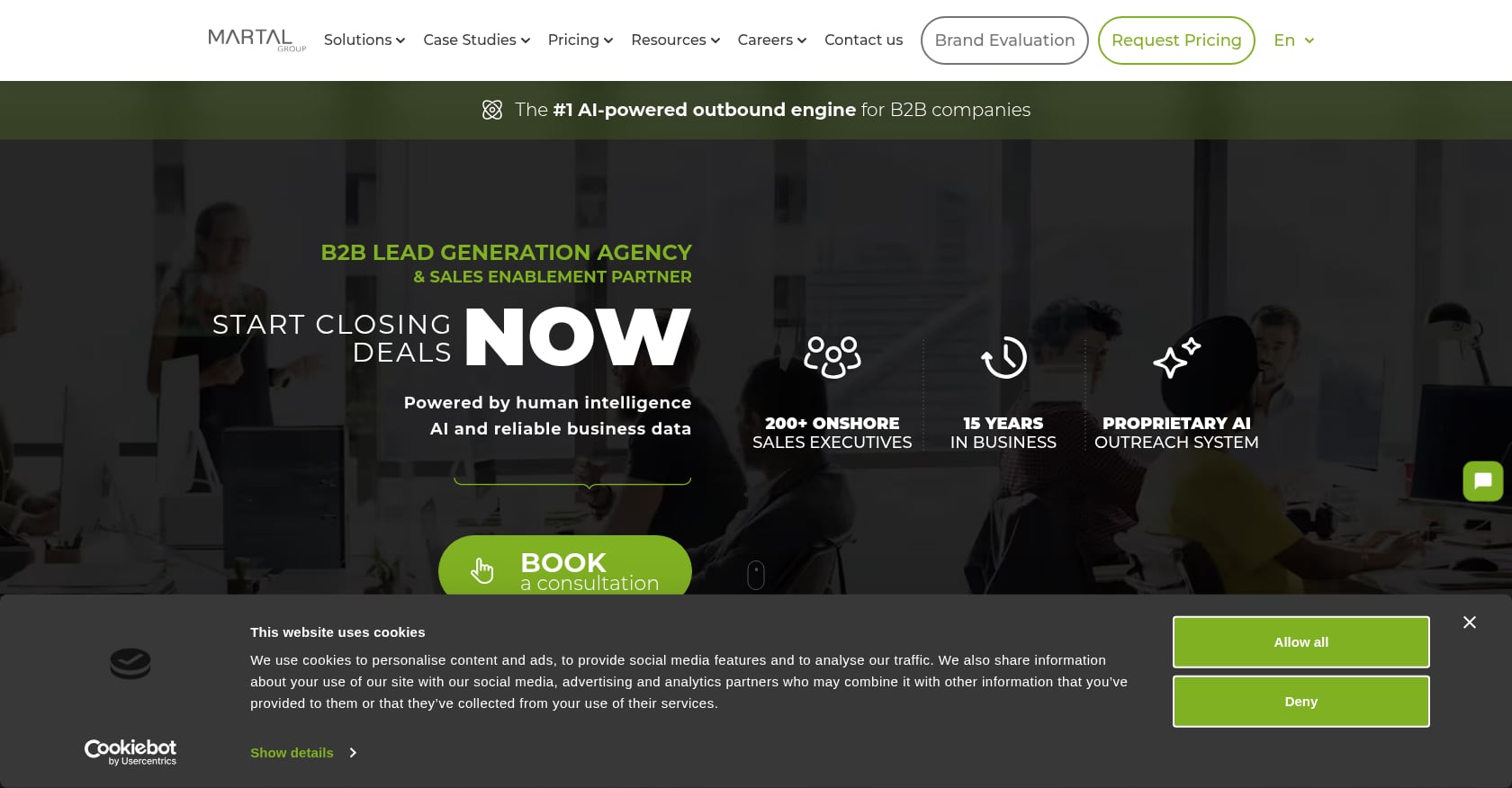
Best for: B2B tech companies expanding into North America, or testing outbound before committing to full-time hires.
Martal Group was founded in 2009 in Oakville, Ontario, Canada. Over 15 years, they’ve partnered with over 2,000 clients worldwide. They offer a tiered model that extends beyond appointment setting into full-cycle sales support.
Pricing:
Sales Team Augmentation packages starting at ~$4,500/month
Services can range from $3K to $40K/month depending on scope
Tiered model with commissions on closed-won deals
Key differentiators:
Multilingual and international outreach capabilities
Full-cycle support (not just SDR, but through to close)
Strong for companies entering the North American market from abroad
4.8 Clutch rating across 104 reviews
Tradeoffs:
Not transparent on pricing until you engage with sales
Full-cycle approach may dilute SDR specialization
Multiple reviewers noted “lengthy conversion process, small amount of leads per cycle”
Quality controls don’t always scale reliably for complex ICPs
Real user perspective: G2 reviews praise responsiveness and speed of onboarding. But Martal works better as a volume amplifier or market-testing tool than as a precision targeting engine. If your ICP is narrow or technical, the results may underwhelm.
Verdict: A solid mid-tier option for companies needing geographic expansion or outbound volume. Less suited for precision-targeted campaigns.
7. memoryBlue
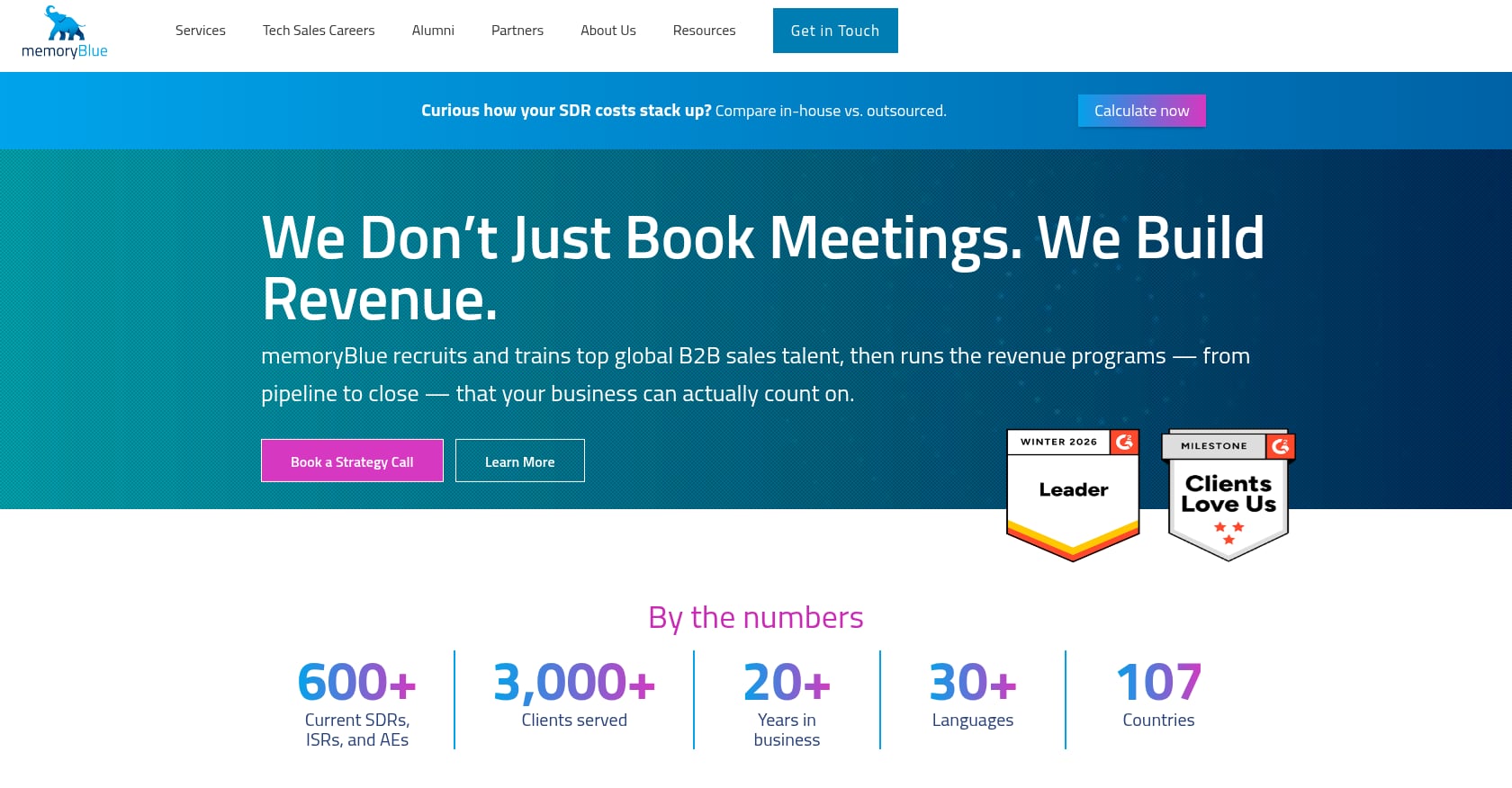
Best for: Tech companies that want pipeline now and the option to hire the SDR later.
memoryBlue is a global sales development firm founded in 2002, now backed by private equity. They have nine offices across North America, Europe, and Singapore, and serve 2,000+ high-tech clients. They acquired Operatix in 2023.
Pricing:
Dedicated SDR (with channels): $11,500/month
Full sales support: $15,000–$16,000/month
Omnichannel: $11,000/month
Requires a 6-month upfront pilot commitment, meaning $66,000–$96,000 before you know if it works
Key differentiators:
“Audition-to-hire” model lets you convert your outsourced SDR to a full-time employee
Large talent pipeline of trained, entry-level SDRs
Global presence with offices in multiple regions
Enterprise-grade processes and infrastructure
Tradeoffs:
Most expensive provider on this list
Uses college graduates with limited experience, which means more ramp time
Frequent SDR turnover is the number one complaint on G2, where “Expensive” has 10 mentions in review tags
The 6-month commitment is significant financial risk with no guarantee of results
Real user perspective: G2 reviewers frequently mention strong communication and professionalism but flag expense and rep turnover. The pattern is consistent: a good SDR gets assigned, performs well, then leaves or gets reassigned, and the client starts over with a new rep.
Verdict: The hire-away model is genuinely unique and worth considering if you’re building a sales team and want to test reps before committing. But the price tag and turnover risk are real. If you’re exploring whether to hire a salesperson for your startup, memoryBlue’s model offers an interesting middle path.
8. Callbox
Best for: Companies targeting Asia-Pacific markets that need local infrastructure and native-language reps.
Callbox was founded in 2004 and provides multi-channel outreach across voice, email, social media, web, and live chat. They serve 15,000+ companies across 60+ countries.
Pricing:
Typical range: $5,000–$15,000/month
4.6/5 Clutch rating
Key differentiators:
APAC specialization with local phone numbers, native-language reps, and timezone-aligned outreach
Broad multi-channel capability
Geographic coverage that most US-based agencies can’t match
Long track record (20+ years in business)
Tradeoffs:
US-market-specific buyers may find them less specialized than domestic providers
Strength is geographic breadth, not niche depth
Less reviewed on G2 and Western platforms, making independent verification harder
Verdict: If you’re targeting Southeast Asia, Australia, Japan, or other APAC markets, Callbox has regional infrastructure that most outsourced SDR companies simply don’t offer. For US-only campaigns, there are better-specialized options on this list.
How to Choose the Right Outsourced SDR Model
The decision isn’t just “which provider.” It’s which model fits your situation. Here’s a framework:
Go founder-led (SalesPipe) if:
You’re a SaaS startup or founder-led team with under 50 employees
Your ACV is above $20K and sales cycles require genuine personalization
You’ve been burned by agencies or want to avoid the agency model entirely
You value senior execution and tight feedback loops over raw volume
Go with a traditional agency (Belkins, SalesRoads, SalesHive) if:
You have a proven ICP and validated outbound messaging already
Your monthly budget is $8K+ and you need volume across multiple channels
You have AEs ready to receive and work meetings from day one
You can commit management time to reviewing quality weekly
Build in-house if:
You plan to make outbound a permanent, core competency
You’re ready to invest $125K–$150K per rep per year (fully loaded)
You have existing sales leadership to manage, coach, and retain SDRs
Your outbound playbook is already documented and repeatable
For a deeper comparison between these approaches, see our guide to SDR as a service.
Companies that treat outsourced SDRs like employees (not vendors) see dramatically better ROI. That means weekly syncs, shared Slack channels, CRM access, and real-time feedback from AEs to reps. The 7% who succeed at outsourced SDR treat it as a partnership, not a procurement.
5 Questions to Ask Before Signing Any SDR Contract
Before committing to any of the best outsourced SDR companies, get clear answers to these:
1. What’s your AE acceptance rate and show rate?
Booked meetings don’t matter if 40% no-show and another 30% are unqualified. Ask for held meeting data, not just booked meeting counts.
2. Who owns the contact data after the engagement ends?
Some agencies keep all data, lists, and sequences. If you stop paying, you lose everything you helped build. Clarify this upfront.
3. What happens when meetings consistently underperform?
Get specific on their process for diagnosing and fixing quality issues. “We’ll optimize” isn’t an answer.
4. Can I review held meeting recordings?
If the answer is no, that’s a red flag. You need to hear how your brand is being represented in those first conversations.
5. What’s your SDR turnover rate?
If a provider cycles through reps every few months, you’re paying for constant re-ramping. This is a known issue with several providers on this list.
Getting these answers in writing before signing will save you thousands. For more context on structuring outbound effectively, check out our cold email structure guide.
Why More Teams Are Moving Beyond the Agency Model
The traditional outsourced SDR model was built for a different era. Hire a bunch of entry-level reps, give them a script, blast emails at volume, and hope enough meetings land to justify the cost. That model is breaking down for three reasons:
First, email deliverability has gotten harder. Bulk sending from poorly configured infrastructure gets flagged, which damages your domain reputation. The technical setup matters more than ever.
Second, buyers are savvier. Generic outreach gets ignored. Personalization and message quality require experience that junior SDRs typically don’t have.
Third, AI has changed the math. A single experienced operator with the right AI tools can now match or exceed the output of a small SDR team, with better targeting and higher quality. For most teams in 2026, the AI-augmented human model wins.
This is exactly why SalesPipe exists. Not as another agency adding headcount, but as a founder-led outbound engine that combines senior expertise with AI-powered execution. Fewer people, better results, less risk.
See if SalesPipe is the right fit →
Key Metrics Every SDR Buyer Should Track
| Metric | Healthy Benchmark |
|---|---|
| Open Rate | 40–60% |
| Reply Rate | 5–12% |
| Positive Reply Rate | 1–4% |
| Meeting Show Rate | 70–85% |
| AE Acceptance Rate | 70%+ |
| Meeting-to-Opportunity Rate | 25–40% |
| Opportunity-to-Close | Depends on ACV |
| Cost per Opportunity | Track monthly |
| Pipeline Generated | 5–10x SDR cost |