SDR as a Service - All to Know About SDR Outsourcing Companies
Discover how SDR outsourcing can increase your sales strategy. Learn why SalesPipe is the perfect partner for smooth SDR integration.
Imagine having a team of sales experts ready to dive into your market, connect with potential clients, and boost your sales without the pain of hiring and training new staff.
Sounds like a dream, right?
Welcome to the world of SDR outsourcing, where companies like yours can tap into a pool of skilled Sales Development Representatives (SDRs) who are ready to take your sales efforts to the next level.
In this guide, we’ll explore everything you need to know about SDR outsourcing and how it can help your startup grow.
What is SDR as a Service?
SDR as a service is a strategic outsourcing model designed to increase sales development, lead generation, outbound prospecting, and building a robust sales pipeline by hiring external expertise. It offers startups a flexible and efficient way to manage their sales development efforts without the overhead of an in-house team — a managed outsourced SDR alternative to building one from scratch
These SDRs take on the task of finding leads, engaging prospects, and qualifying them through a sales process. They integrate with your existing sales strategy so only high-quality leads are passed to the sales team so you can assign resources more effectively and grow the business.
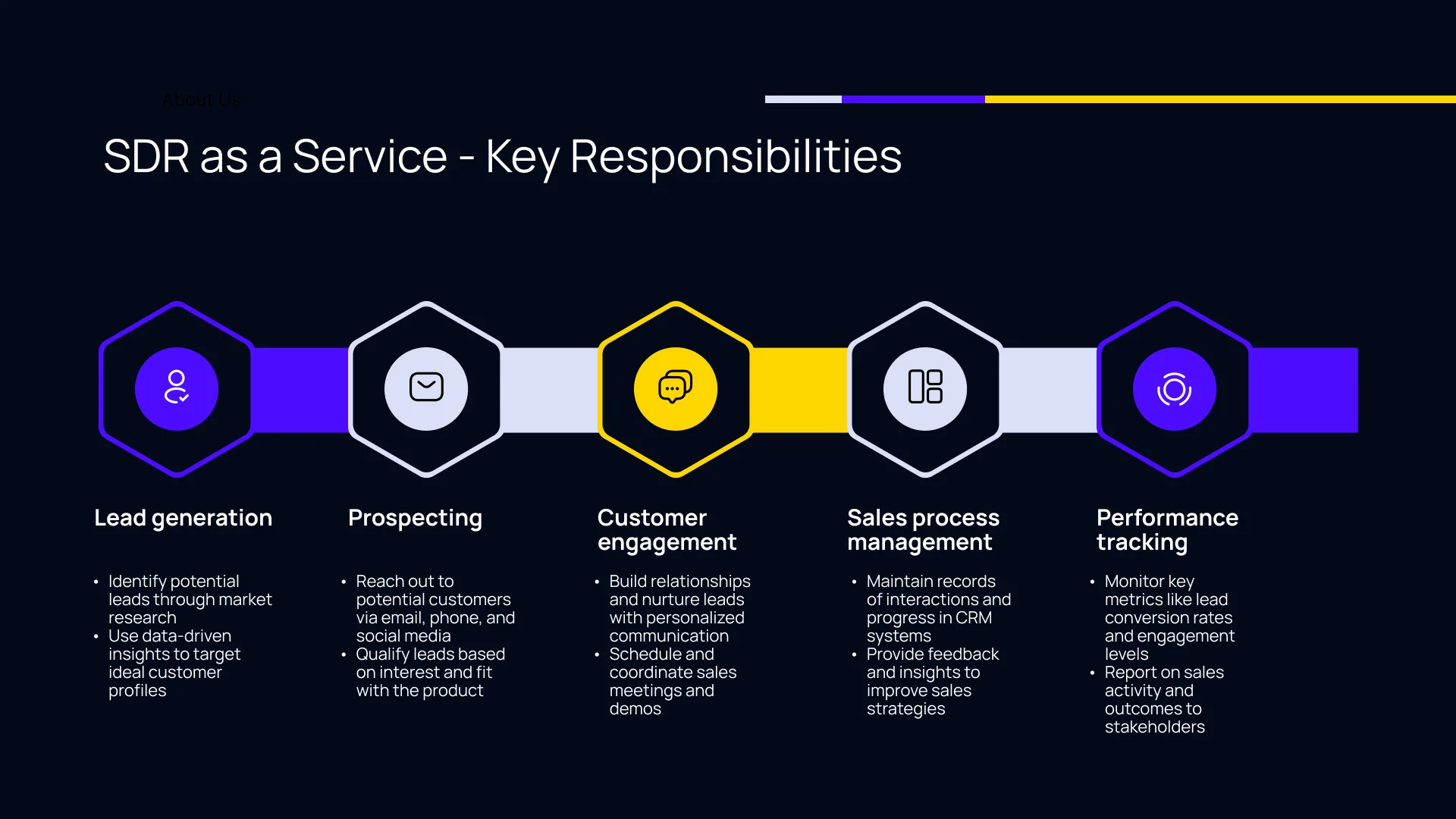
One of the big benefits of SDR as a service is scalability. Whether you’re a startup looking to scale quickly or a mature business looking to simplify operations, this model allows you to adjust your sales efforts to market demand. You can tap into a pool of sales talent without the long-term commitment of full-time staff, it’s a cost-effective solution.
SDR outsourcing also uses proven sales strategies and market research to customize the outreach. This means the sales cycle is optimized and leads convert faster and customers are more engaged. By focusing on sales outreach and industry-specific insights outsourced SDR teams can impact the bottom line of the business.
Adding SDR as a service to a SaaS company’s strategy can drive big business growth. These teams work alongside internal sales teams, aligning with the overall sales strategy to get the best results. This partnership also supports ongoing market expansion efforts.
Benefits of Hiring SDR Outsourcing Companies
When it comes to increasing your company's sales development campaigns, hiring an SDR outsourcing company can make a real difference. These services are especially beneficial for tech startups and SaaS businesses looking for efficient and cost-effective solutions.
Let's dive into the key benefits that SDR as a service offers.
First and foremost, cost reduction is a significant benefit. Hiring and training an in-house sales team can be expensive and time-consuming, with operational costs quickly adding up.
By opting for SDR outsourcing, companies can tap into a pool of expert sales talent without the hefty price tag. This model allows businesses to allocate resources more effectively, ensuring that every dollar spent contributes to business growth.
Scalability is another critical benefit. The need for flexibility in your sales strategy becomes crucial. With SDR as a service, you can easily scale your sales efforts up or down based on market demands. Whether you’re launching a new product or entering a new market, the ability to quickly adjust your sales team size is invaluable.
Furthermore, access to expert sales talent is a significant improvement for many startups. SDR outsourcing companies bring a wealth of experience and industry-specific knowledge to the table.
They specialize in lead generation, market reach, and customer acquisition, providing your business with strategic growth opportunities. This expertise leads to faster lead conversion, as these professionals know precisely how to navigate the sales cycle and engage with B2B leads effectively.
Another significant advantage is the increased sales efficiency that comes with outsourcing. By integrating these services with your existing sales prospecting process and technology platforms, you can simplify operations and focus on other business objectives.
The use of advanced SaaS platforms provides insights and analytics that support data-driven decision-making, ultimately leading to better customer engagement and improved sales outcomes.
Finally, outsourcing helps overcome the load of managing complex SaaS platforms. The integration of technology with skilled sales teams ensures a smooth operation, minimizing disruptions and maximizing productivity.
Choosing the Right SDR Outsourcing Provider
Step 1: Assess Industry Expertise
Begin by evaluating the industry expertise of potential SDR outsourcing companies.
An experienced provider with a deep understanding of your sector can tailor their services to better align with your sales strategy. Look for companies with a proven track record in your industry, as their familiarity with your target market can significantly impact the effectiveness of your sales outcomes.
Step 2: Check Proven Track Record
A provider's history of success can offer insights into their capabilities.
Investigate their past performance and seek client testimonials or case studies that demonstrate their ability to deliver results. A proven track record indicates reliability and effectiveness, crucial factors in choosing an outsourcing partner.
Ensure they have experience in handling the specific challenges and opportunities within your industry.
Step 3: Evaluate Customization Options
Customization is key to integrating outsourced SDR services with your existing sales processes.
The right provider should offer flexible service offerings tailored to meet your unique business needs. Whether it's aligning with your sales cycle or addressing specific lead generation goals, customization ensures that the partnership will increase sales growth.
“
Help your buyers get comfortable with the idea of change. Sellers often believe that 'pain' is enough to make someone act. It’s not.
— Belal Batrawy. Founder of Learntosell.io Source.
Step 4: Prioritize Communication Transparency
Effective communication is the spine of any successful business relationship.
Choose a provider that values transparency and maintains open lines of communication. Regular updates and clear reporting on performance metrics are essential for tracking progress and making informed decisions.
Step 5: Align with Your Sales Strategy
Ensure the provider's offerings align with your sales strategy and business fit. They should understand your goals and be able to integrate seamlessly with your sales process.
Discuss how they plan to engage with your target market and measure success through performance tracking. A good fit will result in improved customer engagement and sales efficiency.
Step 6: Consider Scalability and Flexibility
Your business needs may grow over time, so it's crucial to choose a provider that offers scalability.
Whether you're looking to expand your sales team or adjust your lead generation efforts, the right partner should be able to accommodate these changes. This flexibility ensures that your sales development strategies can grow alongside your business.
Introducing SalesPipe
SalesPipe takes a different approach. I don't place SDRs. At SalesPipe, you work directly with me (Rob), and I build and run your outbound myself, using AI for leverage, so there's no junior SDR handoff.
It suits B2B SaaS and tech companies that want senior attention on targeting, messaging and execution, with clear reporting and direct access to the person doing the work.
Best Practices for Working with SDR Outsourcing Companies
When using an SDR outsourcing company — or an SDR agency alternative — to increase your sales efforts, ensuring a successful partnership requires following some best practices.
Start by aligning your sales strategy with clear goals. This step is crucial for setting the stage for a productive partnership. When your SDR team understands your objectives, target audience, and market nuances, they can tailor their efforts to your specific needs.
Integrating the outsourced SDR team with your existing sales processes is another vital step.
Establish clear communication channels and provide them with access to necessary tools and platforms. A well-integrated team can engage more effectively in lead generation and customer engagement efforts, leading to improved sales alignment and performance metrics.
Ongoing communication is critical for success. Regular check-ins and feedback opportunities help address any issues promptly. This transparency enables collaboration, allowing for continuous improvement. Effective communication also facilitates better reporting and success measurement, enabling adjustments in strategy as needed to improve performance.
Defining performance metrics is essential to evaluate success.
Metrics like sales growth, lead conversion rates, and customer engagement help evaluate the effectiveness of the SDR outsourcing strategy. Regularly reviewing these metrics allows for informed decision-making and optimization of the collaboration for better results.
Providing ongoing support and training is vital for maintaining a productive relationship with your SDR team. Encourage them to share insights and challenges, and be proactive in offering resources and guidance.
Finally, treat the relationship with your SDR outsourcing company as a true partnership. Mutual respect and collaboration can drive better results, leading to a more cohesive sales strategy and improved outcomes.
When both parties work closely together, the partnership can adapt more effectively to changing business needs, ensuring long-term success and scalability in your sales operations. Remember, effective collaboration and clear communication are the foundations of a successful outsourcing relationship.

Overcoming Challenges in SDR Outsourcing
Outsourcing your SDR processes can offer numerous benefits but also comes with its own set of challenges. Effectively navigating these challenges is crucial to access to the full potential of an SDR outsourcing company.
One major challenge is managing cultural differences. When you work with an SDR team from different regions, cultural contrasts may affect communication and collaboration.
Understanding these differences and encouraging an inclusive work environment can significantly improve team synergy. Implementing regular cultural sensitivity training and encouraging open dialogue can help mitigate misunderstandings and promote smoother collaboration.
Ensuring alignment with business goals is another concern. An outsourced SDR team must understand and align with your company's core sales objectives and strategies. Regular strategy sessions and clear communication channels are crucial here. These practices ensure the team is on the same page and can contribute effectively to your sales growth.
“
Adapt your selling approach to how buyers want to buy. One great way to sell more? Make it easier for your buyers to buy from you.
— Peter Strohkorb. Founder of Peter Strohkorb Sales Advisory Source.
Problem-solving and conflict resolution also play important roles in managing an outsourced SDR team.
Proactive management strategies, such as setting clear expectations and providing regular feedback, can help address outsourcing issues before they escalate. It's essential to produce an environment where challenges are seen as opportunities for improvement and innovation.
At SalesPipe, I sidestep many of these challenges by design. You work directly with me, and I run the outbound myself, so your goals don't get lost in a handoff. If you'd rather add a rep, a fractional SDR is another model worth weighing.

Future Trends in SDR Outsourcing
Driven by future trends and technological advancements, the SDR role is quickly expanding.
Central to this transformation is the rise of AI and automation, changing how startups approach their sales processes. As AI technology continues to develop, many SDR outsourcing companies are incorporating AI-driven tools to improve lead generation and customer engagement.
These tools are designed to improve sales efficiency by automating repetitive tasks, allowing human SDRs to focus on strategic planning and relationship building.
However, while AI SDRs offers promising innovations, they cannot fully replace the fine, human touch required in sales.
Human SDRs bring specialized knowledge and adaptability that AI lacks. They can understand complex market trends and engage with potential clients in a way that enables genuine connection.
“
Use AI to eliminate busy work while still remaining human. Be smart about which tasks you delegate to AI and which tasks you spend your own time on.
— Alexine Mudawar. CEO of Women in Sales. Source.
The industry demand for sales outsourcing services is also moving towards more specialized sectors. Companies need outsourcing partners who bring deep industry expertise and can offer insights that drive sales growth.
This need for specialized knowledge highlights an emerging trend where human SDRs, equipped with industry-specific insights, collaborate with AI to optimize the sales process.
Startups must balance technology with human expertise.
Embracing AI and automation can lead to significant sales innovation, but the irreplaceable value of human interaction remains a key player in effective sales strategies.
By leveraging both emerging technologies and the unique capabilities of human SDRs, companies can position themselves at the forefront of sales innovation, ensuring sustainable growth and success in a competitive market.
“
It’s entirely unsurprising that the AI SDR companies are churning customers like crazy. Customers (and VCs) sold on a silver bullet that doesn’t exist.
— Kyle Coleman. CMO at Copy.ai. Source.
SDR as a Service vs. Outsourced SDR vs. Lead Gen: What You're Actually Buying
People ask me about the difference between "SDR as a service" and "outsourced SDR" a lot. Honestly, most vendors use the terms for the same thing. "As a service" just stresses the subscription part: a monthly fee, capacity you can turn up or down, and a provider that runs the operation.
The distinction that matters is between SDR work and lead generation. Here's the simplest test I know: what does your AE actually receive?
- A calendar invite with a qualified prospect and context notes. That's SDR as a service.
- A spreadsheet of contacts or a batch of marketing leads. That's lead gen. Useful, but your team still has to do the outreach and qualification.
Know which one you're paying for before you compare prices. More on the wider landscape in outsourced sales development explained.
How an Engagement Runs, Stage by Stage
Every decent provider follows roughly the same flow. What differs is how well each stage is done.
| Stage | What happens | What you should get |
|---|---|---|
| ICP definition | Agree on industries, company size, titles, geographies and buying signals | A written ICP and target account list |
| List building | Source and verify contacts that match the ICP | A clean, verified contact list |
| Campaign creation | Write email, LinkedIn and call sequences | Copy you've reviewed and approved |
| Outreach | Run multi-channel sequences | Replies, logged in your CRM |
| Qualification | Screen replies against agreed criteria | Only prospects who meet your definition |
| Handoff | Book onto your AE's calendar | A meeting plus notes on why they took it |
If a provider wants to skip the first stage and start sending, that's a warning sign. Good ones push back on a vague ICP. Weak ones accept whatever you give them and start blasting.
What It Costs, and Where the Surprises Hide
SDR as a service is usually priced one of three ways: a flat monthly retainer, a fee per meeting, or a hybrid of a smaller base plus a per-meeting fee. Retainers give you predictable costs. Per-meeting deals feel safe but reward volume over quality. Hybrids sit in between and only work if "qualified meeting" is defined tightly. I go through real ranges in outsourced SDR pricing models and hidden fees.
The bigger issue is what's not in the headline number. Data, tool seats, onboarding fees, sending infrastructure and minimum terms are often billed separately. A quote that looks like $5,000 a month can end up a good deal higher once all of it shows up. Ask for a fully loaded number, in writing, before you sign.
Common Problems and How to Avoid Them
Generic messaging that hurts your brand
Cheap programs send templated email to huge lists. Your prospects form their first impression of you from it. Fix: review and approve every sequence before it goes live. If you need a benchmark, compare it against a solid cold email structure.
Meetings that don't turn into pipeline
Volume looks great on a report. Unqualified meetings waste your AEs' time and kill trust in the program. Put the definition of a qualified meeting in the contract.
Nothing left when the contract ends
This is the complaint I hear most. Six months of meetings, then the engagement ends and you have no playbook, no ICP learnings, no infrastructure. Negotiate ownership of sequences, prospect data and reply history up front.
Deliverability shortcuts
Inbox placement now takes real infrastructure: separate secondary sending domains, warmup, list verification and monitoring. Ask the provider to walk you through their domain setup. If they can't explain it, they probably don't have one. The B2B email deliverability playbook covers what good looks like.
Is SDR as a Service Right for You?
Probably a good fit if:
- You need pipeline in the next one to two months, not six.
- Your deal size is big enough to pay for outbound.
- You don't have anyone to hire, coach and manage SDRs.
- You're testing a new market and want fast feedback.
Probably not if:
- Your deal size is too small to support outbound economics.
- You already have an in-house SDR team that works and stays.
- Your first conversation needs deep, consultative product expertise.
- You won't put time into onboarding and weekly feedback.
There's also a third option: one senior operator who uses AI for research, personalization and workflow, instead of a team of junior reps. That's how I run SalesPipe. It suits companies that want senior attention on outbound and direct access to the person doing the work. I compare the models in outsourced SDR alternative models.
FAQ
Is SDR as a service the same as an outsourced SDR?
In practice, almost always. Both mean an external provider runs prospecting, outreach, qualification and booking for you. "As a service" just emphasizes the subscription-style pricing.
How fast can an SDR as a service provider launch?
Typically a few weeks, since the tools and playbook already exist. Hiring and ramping an in-house rep takes months. Expect the first weeks to go to ICP work, list building and domain warmup, not meetings.
What should I own when the engagement ends?
Your prospect lists, sequences, reply history and CRM records. Get it in the contract. Otherwise you're building on rented land.
Can AI replace SDR as a service?
Not fully, in my view. AI is good at research, enrichment and first drafts. Account selection, qualification and real conversations still need human judgment. The setups that work use AI for volume and keep a person accountable for the outcome.
Conclusion
As we wrap up our exploration of SDR outsourcing, it's clear that this strategy offers incredible benefits.
From increasing sales processes with specialized expertise to smoothly integrating with your existing team, the advantages are clear.
Whichever model you choose, look for a partner who aligns with your sales objectives and stays accountable for results. If you want senior, founder-led outbound instead of an SDR team, get in touch. At SalesPipe, you work directly with me, and I build and run your outbound myself.
Related articles
What is a Business Development Representative (BDR)?
BDRs build your outbound sales pipeline.
How the BDR Increases Lead Generation
Learn how BDRs can help you increase your leads.
SDR vs BDR. What is the Difference?
Understanding the difference between the two positions once and for all.
Fractional SDR - What is it + Advantages
Explore the concept of fractional SDR (Sales Development Representative) and its advantages.
Want pipeline instead of theory? SalesPipe is founder-led outbound run by Rob Whitley. Targeting, messaging, and execution are handled directly, with no junior SDRs in between. Tell us what you're building and we'll map out the outbound motion that fits.