SaaS Outbound Without Building a Team: 2026 Guide & Glossary
Learn SaaS Outbound Without Building a Team with our 2026 glossary of terms, models, tools, and metrics. Cut SDR costs, boost pipeline—start executing now.

TL;DR
Running SaaS outbound without building a team is not only possible, it’s becoming the preferred approach for founders who can’t stomach the $135K–$215K first-year cost of a single SDR, the 5.7-month ramp time, or the 40% annual turnover rate. This glossary covers every term, model, and concept you’ll encounter when running outbound on your own or with minimal help. It’s organized by decision stage, not alphabetically, so you can follow the path from “what does this mean?” to “what should I actually do?”
Why This Glossary Exists
A single SDR costs between $135,000 and $215,000 in their first year once you account for compensation, tools, manager time, recruiting, ramp-period losses, and turnover risk. Average ramp time for SaaS companies has ballooned to 5.7 months. Annual SDR turnover hovers around 40%, which means you might spend half the year training someone who leaves before they hit full productivity.
So you look at outsourcing. But a SaaStr survey of over 1,200 respondents found that only 7% of companies have “really gotten outsourced SDRs to work.” Another 26% said it “sort of worked.” The remaining 67%? Money spent, pipeline not built.
These numbers explain why so many SaaS founders are searching for ways to run outbound without building a team. The terms, tools, and models in this space can be confusing. This glossary defines them all through a single lens: you’re doing this without a traditional sales team, and every concept needs to be understood in that context.
How to Run SaaS Outbound Without a Sales Team (Quick Summary)
To execute a high-growth outbound strategy without hiring full-time SDRs, follow this 4-step framework:
Technical Infrastructure: Set up 5–10 secondary domains with SPF, DKIM, and DMARC. Use "Warm-up" tools for 21 days before sending.
Lean Stack: Replace a human team with an AI SDR or a Senior Outbound Operator using tools like Clay, Apollo, or Instantly.
Signal-Based Prospecting: Instead of mass lists, target "triggers" like recent funding, new hires, or tech stack changes.
Unit Economics: Target a Cost Per Meeting (CPM) of $400–$600, compared to the $2,000+ typical of traditional SDR hires.
Outbound Foundations: Concepts Every Founder Needs
Outbound Sales
Proactive outreach to prospects who haven’t raised their hand. The opposite of inbound, where leads come to you through content, ads, or referrals. When you’re running SaaS outbound without building a team, you’re systematizing everything an SDR team would do (research, messaging, sending, following up, booking meetings) and either doing it yourself, using tools, or engaging a senior operator.
The biggest difference between inbound and outbound, as practitioners in the MicroConf bootstrapper community often point out, is that outbound gives you control over speed. You decide how many prospects to contact, when to contact them, and how quickly to iterate. For founders without teams, that control matters more than raw scale.
Ideal Customer Profile (ICP)
The firmographic and behavioral description of your best-fit customer. Think: company size, industry, tech stack, growth stage, funding status, and the specific pain your product solves for them. ICP is the single most important concept for anyone doing SaaS outbound without building a team because you cannot afford to waste limited sending capacity on bad-fit prospects.
Practitioners on Reddit’s r/smallbusiness report that spending three or more hours defining real ICP criteria (revenue range, tech stack, growth signals) before touching any tools dramatically improves results. This contradicts the “just start sending” advice common in most outbound guides. Get the ICP right first.
Sales Development Representative (SDR)
The role you’re trying to replace or augment. An SDR’s job is to generate qualified meetings for account executives through outbound prospecting. The fully loaded first-year cost runs $135K–$215K when you include base salary ($65K–$80K), variable comp, benefits, tools ($4,700–$11,400/year), recruiting costs, manager time, and ramp-period inefficiency. Average tenure is only 14–16 months, meaning you get roughly a year of real output before the cycle resets.
Business Development Representative (BDR)
Often used interchangeably with SDR, but there’s a useful distinction. A BDR typically focuses on outbound prospecting into net-new accounts, while an SDR may also handle inbound lead qualification. For the purposes of running outbound without a team, both roles describe the work you’re replacing with systems, tools, or a senior operator.
Pipeline Generation
The process of creating qualified sales opportunities. This is the output. Everything in this glossary exists to serve pipeline generation. When teams talk about “building pipeline,” they mean filling the top of the funnel with prospects who match the ICP and have expressed some level of interest (replied to an email, accepted a LinkedIn connection, booked a meeting). High-performing outbound generates $50K–$150K in pipeline per SDR-equivalent per month.
Total Addressable Market (TAM)
The full universe of potential customers for your product. Without a team, you don’t try to reach your entire TAM. You segment it ruthlessly. Start with the narrowest, highest-fit slice, exhaust it, then expand. A founder running SaaS outbound without building a team might have a TAM of 50,000 companies but an initial target list of 500.
Models for Running Outbound Without a Team
This is where the real decisions happen. There are several distinct models, each with different cost profiles, time-to-pipeline, and tradeoffs.
Founder-Led Outbound
The model where the founder personally runs outbound sales. Zero incremental cost beyond tools ($200–$500/month). The founder understands the product, market, and vision better than anyone, and buyers value talking directly to a founder. This creates a trust advantage that no hired SDR can replicate.
The tradeoff is time. Founder-led outbound works well at early stage (pre-revenue through Series A) when the founder has bandwidth and needs to learn what messaging resonates. It stops working when the founder’s time becomes the bottleneck. For context on when to transition, see this guide on how to hire a salesperson for a startup.
Fractional Outbound Leader
An experienced outbound operator engaged part-time or on a project basis. Sits between a full-time VP of Sales hire and a hands-off agency. A fractional leader typically handles ICP definition, messaging strategy, infrastructure setup, and ongoing optimization while the founder or a junior team member handles day-to-day execution. This model has grown significantly as more SaaS companies realize they need senior outbound thinking, not just more SDR bodies.
Outbound Consultant / Outbound Operator
A senior practitioner who handles both strategy and execution. This is the emerging “middle path” between DIY and agency that most content about SaaS outbound without building a team completely ignores. An outbound operator defines the ICP, builds infrastructure, writes messaging, runs sequences, and iterates weekly. They use AI tools for research and personalization to operate at a scale that previously required multiple junior SDRs.
The practitioner consensus across LinkedIn posts follows a clear pattern: define ICP tightly, build infrastructure (domains, warming, tools), use AI for research and personalization, run multi-channel sequences, iterate on messaging weekly. A good outbound operator does all of this.
If you’re exploring this model, SalesPipe offers founder-led outbound execution where you work directly with a senior operator rather than being handed off to junior staff.
Outsourced SDR Agency
An external company that provides SDR headcount to run outbound on your behalf. Typical cost: $10K–$15K per month for Seed to Series A SaaS companies. Time to first sends: 4–6 weeks, which is faster than hiring in-house.
The problem is effectiveness. That 7% success rate from SaaStr isn’t a fluke. Most agencies sell senior strategy but deliver junior execution. The SDR assigned to your account is often handling 3–5 other clients, has limited understanding of your product, and follows a generic playbook. For a deeper look at whether outsourced SDR models actually work, the data is mixed at best.
Agencies can work when you already have a validated outbound playbook and need to scale volume. They rarely work when you’re still figuring out messaging, ICP, or product-market fit.
AI SDR
Software that automates SDR tasks: lead identification, email personalization, sequencing, and follow-up. Costs range from $600 to $5,000 per month, compared to $60K+ per year for a human SDR. Entry-level AI SDR tools handle email-only outreach, while mid-range platforms support multichannel.
According to one analysis, 22% of sales teams have fully replaced their SDRs with AI. That means 78% haven’t. The realistic position: AI SDR tools are best used as leverage for a senior human operator, not as a standalone replacement. They handle volume and personalization well. They handle strategy, objection handling, and nuanced prospect conversations poorly.
Some platforms report clients seeing 60–70% lower costs versus hiring an equivalent team. The savings are real, but only if someone competent is guiding the strategy.
Done-For-You Outbound
A service model where an external partner handles end-to-end outbound execution, from ICP definition through infrastructure setup, messaging, and meeting generation. Differs from the agency model by typically offering more senior, hands-on involvement. This is SalesPipe’s approach: founder-led execution with AI-powered leverage, where clients work directly with an experienced outbound operator instead of being passed to a rotation of junior SDRs.
The Modern "No-Team" Outbound Stack
Running lean requires a specific category of tools that prioritize automation and data enrichment over manual entry.
| Category | Recommended Tooling | Purpose |
| Data & Enrichment | Clay / Apollo.io | Finding "Signals" and verified emails. |
| Sending & Scale | Instantly / Smartlead | Inbox rotation and automated sequences. |
| AI Personalization | Lavender / Jasper | Writing high-conversion, non-robotic copy. |
| Infrastructure | MailerTo / Google Workspace | Managing multiple outbound-only domains. |
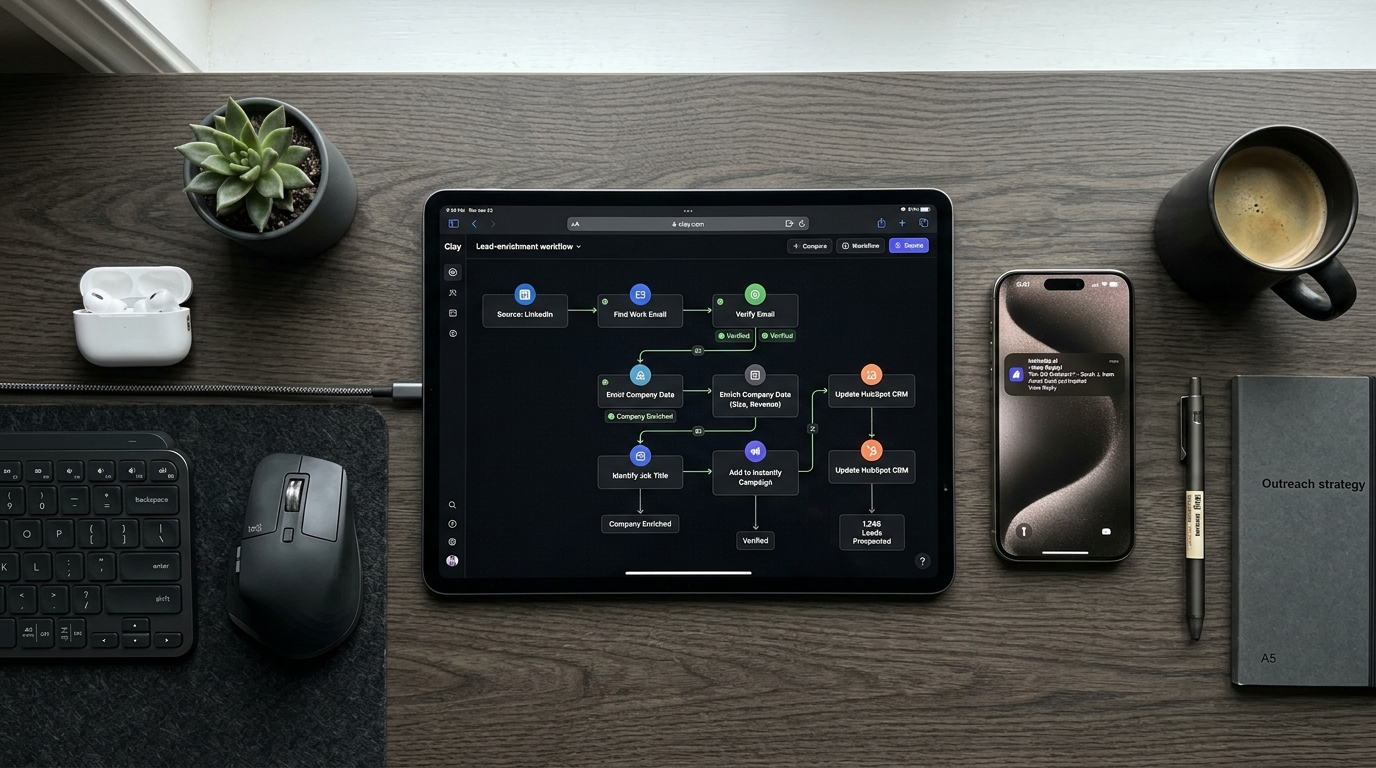
Outbound Infrastructure Terms
This section covers the technical foundation. For founders running SaaS outbound without building a team, deliverability infrastructure is often the single biggest technical blocker, and the one most overlooked.
Cold Email
Unsolicited outreach email to a prospect with no prior relationship. The core channel for outbound at scale. Average response rates across industries sit between 7% and 10%, but that range is misleading. Without personalization, reply rates drop to 1–4%. With personalization beyond just the first name, reply rates increase by 340%. This makes writing effective cold emails one of the highest-leverage skills for anyone doing outbound without a team.
Email Deliverability
The ability of your emails to reach the recipient’s primary inbox rather than spam or promotions. Deliverability is technical, not creative. You can write the best cold email in the world, and it won’t matter if it lands in spam. Deliverability depends on sender reputation, authentication protocols, sending volume, domain age, and content quality.
SPF, DKIM, and DMARC
Three email authentication protocols that prove your emails are legitimate.
SPF (Sender Policy Framework) tells receiving mail servers which IP addresses are authorized to send email on behalf of your domain. DKIM (DomainKeys Identified Mail) adds a cryptographic signature to each email, proving it wasn’t altered in transit. DMARC (Domain-based Message Authentication, Reporting, and Conformance) tells receiving servers what to do when an email fails SPF or DKIM checks, such as quarantine it or reject it.
All three are non-negotiable for outbound. If you skip them, your emails go to spam. Period.
Domain Warming
The gradual process of building sending reputation on a new email domain before sending at volume. New domains have no reputation, and sending 100 cold emails on day one will get you flagged immediately. Warming typically takes 2–4 weeks minimum and involves sending small volumes of emails that generate replies and engagement, signaling to email providers that your domain is legitimate.
Inbox Rotation / Sender Rotation
Distributing outbound email volume across multiple inboxes and domains to protect sender reputation. Best practice: 30–50 emails per inbox per day, with 3 inboxes per domain. If you’re sending 150 cold emails per day, that’s 3–5 inboxes across at least 2 domains. Inbox rotation tools automate this distribution so no single inbox gets overloaded.
Outbound Infrastructure
The complete technical setup for running outbound: domains, inboxes, warming, authentication, tools, and sequences. For small operations running outbound without a team, the recommended starting point is 8–20 domains. Each domain gets 2–5 inboxes, each inbox sends 30–50 emails per day. This infrastructure is what allows a single operator to send at the volume of a small team. A comprehensive cold outreach guide can help you map the full setup.
Outreach Execution Terms
Email Sequence / Cadence
A pre-defined series of emails sent to a prospect over days or weeks with automated follow-ups. A typical cold email sequence is 3–5 touches spread over 10–21 days. The first email introduces the value proposition, subsequent emails add social proof, address objections, or try different angles. Learn more about what an email sequence involves and how to structure one for maximum reply rates.
Multi-Channel Outbound
Combining email, LinkedIn, phone, and sometimes video in a structured outreach sequence. A practical starting sequence is 12–18 touches over 20–30 days that blends all channels. Multi-channel matters more for solo operators because you need maximum conversion per prospect. You can’t compensate for low conversion with volume, so you compensate with presence across channels.
For more on why using multiple sales channels drives better results, the evidence is consistent.
LinkedIn Prospecting
Using LinkedIn for connection requests, direct messages, content engagement, and outreach. Especially effective for founder-led outbound because a founder’s profile carries more authority than a junior SDR’s. When a CEO sends a connection request, the accept rate is significantly higher than when “SDR at [Company]” does the same thing. Read a deep dive on everything about LinkedIn prospecting for tactical details.
Personalization
Tailoring outreach to the specific prospect based on their role, company, recent activity, pain points, or public statements. This is where AI tools deliver the most value for founders running SaaS outbound without building a team. AI-powered personalization has improved campaign click-through rates by 465% compared to non-personalized emails. Only about 5% of senders personalize each email, yet those senders see 2–3x the replies. This is a massive opportunity for operators using AI to personalize at scale.
ICP Targeting / List Building
The process of finding and verifying contacts who match your ideal customer profile. Without a team, list quality matters more than list size. A bad list of 10,000 contacts will waste your limited daily sending capacity (remember: 30–50 emails per inbox per day). A tight list of 500 perfect-fit prospects will generate more pipeline than a loose list ten times its size.
Signal-Based Outreach
Triggering outreach based on buying signals rather than static lists. Buying signals include job changes, funding rounds, new technology adoption, hiring patterns, and company growth indicators. Instead of emailing every VP of Marketing at a SaaS company, you email the ones whose companies just raised a Series B, hired three new sales reps, and started using a competitor’s tool. This approach produces dramatically better reply rates because your timing aligns with the prospect’s actual situation.
Measurement and Optimization Terms
Reply Rate
Percentage of recipients who respond to your outreach. Average cold email reply rate: 1–4% without personalization, 7–10% with decent targeting, and 15–20%+ with strong targeting, personalization, and multi-channel execution. This is the most honest measure of whether your outbound is working.
Open Rate
Percentage of emails opened. Average sits around 42% across industries. Less meaningful as a standalone metric because Apple Mail Privacy Protection and other tools inflate open rates by pre-loading tracking pixels. Use open rate to spot deliverability problems (a sudden drop from 45% to 15% means you’re hitting spam) but don’t optimize for it.
Meetings Booked
The core output metric for SaaS outbound without building a team. Everything else feeds this number. High-performing outbound generates 8–15 meetings per SDR-equivalent per month. For a founder or operator running lean, 5–10 qualified meetings per month is a strong baseline.
Pipeline Velocity
The speed at which prospects move from first touch through the sales pipeline to close. Lean teams need faster velocity because they can’t compensate with volume. Faster velocity comes from better targeting (only engaging high-fit prospects), stronger messaging (creating urgency in the first touch), and tighter follow-up cadences.
Cost Per Meeting
Total outbound investment divided by qualified meetings generated. This is the comparison metric when evaluating whether to stay DIY, use an AI SDR tool, hire an operator, engage an agency, or build an in-house team. If an agency charges $12K/month and books 6 meetings, your cost per meeting is $2,000. If an AI tool costs $900/month and a part-time operator costs $3,000/month, and together they book 8 meetings, your cost per meeting is $487.50. The math often favors the operator-plus-AI model.
Qualified Lead
A prospect who meets ICP criteria and has expressed genuine interest (replied positively, booked a meeting, asked a question about your product). Distinct from a marketing qualified lead (MQL), which might just mean someone downloaded a whitepaper, and a sales qualified lead (SQL), which means they’ve been vetted and are ready for a sales conversation. For more on the qualification process, here’s a guide on how to qualify B2B leads.
The Hidden Costs of a $75k SDR
Many founders think a team costs just the salary. In reality, the "Fully Loaded" cost is nearly triple the base pay.
| Expense Item | Annual Cost (Est.) |
| Base Salary | $75,000 |
| Payroll Taxes & Benefits (25%) | $18,750 |
| Tech Stack (LinkedIn Nav, CRM, etc.) | $12,000 |
| Management Overhead (10hrs/wk) | $25,000 |
| Recruitment & Training | $15,000 |
| Total Fully Loaded Cost | $145,750 |
Model Comparison: SaaS Outbound Without Building a Team
| Model | Typical Monthly Cost | Time to First Pipeline | Best For |
|---|---|---|---|
| Founder-led (DIY) | $200–$500 (tools only) | 1–3 months | Pre-revenue or early stage; founder has bandwidth |
| AI SDR tools | $600–$5,000 | 1–2 months | Scaling email volume; supplements human strategy |
| Outbound operator/consultant | Custom (scope-based) | 2–4 weeks | Founders who want senior execution and strategy together |
| Outsourced SDR agency | $10,000–$15,000 | 4–6 weeks | Speed to scale when a validated playbook already exists |
| In-house SDR hire | $11,000–$18,000 (annualized) | 4–6 months | Post-product-market fit; outbound is a proven channel |
The operator/consultant model sits in a gap that most content about SaaS outbound without building a team never mentions. It gives you senior strategic thinking combined with hands-on execution, AI-powered leverage for scale, and none of the management overhead of hiring. It’s the model that practitioners on LinkedIn and Reddit describe most often when they share what actually worked.
What to Do Next
Running SaaS outbound without building a team requires understanding the terms in this glossary, but understanding alone doesn’t build pipeline. The pattern that works for most founders follows a clear sequence: define the ICP with painful specificity, build the technical infrastructure (domains, warming, authentication), use AI tools for research and personalization, execute multi-channel sequences, and iterate on messaging weekly based on reply data.
If you’d rather have a senior operator handle all of this instead of learning it yourself, SalesPipe offers founder-led outbound execution. You work directly with an experienced outbound operator, not a team of junior SDRs, with AI-powered leverage behind every campaign.