8 Best Outbound Sales Agencies in 2026: Buyer's Guide
Explore the 8 best outbound sales agencies in 2026 - pricing, models, pros/cons, and real reviews. Compare top picks and choose smarter.

TL;DR
Most outsourced SDR programs fail. A SaaStr survey found that only 7% of B2B companies say outsourced SDRs truly worked for them. This guide cuts through the marketing copy to compare the best outbound sales agencies by pricing, model type, real user reviews, and honest tradeoffs. The top picks range from founder-led operators like SalesPipe (best for startups wanting senior, hands-on execution) to established agencies like Belkins (best for mid-market companies with $10K+ monthly budgets). Pricing spans $2,500 to $15,000+ per month depending on scope and model.
Direct Answer
If you're comparing outbound sales agencies in 2026, expect pricing between $3,000 and $15,000+ per month, with enterprise programs exceeding $20,000. The best agency depends on your company stage rather than simply choosing the biggest provider.
For most startups and early growth companies, founder-led outbound operators often provide better execution because strategy and campaign management stay with experienced practitioners. Larger organizations that require dedicated SDR teams, multiple territories, and high outbound volume generally benefit from traditional agencies.
When evaluating agencies, focus on these five factors:
- SDR experience and turnover
- Deliverability infrastructure
- Pricing model
- Contract length
- Pipeline quality rather than meetings booked
The agencies reviewed below represent different operating models, budgets, and ideal customer profiles so you can choose the option that matches your business instead of chasing the biggest brand.
Why 93% of Outsourced SDR Programs Disappoint
Before spending a dollar on an outbound sales agency, you need to understand why the category has such a poor track record. That SaaStr figure, only 7% reporting true success, isn’t a fluke. Another 26% said it “sort of worked.” The rest? Money burned.
Practitioners on Reddit and sales forums paint an even grimmer picture than the listicles suggest. Recurring complaints cite bogus leads, poor targeting, undertrained reps, and revolving account managers. One common thread: the senior person who sold you the engagement vanishes after the contract is signed, replaced by a junior SDR who barely understands your product.
The problem isn’t that outsourced sales development can’t work. It’s that the dominant agency model, rent a team of junior SDRs, is structurally misaligned with how complex B2B sales actually happen.
This guide exists to help you find the exceptions. The outbound partners that are worth the investment.
At-a-Glance Comparison Table
| Agency | Starting Price | Best For | Rating | Primary Channel | Contract |
|---|---|---|---|---|---|
| SalesPipe | Custom, scope-based | SaaS startups wanting founder-led execution | N/A | Cold email + LinkedIn | Month-to-month after pilot |
| Belkins | ~$5,000/mo | Mid-market B2B with established ICP | 4.8 G2 | Email-first | Multi-month |
| CIENCE | ~$2,500/mo+ | High-volume, data-heavy outbound | 3.7 G2 | Multi-channel | Custom |
| SalesHive | $4,000/mo | Month-to-month flexibility, phone-led | 4.3 Trustpilot | Phone + email | Month-to-month |
| Martal Group | ~$5,000/mo | SaaS companies entering North America | 4.5+ G2 | Email + LinkedIn + phone | 3-month pilot |
| memoryBlue | ~$7,000/mo | B2B tech with hire-to-convert intent | Strong G2 | Phone + email | 6-month minimum |
| SalesRoads | ~$7,000/mo | Industries where cold calling still works | 4.9 Clutch | Cold calling | Month-to-month |
| Callbox | Enterprise-level | Complex, global B2B sales cycles | Established | 7-channel | Custom |
How We Ranked These Outbound Sales Agencies
Unlike many comparison articles that simply repeat marketing claims, this guide evaluated each provider using publicly available data and recurring customer feedback.
Ranking Criteria
| Factor | Weight |
|---|---|
| Independent customer reviews | 25% |
| Pricing transparency | 15% |
| Deliverability expertise | 15% |
| SDR quality & execution model | 20% |
| Reporting & transparency | 10% |
| Contract flexibility | 10% |
| Infrastructure ownership | 5% |
Three Models of Outbound Execution
Not all outbound partners work the same way, and choosing the wrong model is often where the failure starts. Here’s a framework most listicles miss.
Traditional SDR Agency
You’re renting a team. The agency assigns one or more SDRs to your account, typically offshore or early-career reps, and runs campaigns on your behalf. Volume-based. Works best for mid-market companies that need 10+ meetings per month and have the budget to absorb ramp time and turnover. If you want a deeper look at this model, here’s a breakdown of SDR outsourcing companies.
Founder-Led Operator
You work directly with an experienced outbound specialist who handles strategy and execution. No handoff to juniors. AI tools provide the leverage that would normally require a team. Best for startups and scaleups that want senior attention, fast iteration, and full transparency. SalesPipe operates in this category.
AI / DIY Outbound
You build the stack yourself using tools like Instantly, Smartlead, Clay, and Apollo. Cheapest option, but requires internal expertise in deliverability, copywriting, data enrichment, and campaign management. Viable for teams with a technical founder or revenue operations hire who can dedicate 15+ hours per week.
The rest of this guide evaluates the best outbound sales agencies and operators across all three models so you can pick the one that fits your stage, budget, and tolerance for risk.
Explore working with SalesPipe →
Should You Hire an Agency, Consultant, or Build In-House?
| Option | Best For | Monthly Cost | Speed |
|---|---|---|---|
| DIY outbound | Early startups | Lowest | Slow |
| Founder-led operator | Growth companies | Medium | Fast |
| Traditional agency | Mid-market | High | Medium |
| In-house SDR | Long-term scaling | Highest | Slowest |
Quick Rule
Choose DIY if you're validating product-market fit.
Choose a founder-led operator if strategy matters more than volume.
Choose a traditional agency if you already know your ICP and need consistent meeting generation.
Build internally once you've established a repeatable outbound process.
Which Outbound Sales Agency Is Right for You?
| If you are... | Best Choice |
|---|---|
| Startup under $1M ARR | Founder-led operator |
| SaaS startup | SalesPipe |
| Enterprise company | Callbox |
| Need cold calling | SalesRoads |
| Need North America expansion | Martal Group |
| Want transparent pricing | SalesHive |
| Want to eventually hire SDRs | memoryBlue |
| Need enterprise-scale data | CIENCE |
| Want white-glove service | Belkins |
The 8 Best Outbound Sales Agencies in 2026
1. SalesPipe
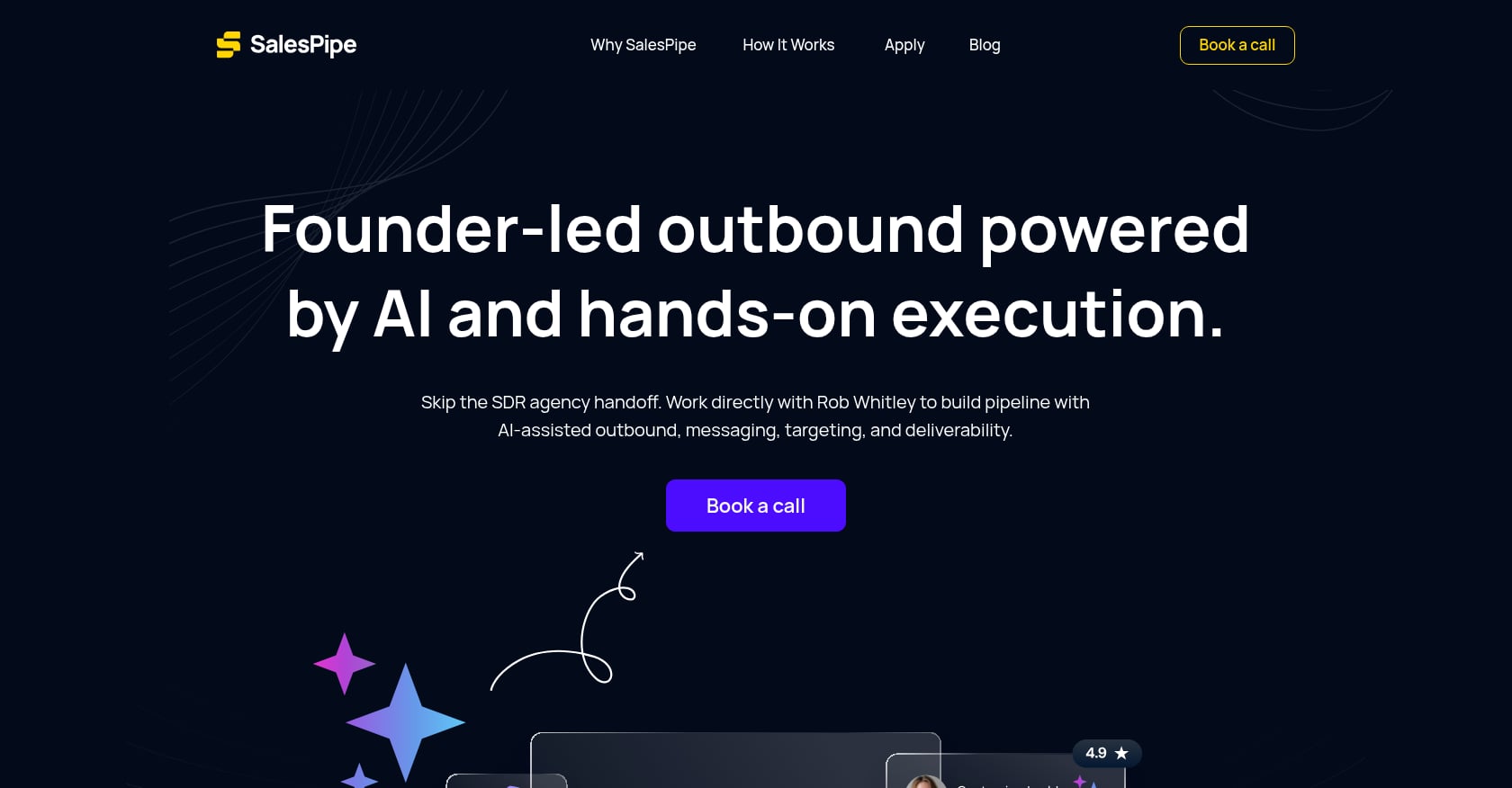
Best for: B2B SaaS startups and scaleups that want senior, founder-led outbound execution without the typical agency experience.
Pricing: Custom, scope-based engagements. Typically begins with a pilot and continues month-to-month.
Key features:
Clients work directly with founder Rob Whitley on every aspect of outbound: ICP definition, messaging, infrastructure setup, campaign execution, and optimization
AI-powered leverage for research, personalization, and workflow execution, meaning one senior operator can match the output of a multi-person SDR team
Full outbound infrastructure setup including secondary domains, SPF/DKIM/DMARC configuration, inbox warm-up, and deliverability monitoring
Multi-channel execution across cold email and LinkedIn
Clients own their infrastructure, domains, data, and sequences stay in your accounts
Why it stands out:
The core complaint about outbound agencies, strategy sold by seniors, executed by juniors, doesn’t apply here. The senior person IS the execution. There’s no handoff, no knowledge loss between calls, and no incentive to optimize for vanity metrics like “emails sent.”
SalesPipe also addresses what practitioners on Reddit consistently flag as a hidden risk: infrastructure ownership. When many agency engagements end, the client walks away with nothing. No domains, no warmed inboxes, no refined sequences. With SalesPipe, the system you build together stays yours.
Tradeoffs:
Limited bandwidth compared to agencies with 50+ SDRs. Fewer clients served simultaneously.
Pricing is less standardized than agencies with published plan tiers.
Not the right fit if you need 30+ meetings per month from day one across multiple geographies.
Verdict: The best option for founders and revenue leaders who’ve been burned by agencies and want an embedded outbound partner who operates at a senior level. Particularly strong for companies in the $1M to $20M ARR range that need pipeline without building a full SDR team.
Apply to work with SalesPipe →
2. Belkins
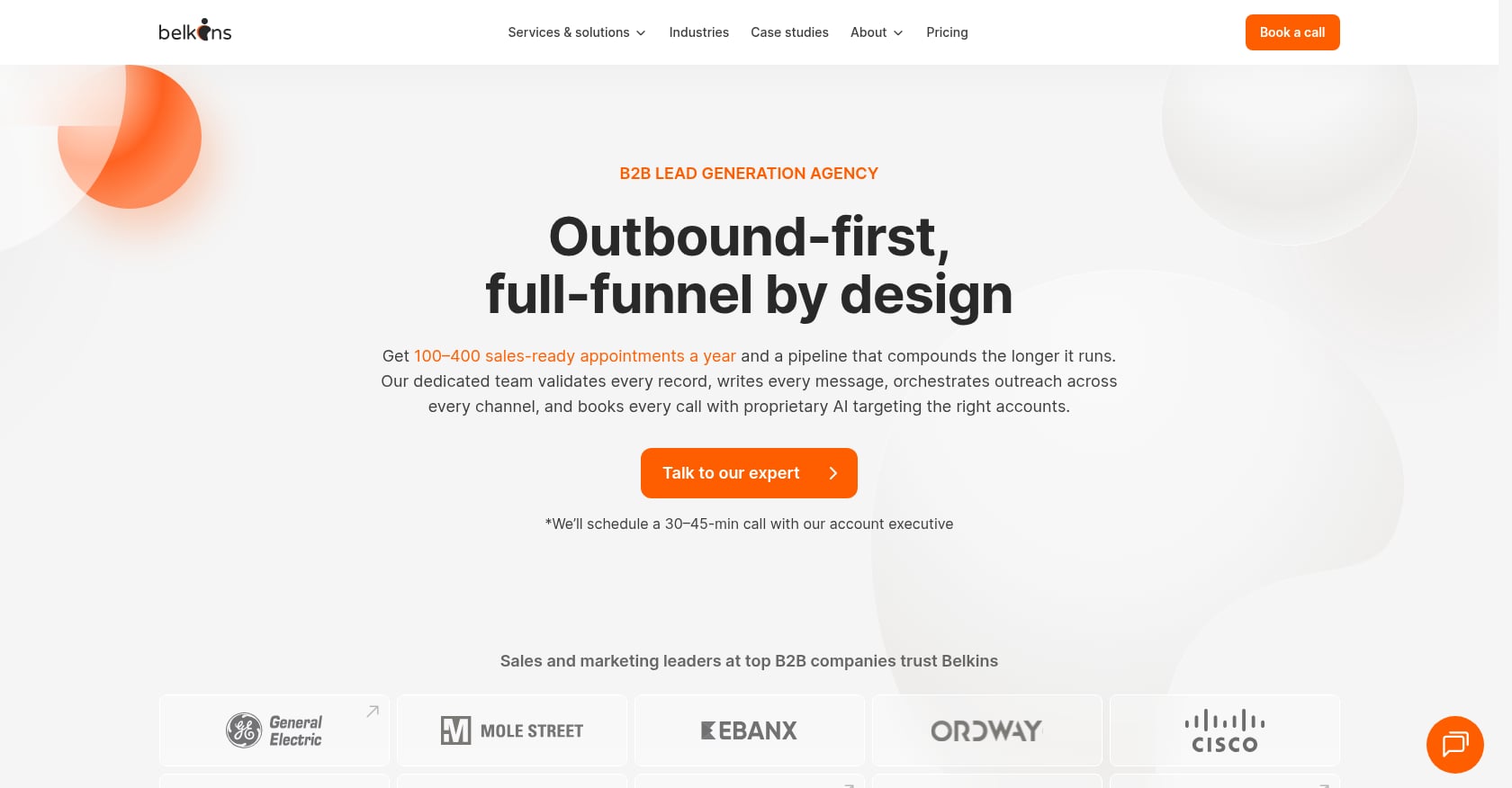
Best for: Mid-market to enterprise B2B companies with established ICPs and $10K+ monthly budgets needing white-glove, email-first appointment setting.
Pricing: Startup packages range from approximately $2,000 to $5,000 per month. Full-service retainers run $5,000 to $14,800+ per month. Pay-per-appointment models at $300 to $800+ per meeting are also available. Many projects land above $10K per month in practice.
Key features:
Dedicated account teams with SDRs, copywriters, and deliverability specialists
Proprietary deliverability tool (Folderly) for inbox placement
Strong operational processes with transparent reporting dashboards
4.8/5 on G2, 4.9/5 on Clutch across 230+ verified reviews
Tradeoffs:
Premium pricing puts it out of reach for most early-stage startups
Operates on a best-effort model rather than guaranteeing a specific number of meetings per month
Pricing isn’t publicly listed, which means a sales process before you know what you’ll pay
Some reviewers note that results depend heavily on having strong underlying positioning before engaging
Real user perspective: Clutch and G2 reviews are overwhelmingly positive, though a recurring critical theme is that pricing felt high relative to results for companies that hadn’t nailed their messaging and ICP first.
Verdict: One of the strongest traditional agencies if you have the budget and an established market position. Not where you should start if you’re still figuring out product-market fit.
3. CIENCE
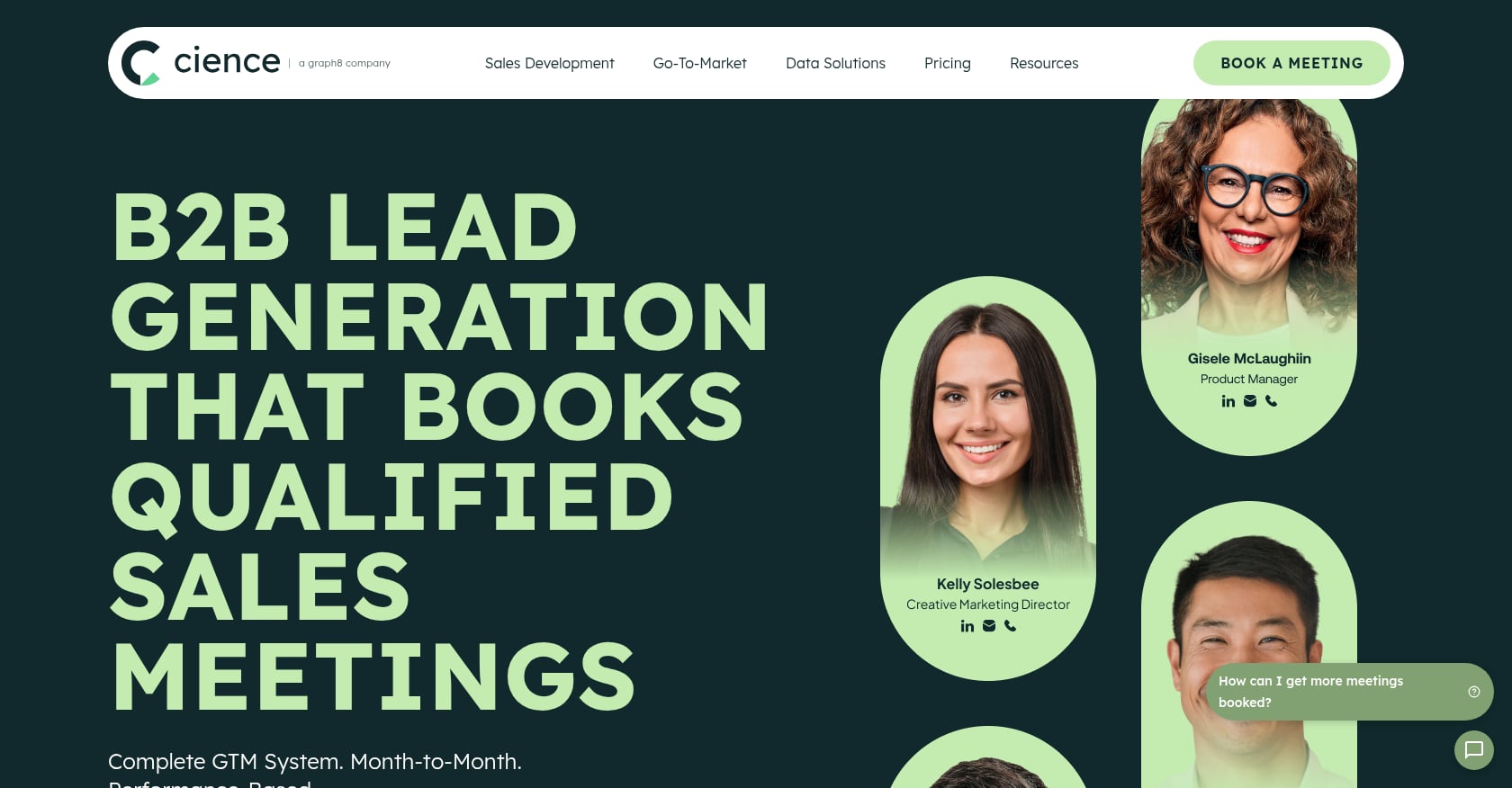
Best for: Mid-market companies needing high-volume, data-heavy outbound with broad list coverage.
Pricing: Ranges from $2,500 to $50,000 depending on project scope. Setup fees of approximately $5,000 have been reported. The wide range reflects everything from basic list building to full multi-channel execution.
Key features:
Large proprietary data engine (GO Data platform) with 300M+ records
Vertically integrated tech stack for research, outreach, and analytics
Broad industry coverage and multi-channel execution
3.7/5 on G2
Tradeoffs:
Reviews are sharply polarized. G2 and Clutch show decent ratings, but Trustpilot tells a different story.
SDR churn is a common complaint. Multiple reviewers mention constant turnover on their account team.
Offshore account management can create communication gaps
Quality appears to vary dramatically depending on which pod or team you’re assigned
Real user perspective: One Trustpilot reviewer wrote: “We were extremely disappointed… Despite 6 months of interactions and repeated assurances, they did generate a single new lead.” Another described the experience as “oversold, under delivered” with constant turnover. These aren’t isolated complaints; they represent a pattern in publicly available reviews.
Verdict: The data infrastructure is impressive, and some teams get strong results. But the inconsistency is a real risk. If you go with CIENCE, negotiate a short initial commitment and get clarity on your specific team assignment before signing.
4. SalesHive
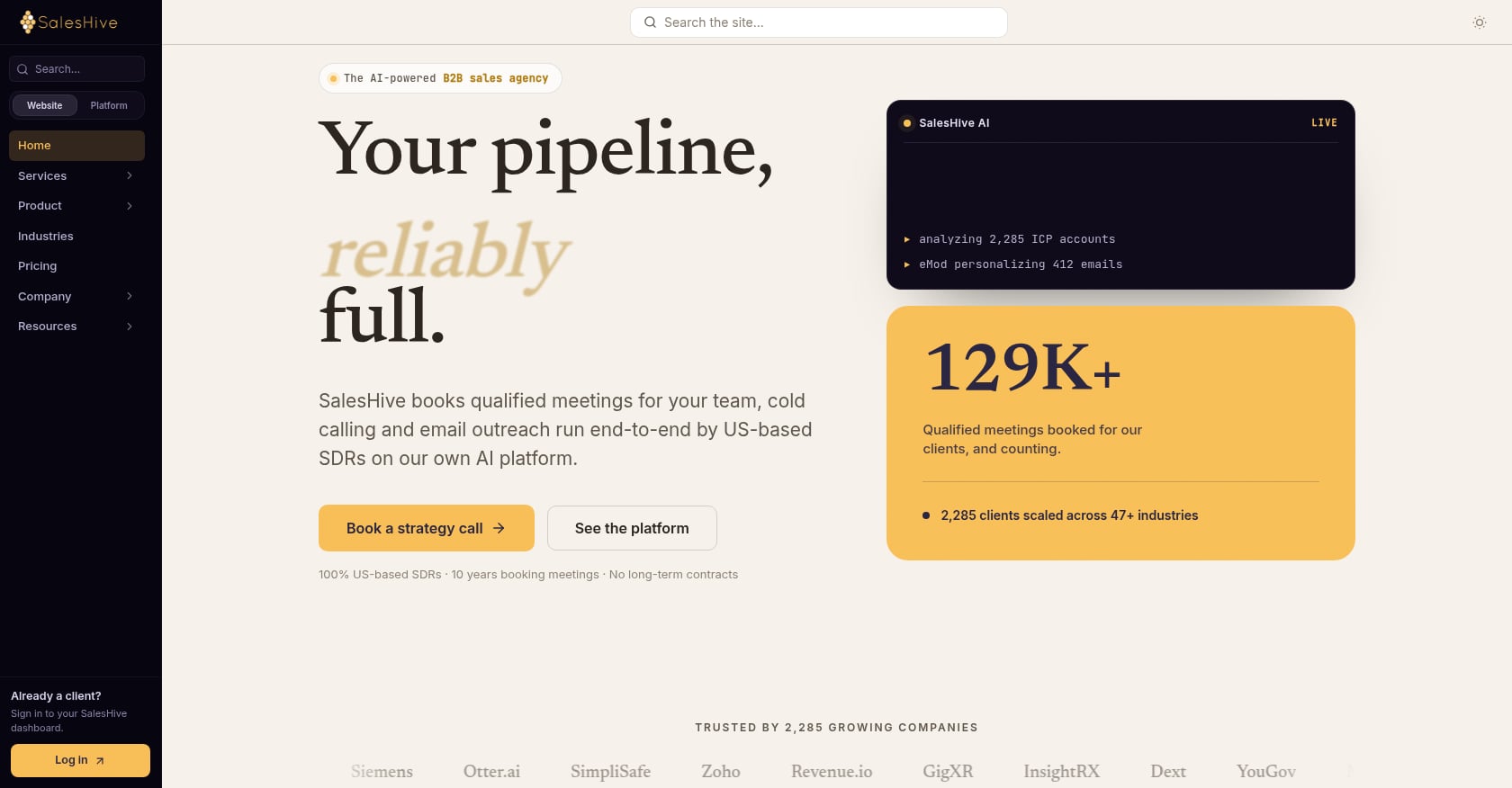
Best for: Companies wanting transparent, month-to-month pricing with phone-heavy outbound and US-based reps.
Pricing: Three flat-rate packages: Starter at $4,000/month, Growth at $8,000/month, and Crush at $12,000/month. Philippines-based options start around $4,500. Published pricing is a rarity in this space and a genuine advantage for buyers comparing options.
Key features:
Transparent published pricing with no long-term contracts
US-based SDRs (with offshore options available)
Proprietary AI platform (eMod) for email personalization
Risk-free onboarding with month-to-month flexibility
4.3/5 on Trustpilot
Tradeoffs:
Relatively small review footprint: only about 36 reviews after nearly a decade in business, which makes it hard to draw firm conclusions
Limited independent case study verification
Generalist positioning means less industry-specific expertise than specialized agencies
Clutch profile shows 0 reviews at time of writing
Real user perspective: The published pricing and month-to-month terms are frequently cited as positives by buyers on forums who are tired of being locked into six-month minimums with opaque costs.
Verdict: A good entry point for companies that want to test outsourced outbound without a major commitment. The transparent pricing model is refreshing, though the thin review volume means you’re taking some risk on consistency.
5. Martal Group
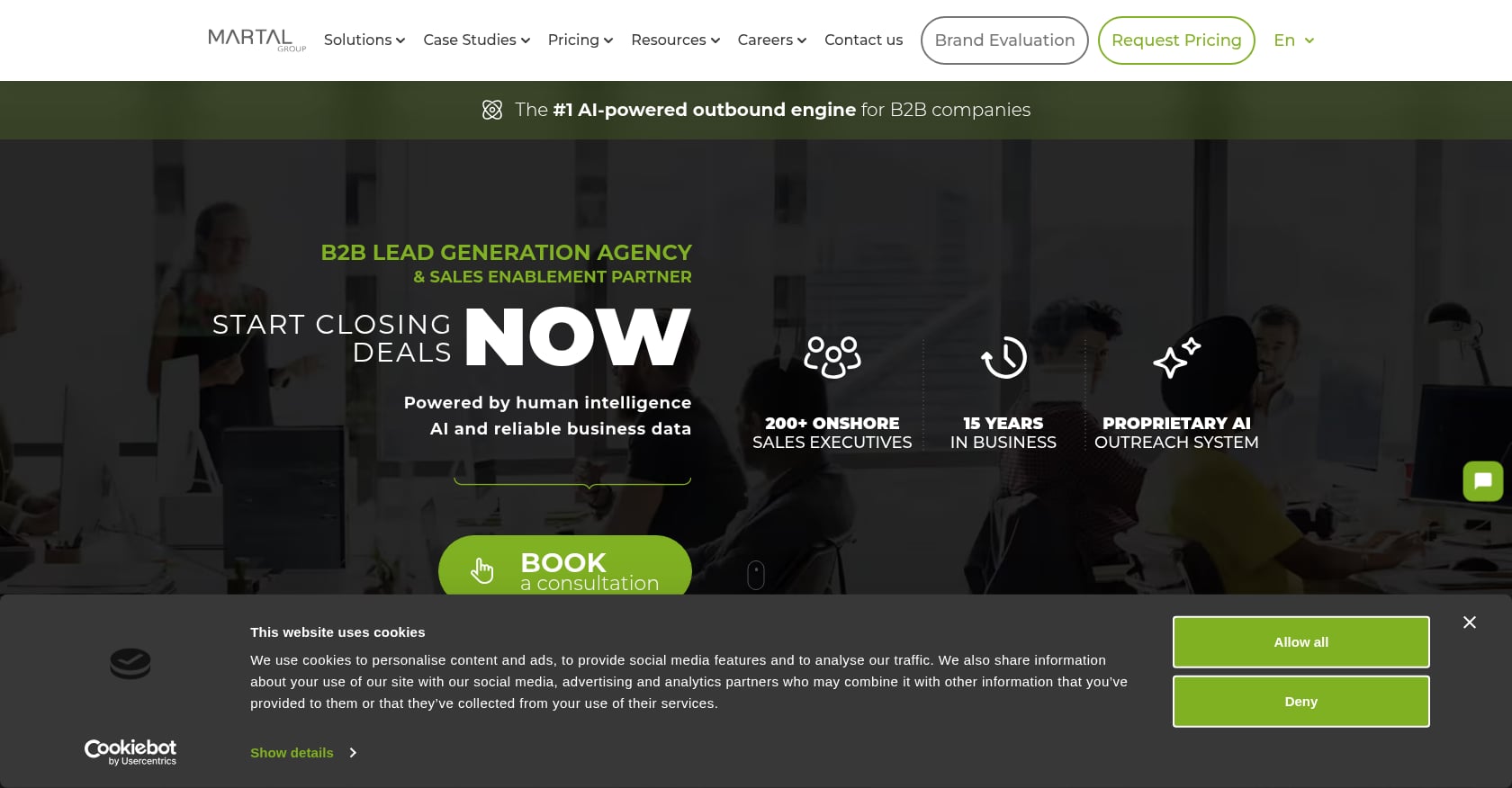
Best for: International SaaS companies entering North American markets or US-based companies needing multichannel outbound with onshore reps.
Pricing: Retainers typically start around $5,000 per month based on public review data. Requires a 3-month pilot commitment. Full pricing isn’t published.
Key features:
North American onshore sales reps
AI-powered SDR platform supplementing human outreach
Fractional sales team model with flexible scaling
Strong communication and account management per multiple reviews
Solid G2 presence with 134 reviews
Tradeoffs:
Early-stage lead quality can be inconsistent before the intent-signal layer calibrates
Limited visibility into campaign mechanics, which makes optimization harder on the client side
Three-month pilot commitment means you’re locked in before seeing meaningful results
Less suited for companies that need pure cold calling
Real user perspective: Reviewers consistently praise communication quality but note that the first month often produces lower-quality leads as the system learns your ICP.
Verdict: A strong choice for SaaS companies that need a North American presence without hiring locally. The ramp period is real, so expect month one to be more calibration than production.
6. memoryBlue
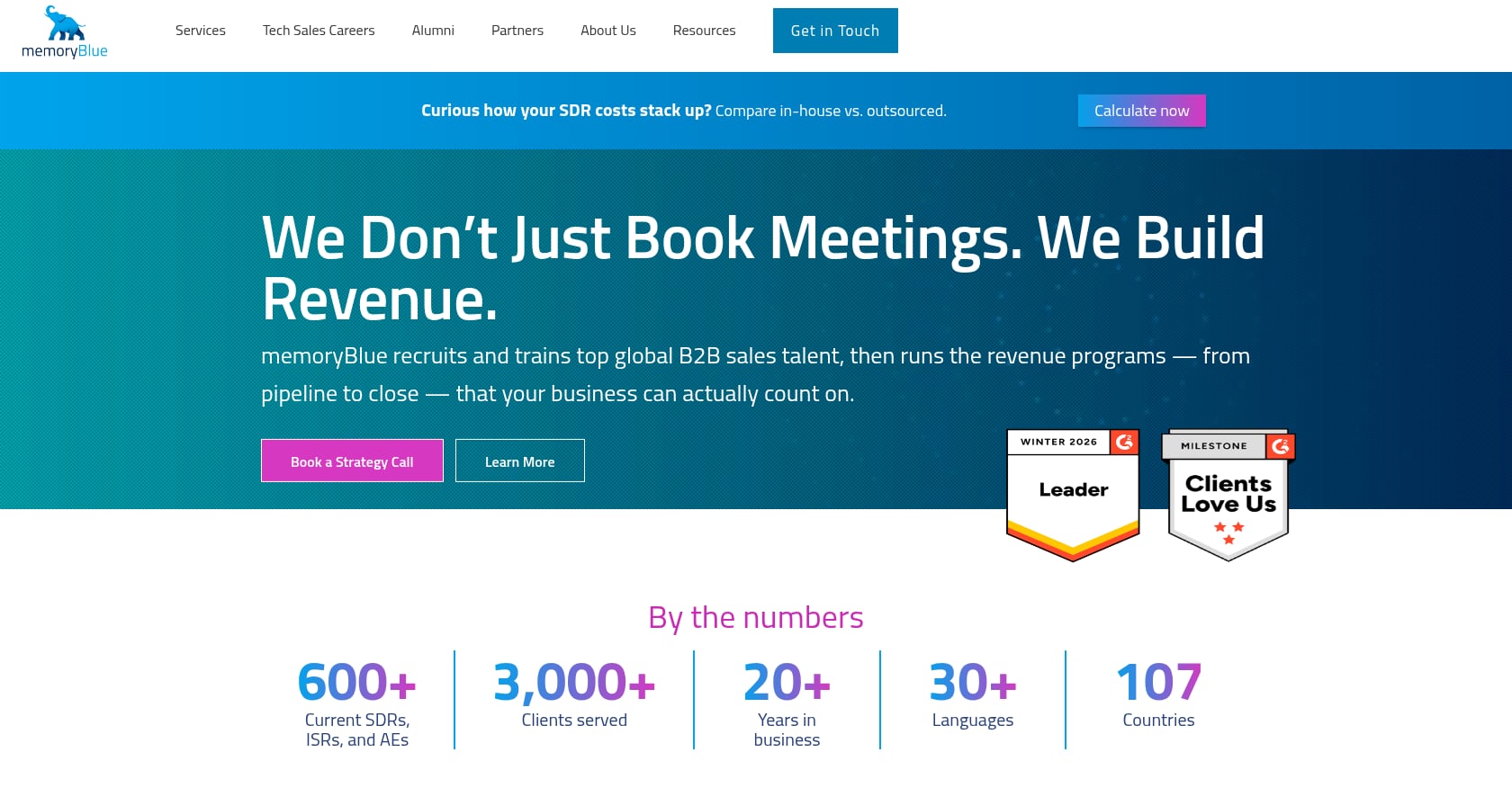
Best for: B2B tech companies with meaningful deal sizes that want the option to hire their outsourced SDRs full-time.
Pricing: Premium at $7,000 to $12,000 per month per SDR. Pricing includes intensive training, coaching, and the audition-to-hire option. Requires a 6-month minimum contract.
Key features:
Audition-to-hire model: if an SDR performs well, you can bring them in-house
20+ years in business (founded 2002), one of the longest track records in the space
Global coverage through acquisition of Operatix
Strong internal training academy producing higher-caliber SDRs
Solid G2 and Clutch presence
Tradeoffs:
Premium pricing is difficult to justify for startups or companies with deal sizes under $30K ACV
Six-month minimum commitment is significant, especially given the industry’s poor average success rates
Multiple clients report frequent SDR turnover within ongoing campaigns, requiring re-training
Workflow rigidity noted in some reviews
Real user perspective: The audition-to-hire model is genuinely unique and valuable for companies planning to build an in-house team. But several reviewers mention that SDRs left unexpectedly mid-campaign, which undermines the relationship-building advantage.
Verdict: Best understood as a recruiting pipeline disguised as an agency. If your end goal is building an internal SDR team and you can afford the premium, memoryBlue solves two problems at once. If you just want meetings, the cost-per-meeting math gets tough. For more context on whether building in-house makes sense, see this guide on does outsourced SDR work.
7. SalesRoads
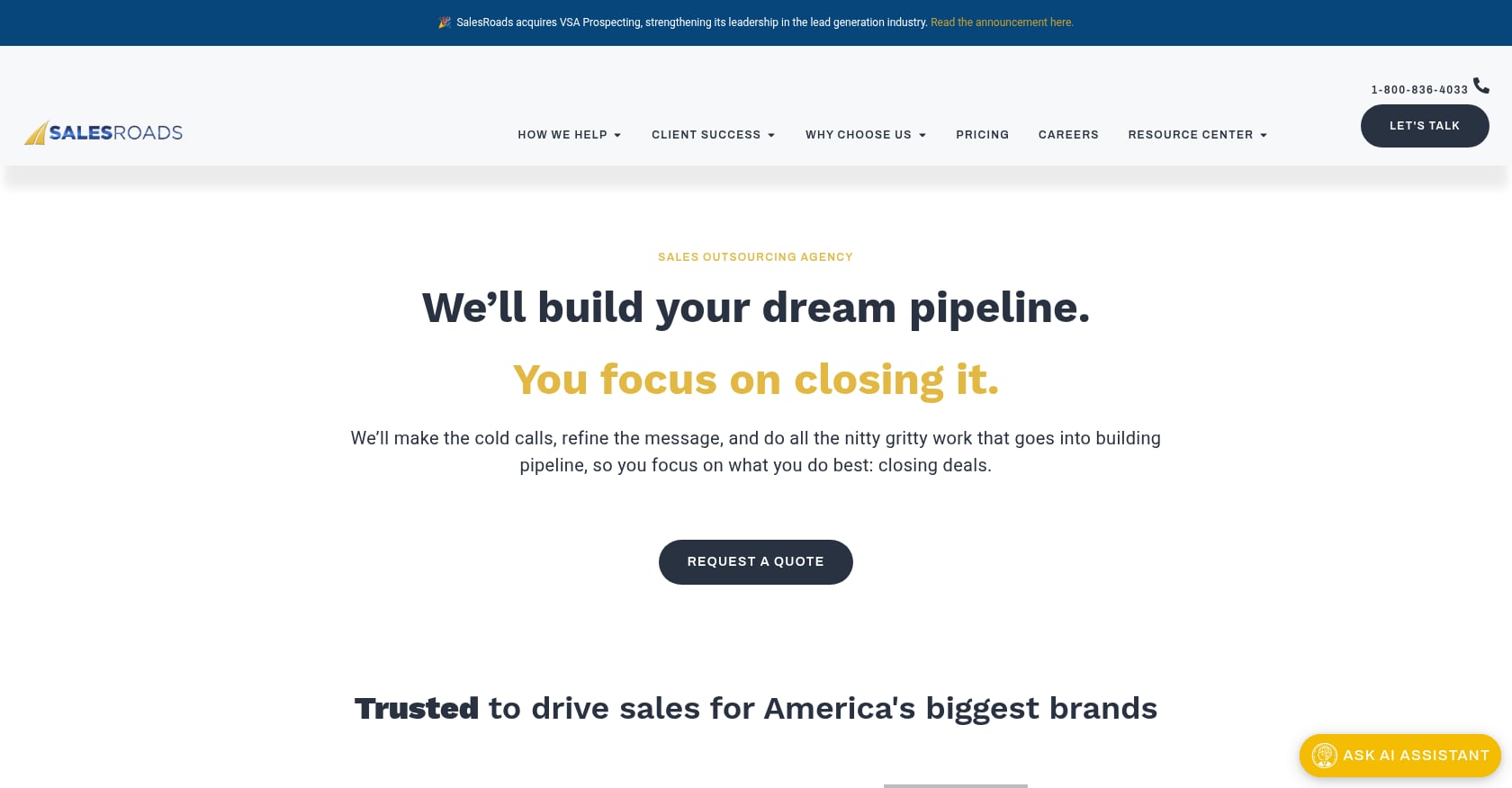
Best for: B2B companies in industries where cold calling is still the primary driver: staffing, insurance, commercial services, and similar verticals.
Pricing: Starts around $7,000 per month. Phone-first methodology with US-based callers.
Key features:
20+ year track record (founded 2002)
Exclusively US-based sales reps
Phone-first model with demonstrated results: one case study shows 937 appointments generated for AchieveIt, resulting in $540K ARR closed
4.9/5 on Clutch
Tradeoffs:
Less sophisticated email and LinkedIn capabilities compared to email-first agencies
Phone-first approach faces headwinds as pickup rates in 2026 hover around 3%
Premium price point for a single-channel approach
Less suited for industries where buyers don’t answer phones (most of SaaS)
Verdict: If your buyers still answer cold calls, SalesRoads is one of the best at it. For SaaS and tech companies where email and LinkedIn dominate the buying process, this probably isn’t the right fit.
8. Callbox
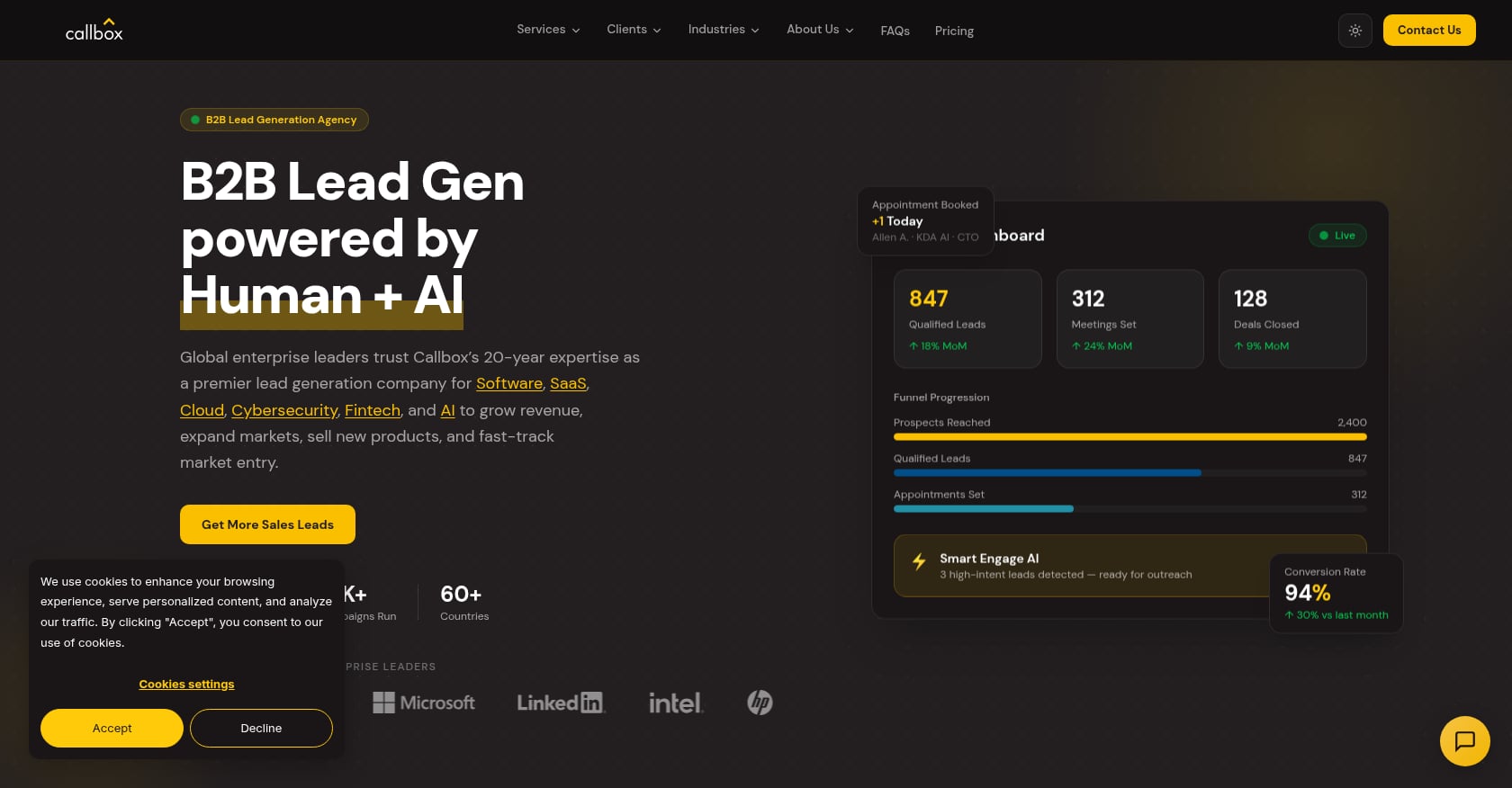
Best for: Enterprise companies running complex, global B2B sales cycles that need multiple touchpoints across regions.
Pricing: Not publicly listed. Expect enterprise-level budgets.
Key features:
Multi-channel, multi-touch campaigns across email, phone, LinkedIn, chat, and social
Global footprint spanning North America, APAC, EMEA, and LATAM
Proprietary CRM and pipeline management platform
Two decades of operational history (founded 2004)
Tradeoffs:
Cost and complexity make it a poor fit for lean startups or companies with simple ICPs
Less agile than smaller agencies; changes to campaigns can move slowly
The proprietary platform means you’re working within their ecosystem, not your own tools
Limited public review data compared to competitors
Verdict: The right choice for large organizations that need multi-geography, multi-channel outbound at scale. For everyone else, the overhead and cost structure don’t make sense.
How to Evaluate an Outbound Sales Agency
Picking from a list is only the first step. Before signing with any of the best outbound sales agencies on this list (or off it), run through this evaluation framework.
Questions to Ask Before Signing
Who actually does the work? Ask for the name and LinkedIn profile of the person who will run your campaigns. If they can’t tell you, that’s a red flag.
What happens to the infrastructure when we leave? Find out whether the sending domains, CRM data, contact lists, and email sequences live in your accounts or the agency’s. This is the single most overlooked question in agency evaluations. If the system doesn’t stay with you, you’re building their asset.
How do you handle deliverability? Secondary domains, SPF/DKIM/DMARC configuration, inbox warm-up, and clean verified lists are non-negotiable infrastructure. Agencies that treat this as a checkbox rather than a core competency will burn your domain reputation. For a deeper look at what good email execution looks like, check out this guide on cold email structure.
What does your reporting look like? Demand to see a sample report. If it’s heavy on vanity metrics (emails sent, open rates) and light on downstream metrics (held meetings, SQL conversion, pipeline generated), the agency is optimizing for the wrong things.
What’s your average client retention? Agencies with high churn are telling you something. Push for specifics.
Red Flags to Watch For
Guaranteed meeting counts with no discussion of meeting quality
Minimum contracts longer than 3 months before you’ve seen any results
Inability to name your specific SDR or account manager
Unwillingness to share sample campaigns or playbooks
Pricing that requires a “custom quote” for even basic information
No mention of deliverability or sending infrastructure in the onboarding process
Metrics That Actually Matter
Forget open rates. The numbers you should track when evaluating an outbound sales agency:
Held meeting rate: What percentage of booked meetings actually happen?
SQL conversion: How many meetings become qualified opportunities?
Cost per qualified meeting: Most companies spend $3,000 to $5,000 per qualified meeting in year one. If your agency can’t get you below $5,000 after 90 days, something is wrong.
Pipeline velocity: How quickly are agency-sourced leads moving through your funnel compared to other channels?
Why Most Outbound Agency Engagements Fail
Understanding the failure modes helps you avoid them. Here are the structural problems that explain why outsourced SDR teams underperform so often.
Junior SDR Churn
The average SDR tenure is 14 to 16 months, and ramp to productivity takes 6 to 12 weeks. In an agency context, the math is worse because the SDR is splitting attention across multiple accounts. By the time they understand your product, they’re often leaving for another role.
Misaligned Incentives
Agencies bill for headcount or activity, not outcomes. This creates a natural incentive to optimize for volume (more emails sent, more calls logged) rather than quality (meetings that convert to pipeline). The gap between “meetings booked” and “meetings that matter” is where most budgets go to die.
Poor Deliverability
Sales reps already spend 70% of their time on non-selling tasks. When deliverability isn’t handled properly, even good copy never reaches the inbox. Many agencies use shared sending infrastructure across clients, which means one bad actor can tank your deliverability.
Black-Box Reporting
If you can’t see exactly what’s being sent, to whom, and what’s happening downstream, you can’t improve. Too many agencies provide weekly summaries that obscure the actual performance data.
The Fully Loaded Cost Problem
Consider the alternative: a fully loaded in-house SDR in the US costs roughly $120,000+ per year when you factor in salary, benefits, tools, management overhead, and ramp time. That’s $10,000+ per month before the rep books a single meeting. Outsourcing can save up to 70% versus in-house hiring, but only if the agency actually delivers.
When a Founder-Led Outbound Partner Beats a Traditional Agency
The traditional agency model works for some companies. But for startups and scaleups, particularly in SaaS, the founder-led operator model is often the better bet. Here’s why.
Direct accountability. When the person who designed your campaign is also the one executing it, feedback loops are instant. No telephone game between your account manager, the SDR team lead, and the actual rep doing the work.
AI changes the leverage equation. 83% of sales teams using AI report revenue growth. One experienced operator with the right AI tools can now match the output of a 3-person SDR team, handling research, personalization, sequencing, and optimization, at a fraction of the cost.
Faster iteration. Traditional agencies often take 2 to 3 weeks to implement messaging changes. A solo operator can test new angles the same day.
You keep everything. The domains, the sequences, the data, the learnings. When the engagement evolves or ends, your outbound system doesn’t disappear.
This is the model SalesPipe was built around. For companies that want senior outbound execution without the overhead and risk of a traditional agency, it’s worth a conversation.
Choosing the Right Model for Your Stage
Not every company needs the same thing. Here’s a quick decision framework:
Pre-PMF startups ($0-1M ARR): Start with DIY outbound or a founder-led operator. You need iteration speed and tight feedback loops, not volume. Our cold outreach guide can help you build the foundation.
Growth stage ($1M-10M ARR): This is the sweet spot for a founder-led operator or a boutique agency. You have enough ICP clarity to run effective campaigns but probably not enough budget or management bandwidth for a full in-house team.
Scale stage ($10M+ ARR): Consider a traditional agency for volume, supplemented by a founder-led partner for strategic accounts. Or build in-house and use an agency for overflow.
Enterprise: Agencies like Callbox or Belkins with global footprints and dedicated teams make sense when you’re running multi-geography campaigns with complex buying committees.
See if SalesPipe is the right fit →
Average Outbound Sales Agency Pricing in 2026
One of the biggest questions buyers ask is how much outbound agencies actually cost. Pricing varies significantly depending on the execution model.
| Agency Type | Typical Monthly Cost |
|---|---|
| Freelancer | $1,000–3,000 |
| Founder-led operator | $3,000–8,000 |
| Boutique agency | $4,000–10,000 |
| Full-service SDR agency | $8,000–20,000+ |
| Enterprise outbound program | $20,000+ |
Remember that lower pricing often means junior SDRs, shared account management, or limited infrastructure support.