What is an Outsourced SDR?
Discover the role and benefits of outsourced SDRs, boosting sales efficiency and lead generation for tech startups and SaaS companies.
Mattes Woestemeier
Content collaborator at SalesPipe
Finding the right outsourced Sales Development Representatives (SDRs) can be the key to achieving growth for your startup.
The choice of partner not only impacts your lead generation efforts but also determines the efficiency and effectiveness of your sales strategy.
This blog covers strategies for selecting outsourced SDR services and what to check before you sign.
I'll also share how I approach it at SalesPipe, where you work directly with me (Rob) instead of a junior SDR.
Read on!
Outsourced SDR - Definition
An outsourced SDR is a Sales Development Representative hired through an external service provider to handle the initial stages of the sales process for tech and SaaS companies.
The SDR role involves identifying and qualifying potential leads, sparking interest in a company's offerings, and determining if these prospects are suitable for further engagement by the sales team.
Outsourced SDRs, or outsourced sales development representatives, play a crucial role in building rapport with prospects and expanding your sales pipeline with qualified leads — which is why many SaaS teams now weigh a managed outsourced SDR alternative against hiring reps one by one.
By getting outsourced sales team services, businesses can tap into a pool of remote sales agents or lead generation experts who bring specialized and niche expertise to the SaaS industry. These professional sales supports are often more cost-effective than building an internal team, allowing startups to enjoy significant savings without compromising quality.
Also, outsourced SDRs work under a contract with their agency or marketplace, offering flexibility and reducing complexities such as managing full-time staff.
This fractional SDR approach means that companies can access part-time sales reps or external sales forces that align with their specific needs and market strategies, thereby maximizing their return on investment in sales development.
What do Outsourced SDRs do?
Outsourced SDRs are crucial for lead generation, which involves identifying and qualifying potential customers for your business. This process is vital to keep your pipeline active and moving.
Cold emailing involves reaching out to potential clients to introduce them to your company's products and services. The goal is to send valuable and relevant emails, increasing the chances of a positive response.
On the other hand, cold calling entails directly contacting potential clients over the phone, even if they are unfamiliar with your company. Cold calling requires SDRs to have strong negotiation skills to handle any objections that may arise.

Social selling uses platforms like LinkedIn to identify and engage with new prospects, allowing SDRs to build relationships before making formal sales pitches. This method helps create a foundation of trust and familiarity, which can be beneficial when pushing the prospect down the funnel.
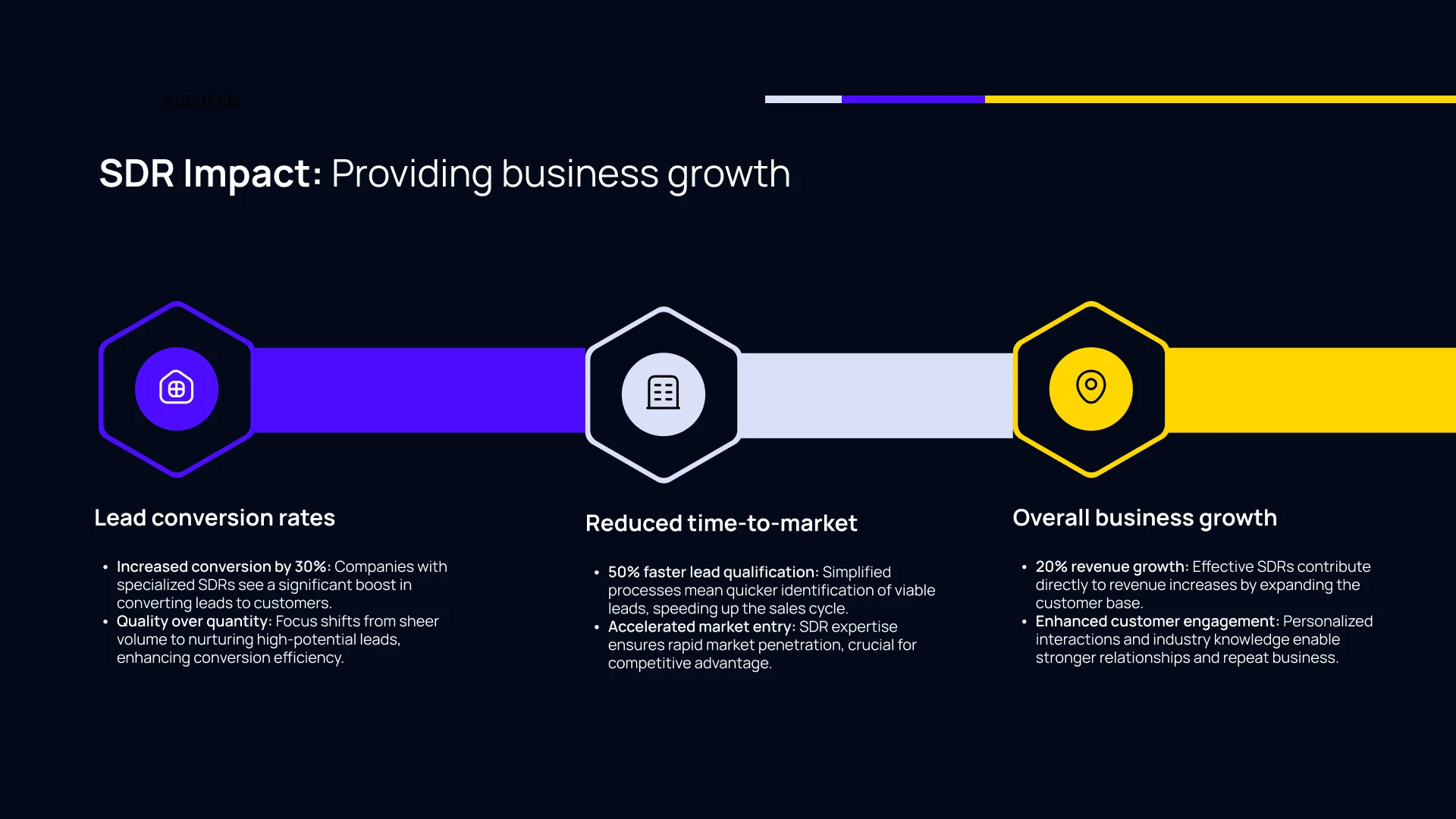
Beyond outreach, outsourced SDRs are responsible for qualifying leads. This means creating ideal customer profiles ( ICPs) and engaging prospects in conversations about their challenges and needs. Experienced SDRs know how to efficiently qualify leads, allowing your sales team to focus their efforts on high-potential opportunities, resulting in a faster time to market
Through this process, SDRs determine if a lead is ready to move further down the sales funnel. The ability to effectively qualify leads is a key skill that distinguishes successful outsourced sales teams, as it directly influences business outcomes.
What is Sales Outsourcing?
Sales outsourcing involves partnering with a third-party firm — or an alternative to an SDR agency — to manage one or more sales functions, with a primary focus on lead generation and qualification.
This strategy allows companies to get professional sales support without developing these capabilities in-house.
Typically, startups compensate these outsourced sales teams based on a percentage of sales revenue or a predetermined fee.
For many B2B companies, sales outsourcing solutions present a cost-effective way to expand sales operations swiftly. The global SaaS industry is expected to grow in revenue from $197 billion in 2023 to $232 billion in 2024.
However, successful sales outsourcing goes beyond handing over a list and scripts. It requires building a strong partnership with the outsourced sales firm. By collaborating closely and treating them as an integral part of your company, you ensure that their insights and feedback are valued.
How to Find Outsourced SDRs?
Finding the right outsourced SDRs requires a clear understanding of your industry, goals, and target audience. Before exploring potential outsourced SDR companies, it’s crucial to define your needs.
Determine specific outcomes you expect, like lead generation or sales development, to ensure you achieve the desired results from your outsourced sales team.
While many measure SDR performance by the number of meetings scheduled, it's not always the most effective KPI. High meeting counts with unqualified leads can waste resources.
Instead, consider tracking the meeting-to-opportunity acceptance rate and attendance rate for a more meaningful assessment of your outsourced sales development representative's effectiveness.
A qualified outsourced SDR firm won’t promise a fixed number of meetings. Instead, they collaborate with you to establish realistic KPIs and strive to meet those goals.
“
Get back to basics, your sales 101, making sure you’re assuming nothing, that you are asking very detailed questions of your prospects about what the process looks like on their end.
— Lindsay Bennett, Regional Vice President of Enterprise Sales at Seismic Software. Source.
When searching for sales outsourcing solutions, utilize the internet to connect with potential B2B firms. Evaluate their experience, quality of work, and client feedback to ensure they provide the services your sales team requires.
For those unsure of their exact needs, reaching out directly to a manager or founder — at SalesPipe, that's Rob Whitley — via their website or LinkedIn can provide clarity.A brief conversation often reveals their approach and whether they can support your sales objectives.
Besides online searches, use your LinkedIn network for recommendations. Many professionals in sales, tech, and SaaS sectors are active on LinkedIn, making it a valuable resource for finding reliable sales outsourcing options.
If you'd rather skip the junior SDR layer entirely, SalesPipe works differently: you work directly with me (Rob). I build and run your outbound myself, using AI for leverage, so there's no junior SDR handoff.
“
Historically, you would look for a salesperson who is a great communicator, a great problem solver, someone who can overcome objections and kick open that door and close that deal. I’m not saying those things aren’t important anymore, but they’re really lower on the scale. What organizations need to hire and train for are people who are digitally adept and creative.
— Mary Shea, Principal Analyst at Forrester. Source.
Outsourced SDR vs. In-House SDR: Where the Difference Shows Up
Most comparisons stop at "outsourced is cheaper." That's only part of it. The real differences are time, risk, and who carries the cost when things go wrong.
| In-house SDR | Outsourced SDR | |
|---|---|---|
| Time to first outreach | Recruiting alone often takes about a month (Workable puts average time to hire at 28 days), then onboarding. | Usually weeks. The playbook, tools and sending setup already exist. |
| Ramp | HubSpot reports most SDRs need about 4.1 months to fully ramp. | Shorter, but they still need to learn your product, ICP and objections. |
| Cost structure | Salary, benefits, tools, data, and your management time. | A monthly fee. Check what it includes. Data and tooling are often extra. |
| Turnover risk | When a rep leaves, you lose the months you spent ramping them. | The provider absorbs it. Ask how they handle it before you sign. |
| Product depth | Grows over time. Your rep sits next to product and sales. | The weak spot. You have to feed it on purpose. |
| Control | Full. | Shared. You set the targets and approve the messaging. |
If you want the full cost math, I break it down in SDR agency vs. in-house SDR and the true cost of hiring an SDR team.
When Outsourced SDRs Don't Work
I'll be straight. Plenty of companies try outsourced SDRs and walk away unhappy. The failures tend to look the same.
- The product is complex and nobody teaches it. Buyers of sophisticated software expect product knowledge, even on a first call.
- The provider doesn't know your market. Generic messaging to a niche buyer gets ignored.
- Success is measured in meetings booked. That rewards volume, not pipeline.
- It's treated as hand-off and forget. A list and a script go over the wall, and nobody reviews replies.
Two operators put it well in a SaaStr discussion on this exact topic:
“
IMO, if you’re going to hire an outsourced BDR team, they either need to 1. Specialize within your market Or 2. Use them exclusively for inbound qualification.
Kevin Kost, Director CS at GrammaTech. Source.
“
Hard for B2B SaaS, where the solution is geared towards solving sophisticated customer workflows. Customers expect more product knowledge, even at the appointment setting engagement.
Eric Harrington, Co-Founder at TeamSupport.com. Source.
I agree with both. If your provider can't talk credibly about your buyer's problem, no amount of volume fixes it. More on this in why most SDR agencies fail.
Questions to Ask Before You Sign
A short call answers most of these. If a provider dodges them, that tells you something.
- Who actually does the work? A senior operator, or a junior rep you've never met?
- Which markets have you sold into? Ask for examples close to your buyer.
- How do you measure results? What do you report weekly, and what do you report monthly?
- What domains and inboxes do you send from? Cold email should go out from separate secondary domains, never your primary domain.
- Who owns the data, sequences and reply history? You should keep it all if you leave.
- What's the contract length and notice period? Long lock-ins before any proof are a red flag.
- What happens in a bad month? You want a plan for diagnosing it, not excuses.
How to Run the First 90 Days
Before launch
Write down your ICP, your best customer stories, the objections your closers hear most, and what a qualified meeting means for you. Give the provider CRM access so nothing lives in a spreadsheet.
Every week
Hold a short check-in and keep a shared channel, Slack works fine, for quick questions. Read real replies, not just the dashboard. The objections and "not now" answers tell you more than open rates.
Treat replies as market research
A good outbound program doubles as research. Who responds, which titles ignore you, which pain points land. Feed that back to marketing and product. It's one of the most underrated benefits of outsourcing this work.
Judge on pipeline, around day 60 to 90
Early weeks go to setup and testing. By month two or three, look at meeting attendance, meeting-to-opportunity rate, and pipeline created. Those numbers decide whether you keep going.
FAQ
How long until an outsourced SDR shows results?
Expect the first few weeks to go to setup, list building and message testing. Meaningful pipeline signal usually takes 60 to 90 days. Anyone promising a fixed number of meetings in week one is guessing.
Is an outsourced SDR cheaper than hiring one?
Usually, once you count recruiting, ramp, benefits, tools and turnover. But a cheap provider that books bad meetings costs more than it saves. Compare cost per qualified opportunity, not the monthly fee.
Can an outsourced SDR handle inbound leads too?
Yes, and for very complex products it can be the safer starting point. Qualifying people who already raised their hand needs less deep product knowledge than cold outreach.
Will the cold emails come from my company's main domain?
They shouldn't. A careful provider sets up separate secondary domains and inboxes so your primary domain's reputation stays protected. See the cold email domain setup guide for how that works.
Conclusion
In conclusion, finding the right outsourced SDRs is crucial for enhancing your sales efforts and achieving business growth. By focusing on well-defined goals and realistic KPIs, you can ensure that your sales process is efficient and effective.
If you want senior execution without hiring or managing SDRs, at SalesPipe you work directly with me (Rob), and I build and run your outbound myself.
By leveraging the strategies and tips discussed, you can form strategic partnerships to meet your current needs and push your sales pipeline forward.
Consider these insights to optimize your approach and unlock new opportunities in your sales journey.
Related articles
Outsourced SDR - The Future of Outbound Sales
What an outsourced SDR is and why they're the future of outbound sales.
How to Hire a Salesperson For a Startup
Learn the best way to get top-quality talent.
5 Reasons to Hire an Outbound Calling Service
An easy way to increase lead generation.
Fractional SDR - What is it + Advantages
Explore the concept of fractional SDR (Sales Development Representative) and its advantages.
Want pipeline instead of theory? SalesPipe is founder-led outbound run by Rob Whitley. Targeting, messaging, and execution are handled directly, with no junior SDRs in between. Tell us what you're building and we'll map out the outbound motion that fits.