
Founder-Led Outbound for SaaS: 2026 Step-by-Step Guide

For early stage B2B SaaS companies, the path to the first crucial sales is often paved by the founders themselves. This approach, known as founder-led outbound for SaaS, is more than just a necessity due to a small budget. It’s a powerful strategy for validating your market, refining your message, and building a sales process that can actually scale. When founders roll up their sleeves and dive into prospecting, outreach, and closing deals, they gain priceless insights that no hired salesperson could replicate.
Quick Takeaway: The Founder-Led Outbound Formula
To successfully execute founder-led outbound in 2026, founders should follow the 10-10-10 Rule:
10 High-Intent Prospects: Hand-pick 10 leads daily based on "trigger events" (e.g., new hires, funding, or tech stack changes).
10 Personalized Touchpoints: Send 10 deeply researched emails—templated "personalization" no longer works in the age of AI noise.
10 Minutes of Social Signals: Engage with prospect content on LinkedIn before sending the first email. The Goal: Close 10–20 deals personally to document a repeatable playbook before making your first sales hire.
This guide breaks down everything you need to know about mastering founder-led outbound. We will explore the core concepts, practical tactics, and the transition plan for when you’re ready to grow.
The Unique Power of Selling as a Founder
Before diving into tactics, it’s important to understand why having a founder lead the sales charge is so effective. It’s a temporary phase, but it’s a phase with some serious advantages.
The Founder-Led Outbound Advantage
Founders possess a unique edge in sales that is difficult to replicate. First, your knowledge and passion for the product are unparalleled. You can answer any question, discuss the product vision, and convey a level of enthusiasm that builds immediate trust with customers. This deep expertise gives founder-led companies a significant competitive edge in winning those critical early deals.
The numbers support this. A Reuters analysis found that founder-led tech companies saw profit growth of around 30% over the past five years, versus 6.7% for companies led by other managers. This advantage often translates to higher close rates. For example, one SaaS company saw its founder close deals at a 33% rate, while their first sales hire initially closed at around 22%. Founders can also leverage personal networks for warm introductions, which are far more effective than pure cold outreach that averages about a 0.7% reply-to-meeting conversion rate. Finally, it’s cost effective. You save on a six figure sales salary, conserving precious cash until revenue can support a growing team.
Feature | Founder-Led Outbound | First SDR Hire |
Primary Goal | Learning & PMF Validation | Scaling & Volume |
Authority Level | High (CEO/Founder Title) | Moderate (Rep Title) |
Product Knowledge | Deep / Visionary | Functional / Tactical |
Messaging Style | Experimental & Agile | Standardized Playbook |
Success Metric | Feedback & Iteration Speed | Meetings Booked & Pipeline |
Avg. Close Rate | 25% - 35% | 15% - 22% |
Overcoming Common Objections to Outbound
Many founders, especially those with technical backgrounds, hesitate to jump into sales. Common objections include:
“I don’t have time for this.”
“I’m not a natural salesperson.”
“I don’t want to be pushy or annoy people.”
“I’m not sure the product is ready.”
While these are valid feelings, they can stall growth. The reality is that early on, selling is one of the highest leverage activities a founder can do. You don’t need to be a “natural” because your founder authority and passion are more compelling than any polished pitch. Good outbound is not about being pushy; it’s about being helpful and personalized. Start with this cold outreach guide to structure messages that land. Furthermore, outreach is the perfect way to validate if the product is ready. The feedback you get from cold prospects is invaluable for iteration. Many technical founders dread sales, but overcoming this reluctance is often directly tied to finding product market fit.
Gathering Market Intelligence from Founder Outreach
Every outbound call and email is a market research opportunity. When you are on the front lines, you receive unfiltered feedback that goes straight to the top, allowing for rapid changes to product and strategy. This creates a tight feedback loop between the customer and the product, which is essential in the early stages.
Through these conversations, you can:
Validate your messaging. You learn what value propositions actually resonate.
Refine your ICP. You might discover that a different type of company or buyer persona is a much better fit than you initially assumed. Use these principles to qualify B2B leads as you go.
Gather competitive intel. Prospects will often tell you what other solutions they are using or considering.
Identify product gaps. You’ll hear directly from the market about what features are missing or what parts of your product are confusing.
The founders of Clay famously used a founder-led approach to run “reverse demos,” letting customers guide the experience. This allowed them to find and fix bugs and UX issues after every single call, dramatically improving their product in real time.
The “Do Things That Don’t Scale” Playbook
The early days are not about automation and massive scale. They are about manual, hands on effort that creates a strong foundation.
Embracing “Do Things That Don’t Scale”
Coined by Y Combinator’s Paul Graham, “do things that don’t scale” is a core startup principle. It means that founders must personally engage in manual, high effort tasks to get initial traction. For sales, this means hand picking every prospect, writing highly individualized emails, and onboarding your first customers yourself. If you need a refresher on how to write a cold email, start there. As Graham says, “startups take off because the founders make them take off.”
Famous examples include Airbnb’s founders going door to door in New York to recruit hosts and Stripe’s founders literally installing their software for their first users. These unscalable actions are what ignite momentum and provide the best quality feedback you will ever get. A great founder-led outbound for SaaS strategy begins with this mindset.
The Critical Phase of Early Stage Founder Sales
Founders should lead sales for as long as they possibly can. Hiring a sales team or outsourcing too early is a classic startup mistake. Why? Because you miss out on all the crucial lessons that come from selling it yourself.
Hiring an Account Executive before the founder has proven the sales playbook often results in that person churning. The average cost to replace a salesperson is $97,690. The founder has to step back in anyway, having wasted precious time and money. Your first sales rep will almost always be worse at selling the product than you are, because you have the context, passion, and credibility that they lack.
Using Outbound for Product Market Fit Validation
Outbound sales is one of the best ways to test for product market fit (PMF). If you can consistently reach out to strangers in your target market and convert them into paying customers, you have strong evidence that you’ve built something people want. This is why VCs say that founders who avoid sales can actually impede their own path to product market fit.
A clear signal of PMF is when a founder can personally close more than 10 customers through outbound. This demonstrates that there is a repeatable motion and a real customer pain point being solved. With 42% of startups failing due to a lack of market need, using outbound to validate demand early is a powerful way to de risk your business.
A Practical Framework for Founder-Led Outbound for SaaS
So, what does this look like in practice? A successful founder-led outbound for SaaS effort is built on a disciplined, focused framework.
The Essential Founder Sales Stack (2026)
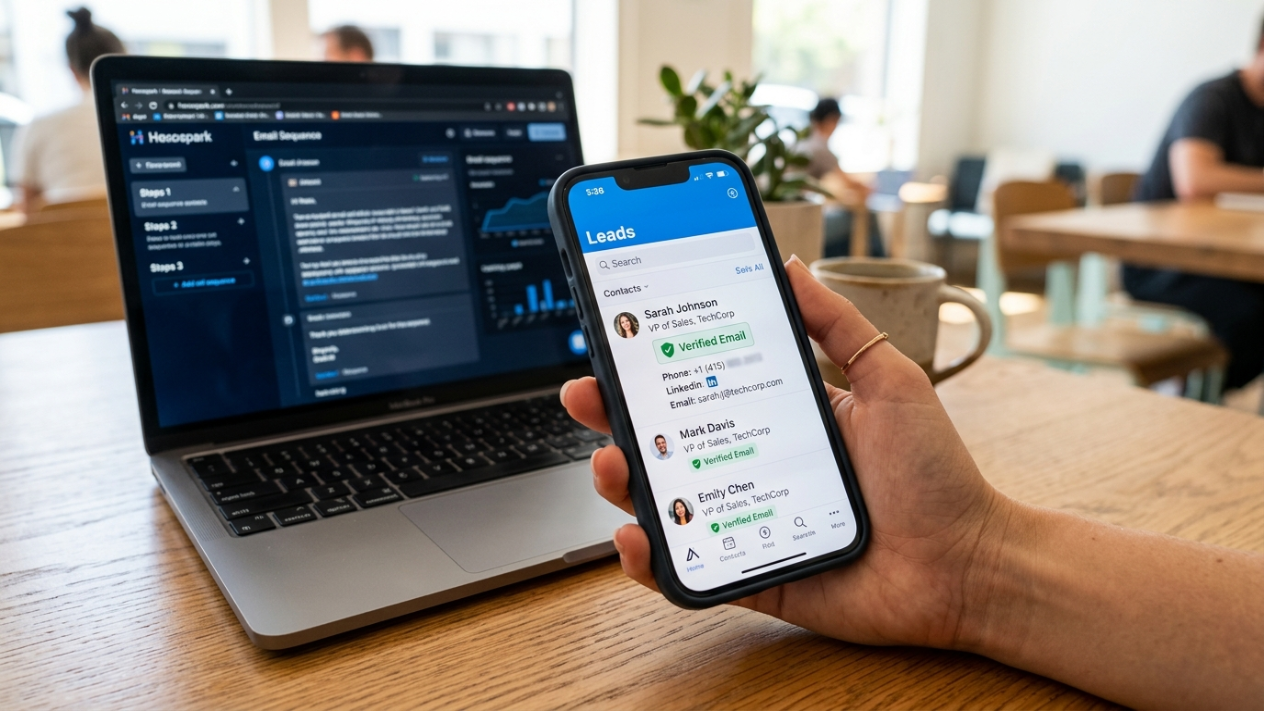
You don't need a complex enterprise CRM yet. To remain lean and fast, use:
Prospecting: LinkedIn Sales Navigator + Apollo.io (for verified emails).
Engagement: Clay or Hexospark (for AI-assisted personalization at a human scale).
CRM: HubSpot Free or Pipedrive (keep it simple for now).
Intelligence: Gong or Chorus (to record and review your own calls for feedback).
The 30 Day Founder-Led Outbound Sprint
A 30 day sprint is an intense, focused push to rapidly test outreach tactics and build pipeline momentum. The goal is to learn and iterate quickly. During this month, a founder will typically define a sharp ICP, build a targeted list, and execute a multi touch cadence of emails and social outreach, including focused LinkedIn prospecting.
The results can be significant. A well structured sprint can generate replies from ideal prospects. Over 30 to 45 days of sustained effort, a founder could secure 8 to 12 qualified meetings, building an initial pipeline of roughly $150,000 to $250,000.
Defining Your Ideal Customer Profile (ICP) for Outbound
A clear Ideal Customer Profile (ICP) is the foundation of all successful outbound. It’s a precise description of your perfect customer. A strong ICP prevents you from wasting time on poor fit prospects, given that at least 50% of your prospects aren’t a good fit for what you sell.
Your ICP should be concise enough to fit on an index card, focusing on key attributes that truly matter. Look at your best current customers and find the common threads (industry, company size, technology used). Critically, you should also include a disqualifier. In one case, adding a single disqualifying rule (e.g., they haven’t bought a competing product in 12 months) cut a target list by 35% but doubled the reply rate from 4% to 9%.
Documenting Your ICP and Templates Before Hiring
All the sales knowledge you gain cannot live only in your head. Before you even think about hiring a salesperson, you must document what works. This means writing down your ICP, the email templates that get replies, your call scripts, and your answers to common objections.
The founder’s job isn’t just to sell; it’s to build a repeatable system that someone else can eventually run. The CEO of Workstream famously created a 60 page sales playbook documenting every part of their process before hiring a single account executive. This ensures that your first sales hire can be productive from day one instead of trying to figure things out from scratch.
Message Variant Testing for Outbound
You should never assume your first message is the best one. Message variant testing, or A/B testing, involves experimenting with different versions of your outreach to see what performs best. You can test subject lines, calls to action, value propositions, or even the tone of your email and how you structure your email sequence.
This data driven approach can lead to huge wins. Reply.io’s analysis of 712,000 first‑step cold emails found reply rates were 6.95% higher with subject-line emojis and 10.93% higher when most words were capitalized. In one case study, a simple A/B test on an email campaign increased the reply rate from 9.8% to 18%, leading to 97% more booked meetings. The key is to test one variable at a time to know what truly caused the change.
Personalized Email Volume Guidelines for Founders
For founders, quality always trumps quantity. A good guideline is to send around 10 to 15 highly personalized cold emails per day. This may not sound like much, but each email should be well researched and tailored to the prospect. Sending more than 15 per day often leads to a drop in quality, which hurts response rates.
Remember, fully templated emails perform about 60% worse than semi personalized ones. Focusing on a dozen thoughtful emails is a much better use of a founder’s limited time than blasting a generic template to hundreds. This focused approach to founder-led outbound for SaaS consistently delivers better results.
Scaling Beyond the Founder
There will come a time when you need to transition beyond a purely founder-led model. This transition needs to be handled carefully to maintain momentum.
Founder-Led Versus the First SDR Hire
When you compare a founder selling to your first Sales Development Representative (SDR), there are key differences.
Authority: An email from a founder or CEO simply carries more weight and gets more attention than one from an SDR.
Knowledge: Founders have a deep, holistic understanding of the product and market, allowing them to handle any question and be more flexible in conversations.
Learning vs. Executing: A founder is in learning mode, figuring out what works. An SDR is in execution mode, scaling a process that already works. SDRs are not meant to discover product market fit for you.
Because of this “founder magic,” you should not expect your first hire to perform as well as you do, at least not for a long time.
Readiness Signals to Hire Your First SDR
How do you know it’s time to hire? Look for these signals:
You’re maxed out: You are getting more interest than you can handle and are starting to drop balls on follow ups.
You have a repeatable process: You know your ICP, your messaging works, and you have a basic sales process documented that you can teach someone.
You have consistent wins: You are winning a repeatable win rate of 20% or higher before hiring your first sales rep, showing the process is viable.
You have happy customers: Your early customers are sticking around and not churning, which validates product market fit.
You’ve closed enough deals yourself: Many experts suggest a founder should personally close 10 to 20 deals before making that first sales hire.
The Gradual Transition to Scaled Outbound
The move from founder-led sales is a gradual transition, not an abrupt handover. When you hire your first reps, the founder should still be heavily involved, acting as a player coach. The goal is to build a machine that works so well you can eventually “fire yourself” from the daily sales grind.
Consider hiring 2 or 3 reps with diverse profiles at once. This allows you to A/B test your hiring and see what type of person succeeds in the role, de risking the transition. Your role will shift from doing to coaching, reviewing emails, and refining the strategy.
Using a Hybrid Outbound Model After Validation
A hybrid model is an excellent way to bridge the gap between founder-led and fully scaled outbound. In this model, the founder remains involved in high value activities while delegating others. For example, an SDR or an external partner can handle top of funnel prospecting and appointment setting, while the founder takes the demo and closing calls.
This allows you to scale the volume of outreach while preserving the quality and feedback loop that comes from founder involvement. You get the best of both worlds, increasing capacity without losing touch with your customers. For many startups, a partner like SalesPipe can act as that expert operational arm, executing outreach with a founder’s level of quality.
Knowing When to Outsource After Traction

Outsourcing can be a powerful accelerator once you have traction. If you’re weighing models, here’s what an outsourced SDR actually is and when to use one. The right time to consider it is when you have a clear ICP and a proven outbound playbook, but you lack the internal capacity to scale it. It’s about outsourcing execution, not learning.
If you find that hiring SDRs is too slow or they have high turnover (which is common), an outsourced partner can provide immediate, trained capacity. The key is to keep the strategy in house while outsourcing the execution. A 90 day pilot project is a great way to test an outsourced relationship and ensure they can deliver quality meetings before making a long term commitment. If you’re ready to try one, apply here.
Key Benchmarks for Your Outbound Efforts
To know if your strategy is working, you need to track the right metrics and compare them to industry benchmarks.
Reply Rate Benchmarks for Founder-Led Outreach
For general cold email campaigns, a reply rate between 1% and 5% is common. However, a well executed founder-led outbound for SaaS campaign should perform much better.
A good baseline: Aim for a 8% to 15% positive or neutral replies. This indicates your targeting and messaging are solid.
Excellent performance: Aim for 8 to 15% positive or neutral replies and usually the result of intense personalization.
Poor performance: A reply rate below 1% is a red flag. One case study found a Baseline positive reply rate: 0.4% across 50,000 cold emails, proving that spray and pray doesn’t work.
Outbound Meeting Rate Benchmarks
A reply is good, but a booked meeting is better. The conversion rate from a cold contact to a booked meeting is naturally lower.
A common benchmark is that a good campaign will convert 0.5% to 2% of total contacts into a qualified meeting. So, for every 100 prospects you contact, booking one or two meetings is a solid result. Meeting book rate above 3% is considered excellent. For cold calls, the numbers are similar, with data suggesting only about 2% of calls result in an appointment. See this overview of cold calling as a service for tactics that improve connect rates.
As a founder, if your personalized approach is consistently booking meetings at a 3% rate or higher, you have a winning formula ready to be scaled.
If you’ve proven your sales motion and are ready to scale without the headache of building an in house SDR team, a dedicated partner can be the perfect next step. A service like SalesPipe provides the expertise and execution of a senior outbound operator, helping you build pipeline while you focus on closing deals and building your company.
Founder Pro-Tip: "The best outbound doesn't feel like sales; it feels like a consultation. If your email doesn't teach the prospect something about their own business, don't send it."
Frequently Asked Questions about Founder-Led Outbound for SaaS
What is founder-led outbound for SaaS?
It is a go to market strategy where the company’s founders are the primary drivers of outbound sales activities. This includes prospecting, sending cold outreach, taking sales calls, and closing the initial set of customers before hiring a dedicated sales team.
Why is founder-led outbound so effective?
Founder-led outbound for SaaS is effective because founders have unmatched product knowledge, passion, and credibility. Prospects are more likely to trust and engage with a founder, leading to higher response rates and better feedback. It also creates a tight learning loop that helps the company find product market fit faster.
How many emails should a founder send per day?
A founder should focus on quality over quantity, aiming for 10 to 15 highly personalized and well researched emails per day. This volume allows for meaningful customization, which dramatically increases reply rates compared to generic mass email blasts.
When should a founder stop doing sales?
A founder should begin transitioning away from front line sales when they have a repeatable and documented sales process, consistent deal flow that is maxing out their personal capacity, and a clear understanding of why they win deals. This usually happens after they have personally closed 10 to 20 customers.
Can I skip founder-led sales and just hire an SDR?
Skipping the founder-led sales phase is a common and costly mistake. An SDR’s job is to scale a process that already works, not to invent one. Hiring an SDR before you have a proven playbook often leads to failure for the SDR and wasted money for the startup.