AI-Powered Outbound vs AI SDR: What Really Works in 2026
Compare AI-Powered Outbound vs AI SDR in 2026: system vs product, reply rates, costs, and deliverability. Learn when each wins—and how to choose.
TL;DR
An AI SDR is a software product that autonomously handles prospecting, emailing, and follow-up, essentially replacing a human sales development representative with a bot. AI-powered outbound is a broader system that uses AI across the entire outbound motion (research, targeting, infrastructure, messaging, deliverability) while keeping human judgment in the loop for strategy and relationships. Most teams that buy an AI SDR tool expecting pipeline are actually looking for an AI-powered outbound system, and the confusion between these two concepts explains why over half of AI SDR deployments fail within a year.
Vendor marketing has collapsed these two terms into one. Browse any SaaS comparison page and you’ll find “AI SDR” and “AI-powered outbound” used interchangeably, as if they describe the same thing. They don’t.
One is a product. The other is a system. Understanding the difference between AI-powered outbound and AI SDR will save you months of wasted budget and a lot of frustration, because the wrong choice doesn’t just underperform. It can actively damage your domain reputation and brand.
This guide breaks down what each term actually means, how they work, where they succeed, where they fail, and which approach fits different situations.
At a Glance: AI SDR vs. AI-Powered Outbound
The primary difference between an AI SDR and AI-powered outbound is scope. An AI SDR is a standalone software tool designed to autonomously automate prospecting and messaging tasks. In contrast, AI-powered outbound is a comprehensive system that integrates AI across data, infrastructure, and strategy, utilizing human-in-the-loop oversight to ensure deliverability and brand alignment.
What Is an AI SDR?
An AI SDR (AI Sales Development Representative) is a software tool that takes over the full job of a human sales development representative: researching prospects, writing outreach, sending emails and LinkedIn messages, following up, and booking meetings. The goal is autonomous operation. You configure the tool, point it at a market, and it runs prospecting through booking with minimal human input.
Named examples include Artisan (Ava), 11x (Alice), AiSDR, and Reply.io’s Jason AI. Pricing typically ranges from $500 to $2,000 per month at the software level, though that number is misleading (more on true costs below).
The key thing to understand: an AI SDR is a product you buy. It sits in one lane of your outbound motion and tries to automate that lane completely.
What Is AI-Powered Outbound?
AI-powered outbound is a system-level approach, not a single tool. It uses AI across the entire outbound motion: ICP definition, data enrichment, domain and deliverability infrastructure, personalized messaging, multi-channel execution, and ongoing optimization.
The critical difference is the human-in-the-loop design. In an AI-powered outbound system, AI handles the volume work it’s good at (research, enrichment, draft generation, data analysis), and humans handle the work that requires judgment (strategy, targeting decisions, messaging refinement, relationship building).
As one practitioner wrote on Substack, “The difference is really between AI as a spam cannon and AI as a research engine.” That distinction captures the gap between these two approaches perfectly.
AI-powered outbound can be delivered by a tool stack you manage yourself, by an agency, or by an operator or consultant who combines AI with strategic execution. What matters is the architecture: AI provides scale, humans provide direction.
How an AI SDR Actually Works
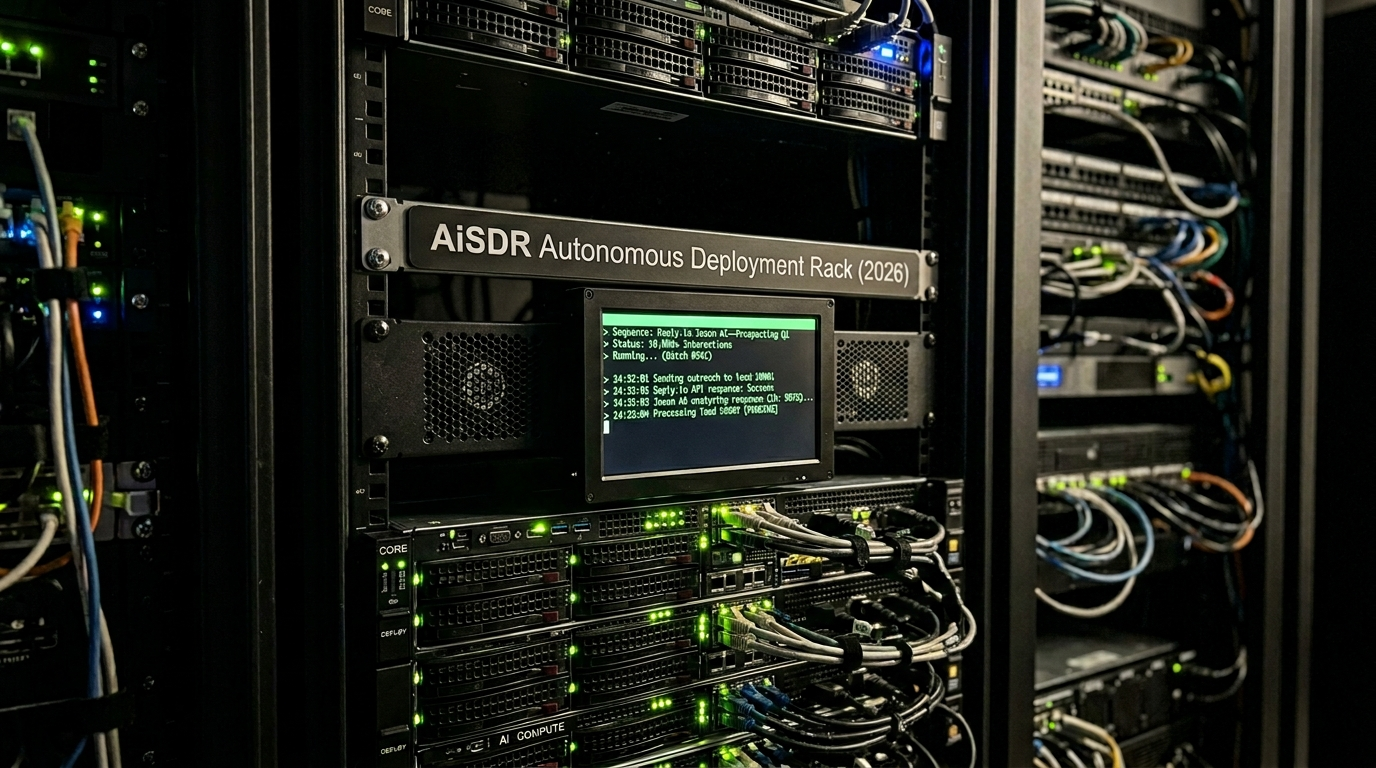
The Autonomous Agent Model
Most AI SDR tools follow the same basic architecture. They connect to a contact database (built-in or integrated), use AI to write personalized emails, automate email sequences and LinkedIn messages, handle replies with AI-generated responses, and attempt to book meetings on your calendar.
The pitch is compelling: replace a $100K+ SDR with a $500/month tool that works 24/7, never calls in sick, and sends thousands of personalized emails per week.
What AI SDRs Get Right
Volume and consistency. An AI SDR tool can research and contact far more prospects than a human can. It never forgets to follow up. Cost per send is extremely low. For teams that need pure volume against a broad total addressable market, the raw throughput is real.
Where AI SDRs Break
The problems show up fast, and they’re structural, not just bugs to fix.
Deliverability collapse. Research from Smartlead and Instantly shows that domains running AI SDR outbound at production volume drop sender reputation sharply within 90 days, with a median observed drop of 38 points on major reputation scales. Domain reputation collapse now caps 47% of attempted AI SDR deployments inside the first 90 days. Your emails stop reaching inboxes before you’ve had time to optimize.
Generic messaging. AI-generated emails at scale tend to sound like AI-generated emails at scale. Practitioners on Indie Hackers report that buyers have learned to recognize AI cold email inside the first sentence, and the detection rate is going up quarter over quarter. When your prospect can tell a bot wrote the email, you’ve already lost.
Autonomous reply rates are abysmal. Industry data points to 1 to 3% reply rates for fully autonomous AI SDR campaigns at production scale. Compare that to 8 to 15% for hybrid AI-plus-human approaches, and 14 to 25% for signal-based outbound layered on top of hybrid AI.
True costs are higher than advertised. The fully loaded cost of running a fully autonomous AI SDR (including data, infrastructure, warmup, oversight, and deliverability management) lands closer to $35K to $65K per year per agent than the $500/month most vendors advertise.
Churn tells the real story. AI SDR tools churn at 50 to 70% annually. More than half the companies buying these tools abandon them within a year. That’s not a product category thriving. That’s a product category burning through its market.
One founder who reviewed eight AI SDR services on Indie Hackers put it bluntly: “Pure-AI was the wrong era’s play.” The 2026 approach, in their view, is AI doing the volume work plus a real human doing the judgment and relationship work.
2026 Outbound Performance Benchmarks
| Metric | Autonomous AI SDR | AI-Powered Outbound (Hybrid) |
| Average Reply Rate | 1% – 3% | 8% – 15% |
| Signal-Based Reply Rate | N/A (Volume Focused) | 14% – 25% |
| Domain Reputation Drop | 38% (Avg. within 90 days) | <5% (Managed Infrastructure) |
| Annual Churn Rate | 50% – 70% | <15% (Systemic Approach) |
| Cost per Closed Deal | High (Low conversion) | Low (High quality/relevance) |
How AI-Powered Outbound Actually Works
The 90/10 Framework
The best way to think about AI-powered outbound is the 90/10 split. AI handles roughly 90% of the work: prospecting research, data enrichment, draft generation, infrastructure monitoring, sequence execution, and performance analysis. Humans handle the 10% that makes or breaks results: ICP definition, strategy, messaging approval, reply handling, and relationship building.
This isn’t a compromise. It’s an optimization. The components of an AI-powered outbound system typically include:
ICP definition and targeting (human-led, data-informed)
Data enrichment (AI-automated across multiple sources)
Domain and deliverability infrastructure (dedicated domains, warming protocols, reputation monitoring)
AI-personalized messaging (drafted by AI, reviewed and refined by humans)
Multi-channel execution (cold email and LinkedIn, orchestrated through a managed cold outreach system)
Continuous optimization (AI surfaces patterns, humans make strategic adjustments)
Why the System Approach Outperforms the Tool Approach
The performance gap is significant. Pods with one human SDR per two AI SDR seats book 1.9x more meetings per dollar than pure AI configurations, and 2.4x more than human-only configurations. Companies using AI to augment human SDRs see 2.8x more pipeline than companies attempting full replacement.
A practitioner writing on Medium captured why this happens: “AI doesn’t fix outbound. It amplifies whatever system you already have. If targeting is sharp and relevance is real, AI adds leverage. If the system is sloppy, AI helps you fail faster and more visibly.”
Deliverability is treated as a first-class discipline in AI-powered outbound systems, not an afterthought. Dedicated domains, proper warming, sender reputation monitoring, and volume controls are built into the architecture. This alone explains a huge portion of the performance difference, because an email that never reaches the inbox can’t generate a reply no matter how well it’s written.
If you’re thinking about how cold email structure fits into this picture, it matters more in a system approach because every message gets human attention before it goes out.
AI-Powered Outbound vs AI SDR: Side-by-Side Comparison
| Dimension | AI SDR (Product) | AI-Powered Outbound (System) |
|---|---|---|
| What it is | Software that replaces SDR tasks autonomously | Methodology using AI across the full outbound motion |
| Human involvement | Minimal, “set and forget” | Strategic, human judgment drives key decisions |
| Scope | Narrow: prospecting, email writing, sending, follow-up | Broad: ICP, infrastructure, data, messaging, deliverability, optimization |
| Deliverability | Often weak, shared infrastructure, reputation problems | Purpose-built with dedicated domains, warming, monitoring |
| Messaging quality | AI-generated at scale, often generic and detectable | AI-assisted but human-refined, higher relevance |
| Typical reply rates | 1-3% autonomous | 8-15% hybrid, 14-25% with signal-based targeting |
| True annual cost | $35K-65K fully loaded per agent | DIY stack: $2,400-6,000/yr; managed service: $36K-96K/yr |
| Best fit | High volume, low ACV, broad TAM, ops-mature team | Precision targeting, higher ACV, brand-sensitive, ongoing optimization |
| Annual churn | 50-70% | Lower (relationship and contract-based) |
The comparison between AI-powered outbound vs AI SDR comes down to this: one bets on full automation, the other bets on smart automation with human leverage.
When to Use an AI SDR Tool
An AI SDR can make sense in specific situations:
High-volume, low-ACV outbound. If your average deal size is under $25K and your ICP is broad, raw throughput might matter more than per-message quality.
Large total addressable market. When you’re targeting hundreds of thousands of potential accounts, the volume advantage of autonomous tools is real.
Your team has ops capacity. Someone needs to manage deliverability, monitor output quality, triage replies, and iterate. If you have that internal muscle, an AI SDR tool becomes more viable.
You’re testing a new market. A quick, high-volume spray into a new segment can help you learn whether there’s signal before investing in a full system.
Even in these cases, understand what you’re signing up for. As one comparison from Agentic Demand noted, “Most companies underestimate this. They think they’ll flip a switch and watch pipeline appear. In reality, you’re running a small operation.”
When to Use AI-Powered Outbound
AI-powered outbound is the stronger choice for most B2B teams, and especially when:
Deal sizes are meaningful. For ACV above $25K, the quality of your first touch directly impacts whether a deal ever starts. Generic AI emails won’t cut it.
Your ICP requires precision. If you’re targeting specific roles, industries, or company profiles, the research and targeting layers of an AI-powered system produce dramatically better results than a tool pointed at a broad list.
Deliverability is critical. If your domain reputation matters (and it does for virtually every B2B company), you need the infrastructure management that comes with a system approach.
Messaging quality affects brand perception. Every cold email you send is a brand impression. If prospects can detect it’s AI-generated, you’re making a negative impression at scale.
You don’t have internal outbound ops. If you want results without building and managing the system yourself, an outsourced outbound model that combines AI with human expertise is the path of least resistance.
For B2B SaaS founders and sales leaders comparing options, the AI-powered outbound vs AI SDR decision often comes down to whether you want to buy a tool and manage it, or partner with someone who runs the system for you.
Why Most Teams Need a System, Not Just a Tool
Here’s the pattern playing out across the industry in 2026: teams buy an AI SDR tool expecting pipeline. What they actually needed was a system. The tool handles one piece (sending emails), but pipeline depends on everything working together: targeting, data quality, deliverability, messaging, timing, and follow-through.
Data Quality Is the Hidden Variable
Lead411’s research highlights that the single most underestimated variable in outbound performance is data quality. An AI SDR with bad data just sends bad emails faster. An AI-powered outbound system treats data quality as a foundational layer, investing in enrichment, verification, and segmentation before a single email goes out.
Deliverability Is the Real Ceiling
You can write the best cold email ever crafted, and it won’t matter if it lands in spam. The deliverability challenge is why 47% of AI SDR deployments hit a wall in their first 90 days. In an AI-powered outbound system, deliverability isn’t something you hope works out. It’s engineered from day one with dedicated domains, proper warming sequences, volume controls, and ongoing reputation monitoring.
Understanding common cold emailing mistakes becomes even more important when AI is amplifying your output.
The Shift in Where AI Creates Value
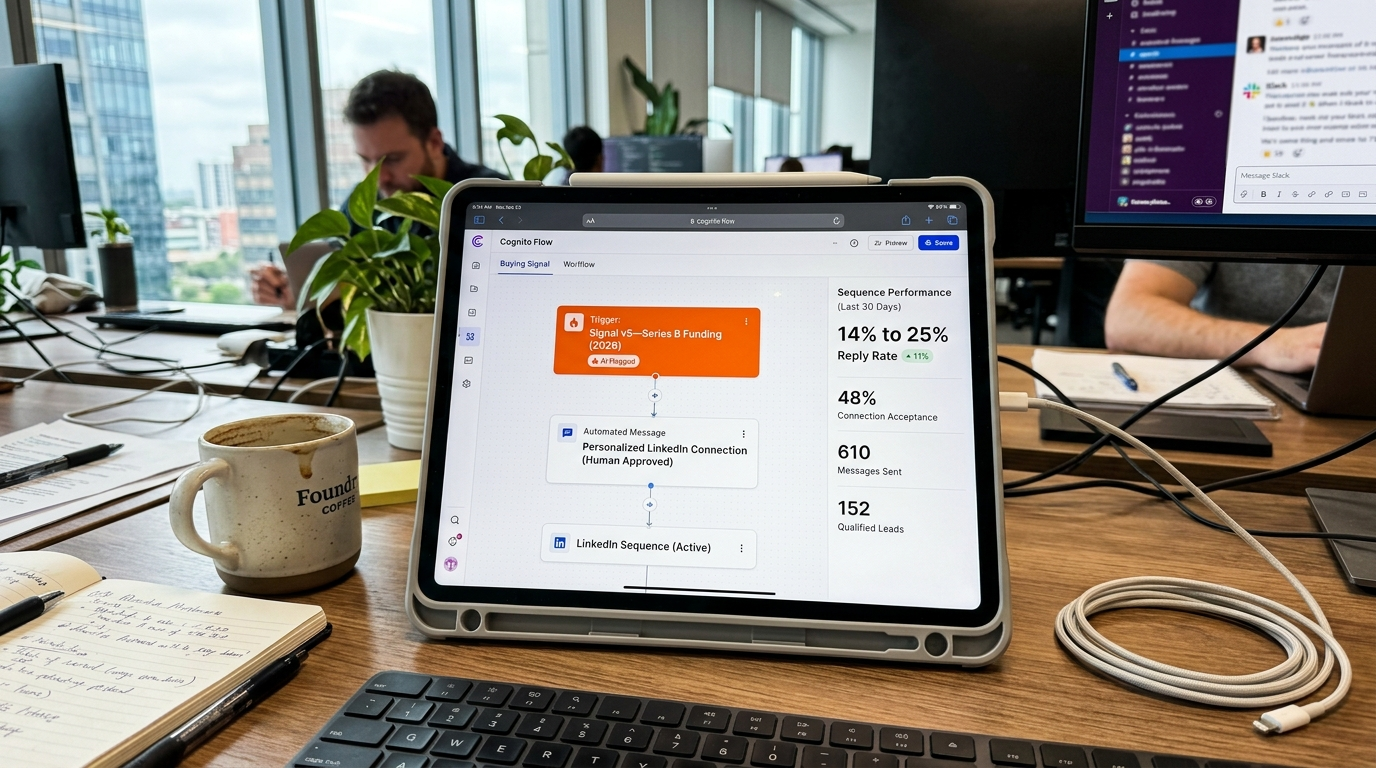
The entire value proposition of AI in outbound is shifting. As a Substack practitioner observed, “The entire value of AI in outbound is shifting from ‘write the email for me’ to ‘tell me who to email and why.’”
Signal-based outbound, where AI identifies buying signals and triggers that indicate a prospect is worth contacting right now, outperforms volume-based outbound by a factor of 2 to 3x. This is inherently a system-level capability. It requires integrating multiple data sources, building trigger-based workflows, and layering human judgment on top. No single AI SDR tool does this well on its own.
What This Looks Like in Practice
SalesPipe’s model is an example of AI-powered outbound in action. Rather than selling an autonomous AI tool, SalesPipe offers a founder-led outbound service where clients work directly with an experienced outbound operator. AI provides the scale (research, personalization, infrastructure management, workflow execution), and human expertise provides the strategy, quality control, and relationship building that makes the output actually work.
This is the hybrid model the data supports. Not AI replacing humans, and not humans ignoring AI, but AI amplifying human judgment.
If you’re evaluating whether to buy an AI SDR tool or invest in an AI-powered outbound system, start a conversation with SalesPipe to see what a founder-led approach looks like for your specific situation.
The Market Context
The AI SDR market hit $4.12 billion in 2025 and is projected to reach $15.01 billion by 2030, growing at a 29.5% CAGR. Over $400 million in venture capital has flooded into AI SDR startups in the last two years.
But adoption tells a more nuanced story. About 22% of sales teams have fully replaced SDRs with AI, and roughly 55% are piloting AI-augmented workflows. The majority are in hybrid mode, not going all-in on autonomous AI.
There’s a revealing cost stat worth noting: AI SDRs are 5.1x cheaper per meeting set but 1.5x more expensive per closed-won deal, because meeting-to-opportunity and opportunity-to-deal conversions both collapse on AI-only configurations. Cheaper meetings that don’t close aren’t cheaper at all.
This data reinforces the core argument of the AI-powered outbound vs AI SDR comparison: optimizing for volume (what AI SDR tools do) and optimizing for pipeline (what AI-powered outbound systems do) are different goals that produce different results.
Outbound Deliverability Checklist for 2026
To prevent the common 38% drop in domain reputation associated with autonomous AI bots, your system must include:
Dedicated Domains: Never send from your primary corporate domain.
Human-Lead Warming: Minimum 14-day gradual ramp-up for all new inboxes.
Inbox Rotation: Spreading volume across 10+ inboxes to stay under provider radar.
DMARC/SPF/DKIM: Properly configured technical authentication.
Spam Trigger Audit: AI-driven scanning of copy to remove "salesy" linguistic markers.