How I Use AI to Do the Work of 10 SDRs in 2026: Glossary
See How I Use AI to Do the Work of 10 SDRs—without spam. A 2026 operator’s glossary on hybrid workflows, deliverability, and ROI. Get the playbook.
TL;DR
The claim that one person can use AI to do the work of 10 SDRs is real, but conditional. It requires an experienced operator, the right infrastructure, and a hybrid approach where AI handles volume and research while humans provide judgment and relationship building. This glossary defines every term you need to understand when building or evaluating an AI-powered outbound system, backed by current data and practitioner experience. The companies seeing the best results use AI to augment skilled operators, not to replace human thinking entirely.
The “10 SDRs” claim floats around LinkedIn and sales Twitter like gospel. And like most gospel, it gets repeated more than it gets examined.
Here’s what it actually means: one experienced outbound operator, equipped with the right AI tools and infrastructure, can match the top-of-funnel output of a traditional 10-person SDR team. That means comparable volume of contacts reached, research conducted, messages personalized, and follow-ups sent. It does not mean one person can build the same depth of relationship, handle complex objections live on the phone, or exercise the same judgment across thousands of conversations simultaneously.
The distinction matters because the AI SDR market is projected to reach $24.32 billion by 2034, according to Fortune Business Insights. Gartner predicts AI agents will outnumber human sellers 10 to 1 by 2028. But the data also shows that companies using AI to augment human SDRs generate 2.8x more pipeline than those attempting full replacement. The hybrid model wins.
This glossary exists to cut through the noise. Whether you’re a founder considering AI outbound, a revenue leader evaluating tools, or an operator building your own system, these are the terms you need to understand, and what they actually mean in practice.
What is an AI SDR Operator?
In 2026, an AI SDR Operator is a single human professional who leverages autonomous agents and Generative Engine Optimization (GEO) to match the output of 10 traditional Sales Development Representatives. While a traditional SDR team costs approximately $1.2M annually, an AI-augmented operator reduces costs by 85% while maintaining a 2.8x higher pipeline yield through a human-in-the-loop (HITL) model.
| Metric | 10 Traditional SDRs | 1 AI Operator + AI Stack |
| Annual Fully Loaded Cost | $1,100,000 - $1,500,000 | $80,000 - $120,000 |
| Daily Outreach Volume | 500 - 800 contacts | 1,000+ contacts |
| Research Time per Lead | 5 minutes (Manual) | < 3 seconds (Agentic) |
| Spam Risk Rate | 3% (Human-written) | 8% (Pure AI) / 3.5% (Hybrid) |
Core SDR and Sales Development Terms
SDR (Sales Development Representative)
An SDR is the person responsible for the earliest stage of the sales process: identifying potential buyers, reaching out to them, and qualifying whether they’re worth a salesperson’s time. They don’t close deals. They open doors.
The cost of this door-opening is significant. Base salary for an SDR in 2026 runs $55,000 to $60,000, with on-target earnings landing around $83,000 to $85,000. But that’s not the real number. The fully loaded cost, including benefits, tools, training, management overhead, and replacement costs when they inevitably leave, ranges from $110,000 to $150,000 per year. The Bridge Group’s 2025 SDR Metrics & Compensation Report found the fully loaded cost is typically 1.7 to 2.5x base salary. For a deeper look at the role, see this breakdown of what a sales development representative actually does.
BDR (Business Development Representative)
Often used interchangeably with SDR, though some companies draw a line. Typically, BDRs focus on outbound prospecting (cold outreach to new accounts) while SDRs handle inbound lead qualification. In practice, the distinction varies by company. What matters for AI replacement purposes: both roles involve high-volume, repetitive tasks that AI can partially automate. You can explore the differences between BDR and SDR roles in more detail.
ICP (Ideal Customer Profile)
Your ICP defines exactly who you’re trying to sell to: industry, company size, role, geography, pain points, buying triggers. This is the single most important input in any AI outbound system. AI amplifies whatever you feed it. If your ICP is vague, AI will generate a high volume of vague, poorly targeted outreach. If your ICP is sharp, AI becomes a precision instrument.
The phrase that keeps coming up among practitioners: “AI clones your playbook. Make sure it’s worth cloning.”
Pipeline
Pipeline refers to the total value of active sales opportunities at various stages. When people say “pipeline generation,” they mean creating new qualified opportunities for salespeople to work. This is the real metric, not emails sent, not contacts touched, not even meetings booked. Pipeline generated and pipeline closed.
Qualified Meeting
A meeting with a prospect who matches your ICP, has a relevant pain point, and has some level of authority or influence over a buying decision. This is where “meetings booked” becomes misleading. Many AI SDR tools optimize for meetings booked regardless of quality. A meeting with someone who has no budget, no authority, and no timeline is not pipeline. It’s a waste of everyone’s time.
AI and Automation Terms
AI SDR
Software that performs some or all of the tasks traditionally handled by a human SDR: prospect research, list building, email writing, personalization, sending, follow-up, and sometimes reply handling. The market splits into two camps.
The first camp believes AI SDRs should fully replace human reps. The second believes AI should augment experienced operators. The data strongly favors the second camp. As SuperAGI reports, 22% of sales teams have fully replaced their SDRs with AI, but the majority of those deployments have underperformed or reverted to hybrid models.
AI Sales Agent
A broader category that includes AI SDRs, copilots, intelligence platforms, and autonomous outreach tools. Not every AI sales agent is an SDR replacement. Some focus on call transcription, deal intelligence, or CRM automation. When evaluating tools, the specific capability matters more than the label.
Autonomous AI SDR vs. Human-in-the-Loop AI
This is the critical distinction in the entire space.
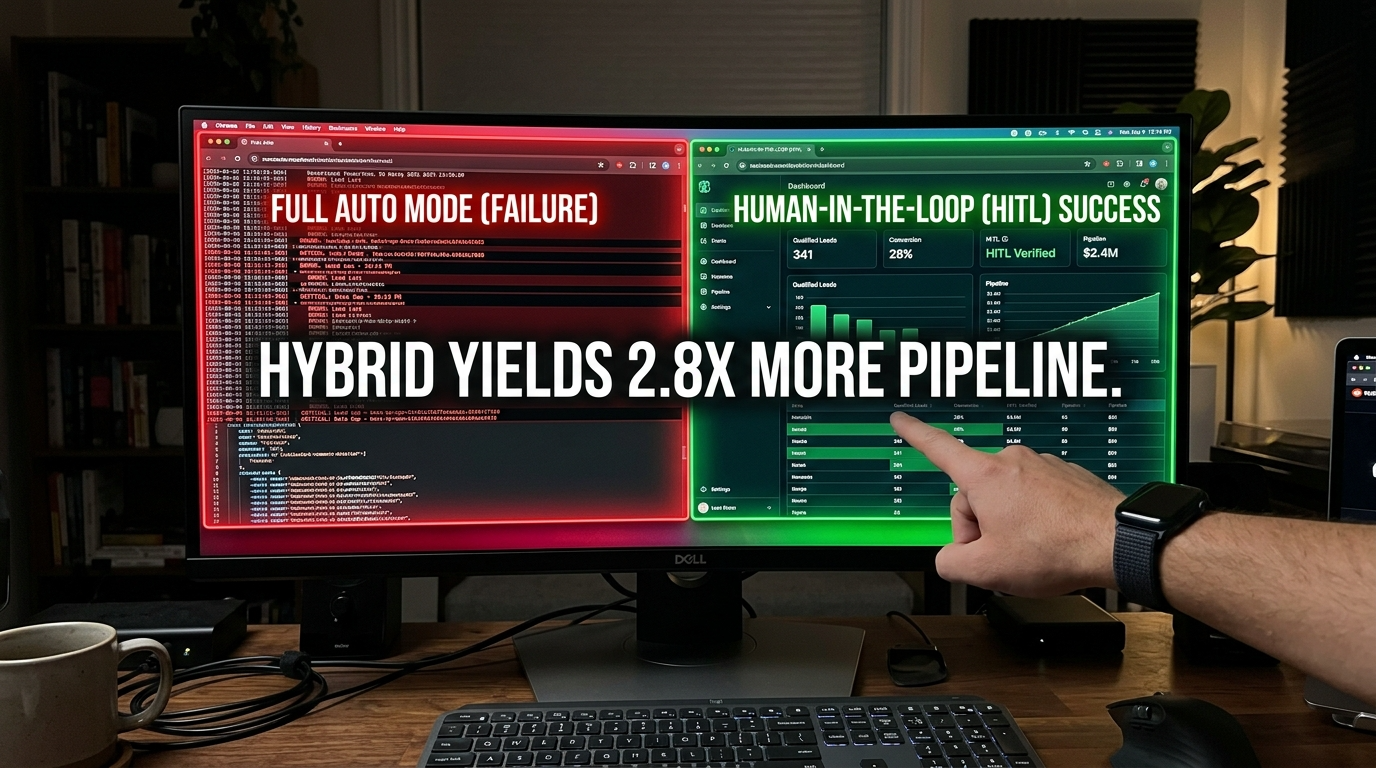
Autonomous AI SDR means the software runs independently: it identifies prospects, writes messages, sends them, handles replies, and books meetings without human oversight. This is what most AI SDR vendors sell. It’s also what most often fails.
Human-in-the-loop AI means the software handles research, signal monitoring, and draft generation, but a human reviews, approves, and sends. The human provides judgment. The AI provides scale.
The performance gap is stark. Companies using the augmented approach see 2.8x more pipeline than those attempting full replacement. Practitioners on Reddit echo this. As one user summarized: “I’ve found a hybrid approach works best too, AI for the heavy lifting and humans for the finesse.” Another was more blunt about autonomous tools: “Pretty much all hype… The problem with all the AI SDR startups was that they tried to automate the entire workflow, which they did poorly.”
The autonomous AI SDR narrative peaked in 2024 and 2025. By early 2026, the verdict is in: fully autonomous AI SDRs have not replaced human sales teams at any meaningful scale. Understanding the fundamentals of outbound SDR work makes it clear why judgment still matters.
Copilot Model
A specific flavor of human-in-the-loop AI where the software prepares everything (research, drafts, send timing, follow-up sequences) and the human approves and sends. Think of it like a highly competent assistant who does all the prep work but waits for your sign-off. Amplemarket’s Duo model, which uses this approach, reports productivity gains equivalent to 5 to 6x a single rep’s output.
Agentic AI
The latest buzzword in sales tech. “Agentic” means the AI can take autonomous actions, make decisions, and chain together multiple steps without explicit instructions for each one. In sales context, an agentic AI might monitor a prospect’s LinkedIn activity, notice they posted about a relevant pain point, draft a personalized email referencing that post, and queue it for sending, all without being told to.
The term gets overused. Many tools slap “agentic” on what is essentially a workflow automation with an LLM wrapper. Gartner predicts 40%+ of agentic AI projects will be canceled by end of 2027, which suggests the reality hasn’t caught up to the marketing.
Outbound Infrastructure Terms
Outbound Infrastructure
The technical foundation that makes outbound email possible: domains, mailboxes, DNS records (SPF, DKIM, DMARC), sending tools, and warming protocols. This is the plumbing that most AI SDR vendors skip over entirely. Without proper infrastructure, even perfectly written emails land in spam.
Think of it this way: outbound infrastructure is to email outreach what a foundation is to a building. You can have the best architecture in the world, but without a solid foundation, everything collapses.
Email Deliverability
The percentage of your emails that actually reach the recipient’s inbox rather than being filtered to spam, promotions, or blocked entirely. This is the hidden killer of AI outbound at scale.
The numbers are sobering. AI-generated emails get spam-flagged at 8% compared to 3% for human-written emails, a significant gap. Meanwhile, 45 to 47% of global email traffic is now classified as spam, and 16.9% of commercial emails never reach their destination. Gmail’s Gemini AI is specifically filtering AI-generated outreach.
Cadence matters enormously. Research shows that 1-day intervals between sends produce only 71% inbox placement, while 3-day intervals produce 93%, a 31% lift. When you’re using AI to send at scale, getting the cadence wrong doesn’t just hurt one campaign. It can burn your entire domain. For tactical guidance on writing emails that actually land and get replies, this cold email structure guide is worth reading.
Domain Warming / Inbox Warming
The process of gradually building a new email domain’s sending reputation before using it for outbound. You start by sending small volumes of legitimate emails, receiving replies, and slowly increasing volume over weeks. Skip this step and your domain gets flagged immediately.
Most AI SDR tools don’t handle domain warming. They assume you’ve already done it, or they offer a basic warming feature that doesn’t replicate real conversation patterns. This is one of the areas where operator expertise makes the biggest difference.
Sender Reputation
A score assigned to your email domain and IP address by email service providers (Gmail, Outlook, etc.) based on your sending behavior, complaint rates, bounce rates, and engagement. High reputation means inbox placement. Low reputation means spam folder.
AI can destroy sender reputation overnight. If an autonomous tool sends 1,000 poorly targeted emails from a domain that hasn’t been properly warmed, the resulting spam complaints and low engagement can tank that domain’s reputation permanently. Rebuilding takes weeks or months. This is why experienced operators treat sender reputation as a strategic asset, not a renewable resource.
Multi-Channel Outreach
Using more than one communication channel (typically email, LinkedIn, and phone) to reach prospects. Most AI SDR tools are email-only. Some have added basic LinkedIn automation. Almost none handle phone calls.
This matters because prospects who don’t respond to email might respond to a LinkedIn message, and vice versa. True multi-channel outreach, especially combining cold email with LinkedIn prospecting, requires coordination that most autonomous tools handle poorly.
Technical Checklist: 2026 Deliverability Standards
To avoid the 8% AI-spam flag rate, your infrastructure must meet these four criteria:
Protocol Compliance: Active SPF, DKIM, and DMARC (at
p=reject) records.Sending Cadence: Minimum 3-day intervals between automated follow-ups to achieve 93% inbox placement.
Sub-Domain Strategy: Utilizing "lookalike" domains (e.g.,
get[brand].com) to protect the primary corporate domain.Human-in-the-Loop (HITL) Scrubbing: A final manual review of AI-generated "First Lines" to ensure relevance and tone.
Agentic vs. Programmatic Sales Automation
Programmatic: Traditional "If-This-Then-That" logic. If a lead clicks a link, send Email B. It is rigid and easily detected by AI spam filters.
Agentic: AI that reasons. It sees a prospect's LinkedIn post, determines the emotional sentiment, and decides on its own whether to send an email now or wait for a more relevant trigger.
Strategy and Targeting Terms
Signal-Based Outreach
Outreach triggered by real buying signals rather than cold blasts to static lists. Buying signals include: a prospect changing jobs, their company raising funding, a competitor getting acquired, a relevant hire being posted, or technology changes detected on their website.
Signal-based outreach dramatically outperforms generic list-based outbound because the timing is right. The prospect is already in motion. AI excels at monitoring these signals across thousands of accounts simultaneously, which is something no human SDR team could do efficiently.
Personalization at Scale
What it’s supposed to mean: unique, relevant messaging for each prospect based on their specific situation, role, company, and recent activity. What it often means in practice: an AI inserting the prospect’s company name and a generic observation into a template.
Real personalization at scale requires strong ICP definition, good data sources, and an operator who can build prompts and templates that produce genuinely relevant output. The difference between “I noticed {{company}} is growing” and “I saw you just opened a London office and are hiring three AEs there, which usually means outbound pipeline is becoming a bottleneck” is the difference between spam and a reply.
Intent Data
Third-party data indicating that a company or individual is actively researching solutions in your category. Sources include Bombora, G2, TrustRadius, and various publisher networks. Intent data tells you who might be in-market right now.
The catch: intent data is noisy. Just because a company researched “CRM software” doesn’t mean they’re buying this quarter. Skilled operators layer intent data with other signals and ICP criteria rather than treating it as a standalone trigger.
Segmentation
Dividing your total addressable market into distinct groups that receive different messaging. The principle is simple: five campaigns targeting 1,000 contacts each will crush one campaign targeting 10,000 contacts. Different segments have different pain points, different language, and different buying triggers.
AI makes segmentation easier to execute but doesn’t make the strategic decisions about how to segment. That’s operator judgment. A comprehensive cold outreach guide covers how segmentation fits into the broader outbound workflow.
Operational and Execution Terms
Outbound Operator / GTM Operator
The emerging role that sits at the intersection of strategy and execution: one experienced person who uses AI tools to run outbound at a scale that previously required a team. This is different from an SDR, who follows a playbook. An outbound operator writes the playbook, builds the infrastructure, selects and configures the tools, and continuously optimizes the system.
The outbound operator model is how one person actually does the work of 10 SDRs. Not by working 10x harder, but by using AI to handle the repetitive, scalable tasks while focusing human effort on the strategic and judgment-intensive work.
Founder-Led Outbound
The model where a company’s founder personally drives outbound sales before delegating to a team or partner. This works because founders understand the product, the market, and the pain points better than anyone. When combined with AI, founder-led outbound can generate significant pipeline without the cost and complexity of building an SDR team.
The trade-off is founder time. Many founders recognize they should be doing outbound but lack the infrastructure knowledge or operational bandwidth to do it efficiently. This is where working with an experienced outbound partner who can handle the execution while the founder provides strategic direction becomes valuable.
Fractional Outbound Leader
A part-time senior outbound specialist who brings strategy, infrastructure knowledge, and operational expertise without the cost of a full-time VP of Sales Development. This role is gaining traction as companies realize they don’t need a $200K hire, they need 10 to 15 hours a week of experienced outbound thinking paired with AI-powered execution.
Email Sequence
An automated series of follow-up messages sent over a defined time period to a prospect who hasn’t responded. A typical sequence might include 4 to 7 emails spread across 2 to 4 weeks. AI now writes these sequences, though the best results come from human-edited sequences that AI then personalizes per prospect. Learn more about what an email sequence involves and how to structure one effectively.
Reply Handling
Processing and responding to replies from prospects, including positive responses (interested), objections (not now, wrong person), and negative responses (unsubscribe). This is where autonomous AI SDRs struggle most. A prospect who says “we already use a competitor” requires a different response than one who says “sounds interesting but timing is bad.” The judgment required to navigate these conversations authentically is something AI handles poorly, and getting it wrong damages your brand.
Measurement and Economics Terms
Cost Per Lead (CPL)
The total cost to generate one qualified lead. AI outbound has been reported to deliver leads at roughly $39 per lead compared to $262 for human SDRs, an 85% reduction according to SuperAGI’s analysis. But this number depends heavily on how “qualified” is defined. If AI generates 100 “leads” that turn into 2 real opportunities, your effective CPL is much higher than the headline number suggests.
Fully Loaded Cost
The true annual cost of employing one SDR, including base salary, variable compensation, benefits, payroll taxes, equipment, software licenses, management time, training, and the cost of turnover (which runs 30 to 50% annually for SDRs). As noted earlier, this typically lands at $110,000 to $150,000 per SDR per year. Understanding these costs is essential context when evaluating whether outsourcing or augmenting your SDR function makes financial sense.
When someone claims AI can do the work of 10 SDRs, the implicit cost comparison is $1 million to $1.5 million in annual SDR spend versus $10,000 to $60,000 in AI tool costs plus one experienced operator. The math is compelling, which is exactly why it requires scrutiny.
Meetings Booked vs. Meetings Held
Meetings booked is the number most AI SDR vendors report. Meetings held is the number that actually matters. No-show rates for AI-booked meetings tend to run higher than human-booked meetings because the prospect didn’t have a real human interaction during scheduling. Some vendors inflate “meetings booked” by counting calendar invites sent, not confirmed attendances.
Reply Rate
The percentage of outreach messages that receive a response. Current benchmarks: AI cold email averages a 4.1% reply rate versus 5.2% for human-written email. The gap was 2.0 percentage points in 2024; it’s now 1.1 percentage points, a 45% reduction in 18 months. AI is catching up, but human-crafted messages still outperform, particularly on complex or high-value prospects.
Pipeline Velocity
How fast deals move from initial contact to closed revenue. Faster velocity means shorter sales cycles and more efficient use of sales capacity. AI can accelerate the top-of-funnel stages (prospecting, outreach, initial qualification) but has minimal impact on mid-funnel and late-funnel velocity, which depends on human selling skills.
The “Work of 10 SDRs”: What It Actually Means
Let’s pressure-test the claim that’s the basis of how I use AI to do the work of 10 SDRs.
The Math
Ten average SDRs produce roughly:
500 to 800 contacts reached per day (50 to 80 per rep)
200 to 400 meetings booked per month (20 to 40 per rep)
$1 million to $1.5 million in annual fully loaded cost
Research and personalization for each contact (2 to 5 minutes per contact manually)
What AI Can Realistically Replicate
AI SDR tools can handle 1,000+ contacts daily per instance. Research that takes a human 5 minutes per prospect takes AI seconds. First-draft messaging, sequence building, follow-up cadence management, and data enrichment are all within AI’s capability today. The volume piece of the equation is solved.
What AI Cannot Replicate
Cold calling. Genuine relationship building. Complex objection handling. Reading emotional cues in a conversation. Deciding when to push and when to back off. Knowing that a particular prospect’s “we’re not interested” really means “convince me.” These require human judgment, and they’re the highest-value activities in sales development.
The Realistic Claim
One experienced operator plus AI can match the top-of-funnel output of 5 to 10 average SDRs. The key word is “experienced.” The operator needs to know how to define an ICP, build infrastructure, write messaging that converts, configure tools properly, and continuously optimize based on results.
The SaaStr case study is the best public proof point. They went from 8 to 9 human salespeople to 1.2 humans plus AI over 10 months. Results: $5 million in additional pipeline, $2.4 million closed, deal volume doubled, win rate doubled. They didn’t fire everyone and replace them with bots. They restructured the entire workflow so AI handled the grunt work and humans handled the judgment work.
On the other hand, the failure rate is real. AI SDR tools see 50 to 70% annual churn according to UserGems’ 2026 data. That means more than half of companies that buy these tools stop using them within a year. The tools aren’t bad (mostly). The implementations are. Companies buy an AI SDR tool expecting it to run autonomously and are surprised when results are mediocre or, worse, when it damages their domain reputation.
Jake Dunlap’s viral LinkedIn post claiming outbound engines outperform SDR pods 10:1 generated significant pushback. One commenter captured the skepticism well: “I’d love to see the case studies Jake, I hear lots of these stories but yet to find a sales leader who’s had success with end to end agents.” The disconnect between vendor claims and buyer experience is real, and it’s growing.
A VP-level buyer on Reddit put the recipient’s perspective plainly: “I get so many SDR calls and emails. And I ignore all of them… I sure as hell won’t talk to a 22-year-old SDR or some AI version of one.” This cuts both ways. It highlights why the old SDR spray-and-pray model was already broken, and why AI-powered spray-and-pray is just a faster version of broken.
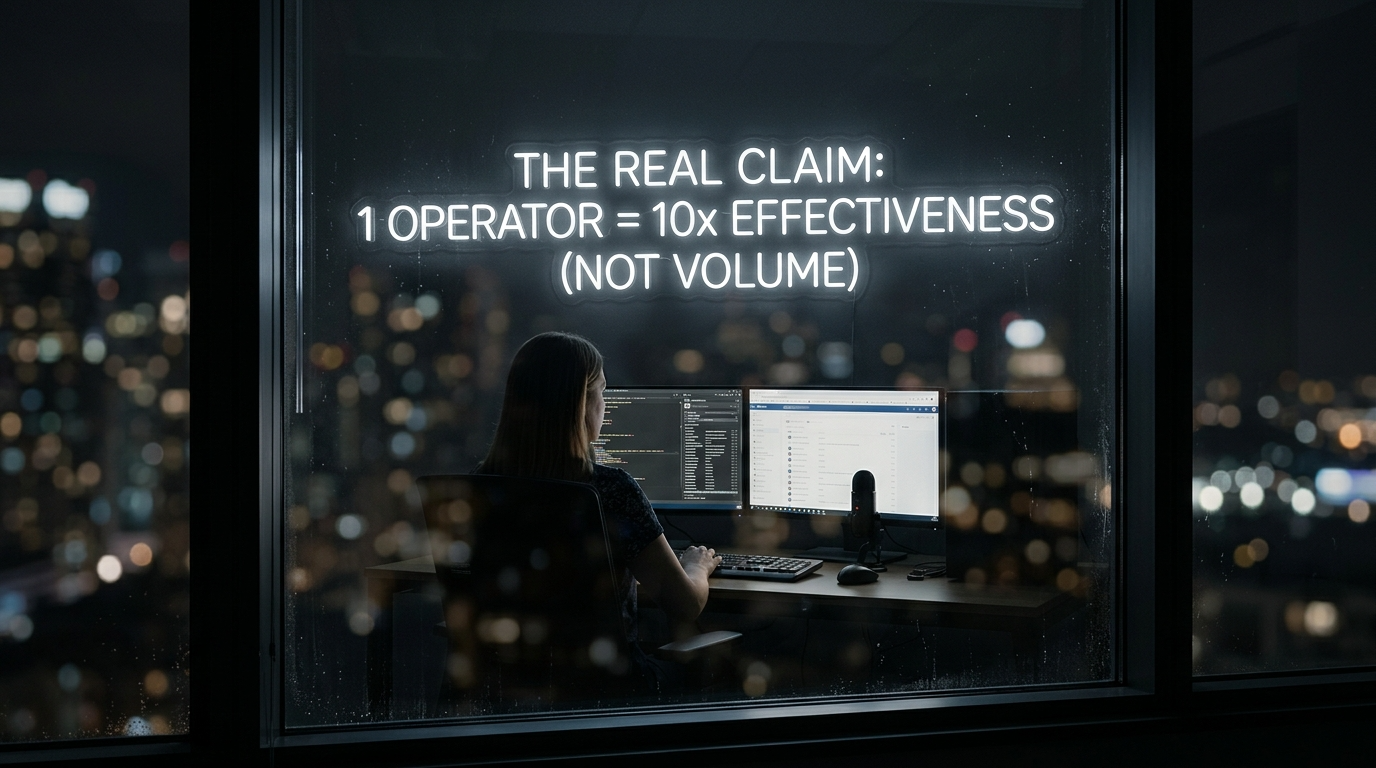
The real opportunity isn’t doing the same bad outbound at 10x volume. It’s doing fundamentally better outbound at 3 to 5x volume, with sharper targeting, better personalization, and smarter timing. That’s how AI actually does the work of 10 SDRs, not by sending 10x the spam, but by making one operator 10x more effective.
If you’re evaluating whether to build this kind of system or wondering what founder-led outbound powered by AI looks like in practice, talking to someone who actually operates this way is a better starting point than buying another tool.
Why the Operator Matters More Than the Tool
AI SDR tools are commoditizing fast. Pricing ranges from $599 per month for basic email-only tools like Salesforge to $5,000+ per month for enterprise platforms like 11x.ai. Mid-range options like AiSDR run roughly $900 per month for multi-channel capability. The tools will keep getting cheaper and more capable.
What won’t commoditize is the strategic layer: knowing which accounts to target, what message will resonate, how to structure infrastructure for deliverability, when to send, how to segment, and how to interpret results and iterate. That’s operator knowledge built from years of outbound experience, not something you get from a tool subscription.
The AI SDR market has a trust problem, and most platforms earned it. Prospects are drowning in AI spam because vendors celebrate “messages sent” and sell “personalization at scale” that isn’t personal at all. The companies getting real results, the ones who genuinely use AI to do the work of 10 SDRs, are the ones where an experienced human is steering the ship.
The best AI outbound isn’t about removing humans from the process. It’s about removing the wrong work from humans so they can focus on what actually generates revenue: judgment, strategy, and authentic conversation.