How to Scale Outbound Without Hiring SDRs: 2026 Playbook
Learn how to scale outbound without hiring SDRs: build an AI-assisted system with sharp ICP, clean data, deliverability, and oversight. Act now.
TL;DR
Scaling outbound without hiring SDRs means replacing the traditional “more reps, more pipeline” model with a system built on ICP clarity, clean data, AI-assisted research, deliverability infrastructure, and senior human oversight. AI is useful, but only after the strategy is already working. The companies that scale outbound successfully are not the ones sending the most messages. They are the ones that combine sharp targeting, strong infrastructure, and a tight learning loop, all owned by someone senior enough to make real decisions.
Direct Answer: How to Scale Outbound Without SDRs
Scaling outbound without SDRs involves replacing manual labor with a senior-led system that integrates five core pillars:
Signal-Based Prospecting: Using triggers (funding, hires) rather than static lists.
Deliverability Infrastructure: Multi-domain setups to bypass 2026 SPAM filters.
AI-Assisted Research: Automating account deep-dives and "first-line" drafts.
Clean Data Enrichment: Real-time verification to keep bounce rates below 0.3%.
Senior Oversight: A "GTM Engineer" or Founder managing the system instead of junior reps.
The Takeaway: In 2026, outbound success is a systems-design problem, not a headcount problem.
What Does It Mean to Scale Outbound Without Hiring SDRs?
Scaling outbound without hiring SDRs means increasing outbound pipeline, qualified replies, and booked meetings without adding a traditional sales development team. Instead of hiring more junior reps to prospect manually, companies use a combination of ICP strategy, data systems, AI-assisted research, outbound automation, deliverability infrastructure, multi-channel outreach, and senior human oversight to create more pipeline from fewer people.
Put simply: you stop treating outbound as a people-count problem and start treating it as a system-design problem.
In one sentence: to scale outbound without hiring SDRs is to build a repeatable outbound engine where technology and a senior operator handle the repetitive work, while humans focus on strategy, buyer conversations, and conversion.
What It Does Not Mean
This concept gets misused constantly, so it is worth being direct about what scaling outbound without SDRs is not:
Blasting more cold emails with an automation tool
Letting an AI SDR run unsupervised
Skipping ICP work because “the tool handles targeting”
Buying a list and sequencing everyone on it
Outsourcing all judgment to software
Ignoring deliverability because volume will make up for it
SaaStr’s team reported strong results from AI agents after six months of deployment, but they also emphasized that AI SDRs require significant human oversight, cannot fix broken outbound, and need proven messaging and clear processes before they can scale. Their Chief AI Officer spent 30% of her time on agent management alone. SaaStr’s firsthand AI SDR report is one of the most honest assessments available.
Related Terms
Outbound scaling: Increasing outbound pipeline output without proportionally increasing manual labor.
AI SDR: Software or agentic system that performs early-stage sales development tasks. IBM defines AI SDRs as systems that identify prospects, engage leads, qualify opportunities, and pass them to human sales teams.
Founder-led outbound: Outbound run or closely guided by a founder or senior operator.
Outbound operator: A specialist who owns targeting, infrastructure, messaging, and execution.
GTM engineer: A technical GTM role focused on data, systems, automation, and workflow orchestration.
Deliverability: The ability of outbound emails to reach the inbox rather than spam or promotions.
For a deeper look at what the traditional SDR function actually involves, see this breakdown of what an outbound SDR does.
Why Companies Want to Scale Outbound Without SDR Headcount
The old playbook was simple: need more pipeline, hire more SDRs. That model has real problems.
It is slow. Recruiting takes weeks or months. Onboarding takes more. Ramp to full productivity can stretch to six months for complex B2B products.
It is expensive. The average U.S. SDR salary is $63,201 per year as of April 2026, according to Salary.com. Add benefits, tools, management overhead, and office costs, and the fully loaded cost per SDR climbs well above six figures.
It wastes talent on repetitive work. Salesforce’s 2026 State of Sales data shows that sellers spend only 40% of their time actually selling, with the rest consumed by admin, research, CRM updates, and internal coordination. Gen Z sellers spend just 35%. Sellers themselves expect AI agents to reduce prospect research time by 34% and email drafting by 36% once fully implemented. Salesforce’s 2026 report makes the productivity gap hard to ignore.
It asks junior people to solve senior problems. Most companies expect SDRs to handle ICP interpretation, account research, copywriting, deliverability, objection handling, and CRM management all at once. That is asking an entry-level hire to do the work of a strategist, a data analyst, a copywriter, and a systems operator simultaneously.
Output varies wildly. Two SDRs with the same tools and territory will often produce completely different results, because the role depends heavily on individual judgment, motivation, and coaching quality.
None of this means SDRs are useless. It means the old model often wastes SDR time on tasks that systems can handle, while underinvesting in the strategic work that actually requires human thinking.
The Old Model vs. the No-SDR Outbound Model
| Dimension | Traditional SDR Scaling | No-SDR Outbound Scaling |
|---|---|---|
| Primary lever | Add reps | Improve system leverage |
| Core cost | Salary, ramp, management | Operator, tools, infrastructure |
| Speed to first results | Months to hire and ramp | Days to weeks to test (longer to optimize) |
| Main risk | Rep underperformance and turnover | Bad inputs scaled too fast |
| Best use | Complex human conversations, discovery, qualification | Research, data, sequencing, follow-up, coverage |
| Required human role | SDR manager | Senior outbound system owner |
| Scaling constraint | Headcount and budget | ICP quality, data, deliverability, message fit |
IBM’s comparison of AI SDRs and human SDRs reinforces this split: AI handles structured, repeatable, data-driven tasks well, while humans remain stronger in judgment, adaptability, emotional intelligence, and complex conversations. IBM’s analysis is balanced and worth reading if you are weighing these tradeoffs.
What Actually Replaces SDR Headcount
This is the practical core of how to scale outbound without hiring SDRs. The answer is not one tool or one tactic. It is a system with six layers.
1. A Sharper ICP
Automation without ICP clarity creates spam. Every no-SDR outbound model starts with defining, in specific terms, who you are trying to reach and why they should care right now.
A practical ICP includes:
Target segment and company size
Industry and geography
Role and seniority of the buyer
The specific pain your product solves
Buying triggers (what makes this relevant now)
Disqualifiers (who to explicitly exclude)
Practitioners on HeyReach put it bluntly: “no automation platform can fix a bad list.” Their guidance emphasizes that lists must be mapped to ICP before sequencing, because automation amplifies whatever you feed it, good or bad.
2. Signal-Based Prospecting
Traditional outbound sprays messages at a static list. Signal-based prospecting watches for triggers that indicate a prospect might actually be ready to buy:
Recent funding rounds
Leadership changes
New job postings that suggest a relevant initiative
Tech stack changes
Product launches or expansions
Regulatory shifts affecting their industry
Competitor activity
Intent signals from content consumption or community conversations
The goal of scaling outbound without SDRs is not to reach more people. It is to reach the right people at the right time. Signals make that possible.
3. Clean Data and Enrichment
Build lists from defined segments. Enrich them with firmographic and role data. Verify email addresses. Deduplicate. Remove bad fits. Tag by source and campaign.
This sounds boring. It is also the difference between a 4% positive reply rate and a 0.3% one.
HeyReach’s practitioners use the phrase “quality in, quality out” repeatedly, and it is the right framing. AI and automation do not fix bad data. They multiply it.
4. Deliverability Infrastructure
This is the most overlooked part of outbound scaling, and it kills more campaigns than bad copy ever will.
Since February 2024, Google requires senders of 5,000+ messages per day to Gmail accounts to authenticate outgoing email, avoid unsolicited messages, and make it easy to unsubscribe. Bulk senders with a user-reported spam rate above 0.3% are ineligible for mitigation. Yahoo’s sender requirements enforced similar List-Unsubscribe policies starting June 2024.
The FTC’s CAN-SPAM compliance guide spells out requirements around sender identity, subject lines, and opt-out rights, with penalties of up to $53,088 per violation.
A proper deliverability infrastructure includes:
Separate sending domains configured appropriately
DNS authentication: SPF, DKIM, DMARC
Mailbox setup and warmup
Sending volume controls
Bounce management
Unsubscribe handling
Spam complaint monitoring
Inbox placement testing
List verification before every campaign
Domain reputation monitoring
Gradual volume scaling
One LinkedIn practitioner from Momentum Outbound argued that teams often blame copy or targeting when the real issue is deliverability and infrastructure. They recommended domain diversification, deliverability testing before scaling, and constant monitoring. If your emails are not reaching inboxes, nothing else matters.
For a deeper walkthrough of cold email mechanics, the cold outreach guide covers tactical setup in more detail.
5. AI-Assisted Research and Personalization
AI should handle:
Summarizing account context
Detecting relevant triggers
Drafting first-line personalization
Suggesting pain-based angles
Clustering accounts by similarity
Generating message variants for testing
Classifying replies by intent
AI should not own unsupervised:
Final positioning and offer clarity
Complex objection handling
Compliance decisions
High-value buyer conversations
Strategic account prioritization
The distinction matters. SaaStr reported that their AI SDR agents sent 3,000 emails per month compared with 75 to 285 from previous human reps, achieved a 4% positive response rate, and contributed to over $2.5M in pipeline. But they also reported that their first 1,000 emails needed manual review, and the team budgeted 30 to 60 minutes per day for every two or three agents.
AI is powerful when the inputs are strong. When the inputs are weak, it scales the mess.
6. Multi-Channel Execution
Scaling outbound without hiring SDRs is not just an email problem. Effective campaigns combine:
Cold email for initial outreach and follow-up sequences
LinkedIn for connection requests, profile views, and direct messages
Phone for high-intent signals or strategic accounts
Founder social proof through content and personal brand
For teams running LinkedIn as a channel, this guide on LinkedIn prospecting covers the fundamentals.
Understanding how to build effective email sequences is also essential, because follow-up timing and logic are where most outbound campaigns either compound or collapse.
7. Senior Human Oversight
This is the piece that AI SDR vendors consistently understate.
If you do not hire SDRs, you still need someone to own the system. That person might be a founder, a GTM engineer, a fractional outbound leader, or an experienced operator. But someone with real judgment has to sit at the center.
SaaStr’s team spent 15 to 20 hours per week managing five AI SDR agents. They recommended waiting 60 to 90 days before judging whether a new agent is working. That is not “set and forget.” That is a real operational commitment.
Practitioners on Reddit report a similar pattern. One user in r/startups said their AI BDR tools “kind of worked,” but only after they stopped treating them as autonomous. Their failure points were bad ICP definition, unclear triggers, and emails that felt “generic but customized.”
| Category | Tool Types | Purpose |
| Data & Signals | Clay, Apollo, Keyplay | Automating ICP research & triggers |
| Infrastructure | MailReach, Instantly, Smartlead | Domain warmup & inbox rotation |
| AI Personalization | Lavender, Writer, OpenAI API | Drafting context-aware outreach |
| Workflow | Zapier, Make.com | Connecting the "Leads to CRM" loop |
What to Automate vs. What to Keep Human
| Outbound Task | Automate? | Why |
|---|---|---|
| Basic enrichment | Yes | Repetitive and data-heavy |
| Email verification | Yes | Protects deliverability |
| Trigger monitoring | Yes | Machines can watch large markets continuously |
| First research summary | Yes | Speeds account prep |
| First-draft copy | Partially | Useful as a starting point, but needs human quality standards |
| ICP definition | No | Strategic decision requiring market understanding |
| Offer and positioning | No | Requires clarity only the founder or senior operator has |
| Final campaign QA | No | Brand and relevance risk |
| High-intent replies | Human-led | Requires judgment and context |
| Objection handling | Hybrid | AI can suggest responses, but important objections need a real person |
| Meeting qualification | Hybrid | AI can route, humans should review quality |
| Campaign iteration | Human-led | Requires reading market signal from replies |
Five Models for Scaling Outbound Without SDRs
Most content on this topic collapses the answer into “buy an AI SDR platform.” The reality is more nuanced. There are at least five distinct models, and the right one depends on your stage, budget, and how much strategic control you want.
| Model | Best For | Strength | Weakness |
|---|---|---|---|
| Founder-led outbound | Early teams validating market | Fast learning, credibility, direct buyer feedback | Founder bandwidth limits scale |
| AI-assisted founder-led outbound | Founders who have ICP clarity and want efficiency | Research speed, message variants, follow-up hygiene | Still constrained by founder time |
| Outbound operator / consultant | Teams wanting senior execution without SDR hires | Strategy plus execution plus AI plus accountability | Depends on operator quality |
| AI SDR platform | Teams with proven ICP and proven messaging | Scale, consistency, always-on coverage | Requires oversight, training, clean data |
| Hybrid: one GTM engineer plus AI | Companies building lightweight internal capability | Control plus system leverage | Needs the right hire |
A practitioner on LinkedIn argued that the old generalist SDR model is being replaced by two specialist roles: GTM engineers who manage infrastructure, enrichment, deliverability, and systems, and conversation specialists who handle calls and objections. This “role decomposition” trend shows up repeatedly in community discussions.
On Reddit, a similar pattern emerges. One user in r/b2bmarketing argued that SDRs are not being replaced by AI wholesale. Instead, the repetitive work is being handed to one person who knows how to manage systems and use AI effectively, often reframed as a GTM engineer.
For teams evaluating whether outsourced SDRs actually work, the distinction between traditional SDR agencies and this operator model is important. A traditional agency replaces internal SDR headcount with external SDR labor. A no-SDR outbound model replaces manual labor with a senior-led system.
When Scaling Without SDRs Works Best
Good fit:
B2B SaaS or tech company with clear ACV and repeatable buyer pain
Founder-led or lean team that needs pipeline before building a full sales org
Company has customer proof or a validated use case
Team knows its ICP or can define it quickly
Target audience is large enough to sustain outbound
Deal value supports the effort
Someone senior can own messaging and reply handling
Poor fit:
No clear ICP or buyer pain
Very small total addressable market
Low ACV where outbound economics do not work
Nobody available to handle replies or run discovery
No budget for infrastructure, tooling, or iteration
The company wants fully hands-off lead generation with zero involvement
A practitioner on Reddit made an important point about timing: early-stage outbound should be used for learning, not just booking meetings. They argued that founders who personally send the first 50 to 100 emails, read every reply, and iterate weekly over six to eight weeks get far better signal before automating. Using AI too early can “automate away the learning signal.”
Luke Shalom echoed this on LinkedIn, arguing that founders should first define ICP, interview their best clients, identify the core business issues, choose a data source, and build lookalike lists before layering AI into outbound.
The takeaway: if you have not validated ICP and message-market fit, do not start with an AI SDR. Start with founder-led or expert-led outbound. Then automate what works.
The Risks of Scaling Outbound Without SDRs
Honesty about risks is what separates a useful guide from a sales pitch.
Risk 1: Scaled Spam
Bad targeting plus automation equals faster brand damage. When you scale outbound without hiring SDRs, you can destroy your domain reputation in days instead of months if the inputs are wrong.
Risk 2: Burned Domains and Poor Deliverability
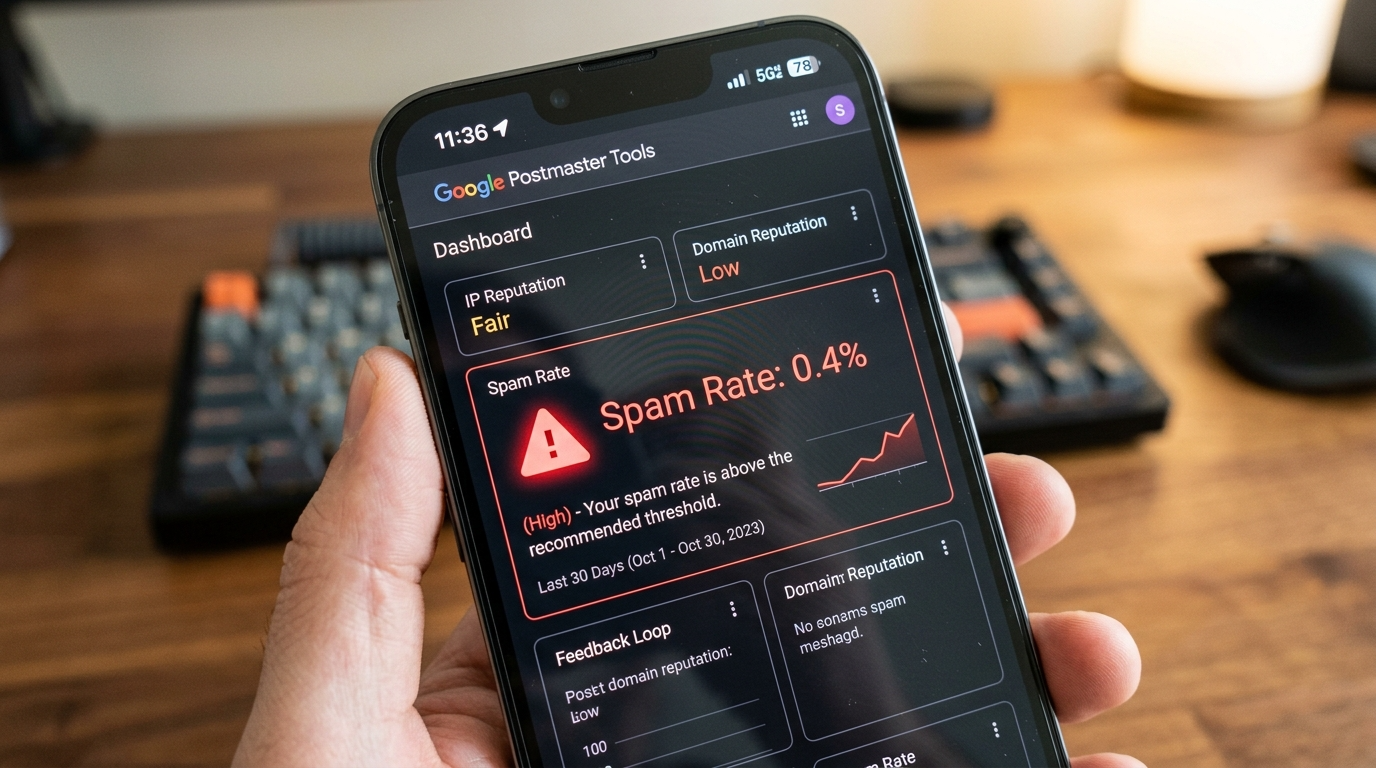
Careless sending practices tank inbox placement. Google and Yahoo’s sender requirements make authentication, unsubscribe handling, and spam-rate control non-negotiable for anyone sending at volume. Getting this right requires ongoing attention, not a one-time setup. Good cold email structure matters, but it is worthless if the email never reaches the inbox.
Risk 3: Generic AI Copy
AI-generated personalization can look personalized while still feeling generic. Reddit users and practitioners repeatedly complain about emails that reference their company name and a recent blog post but say nothing relevant about their actual problems. The “personalization” is cosmetic. The message is still a template.
Risk 4: No Learning Loop
If AI handles replies but nobody studies them, you lose the best signal in outbound. Every reply, positive or negative, is data about what the market thinks of your offer, your timing, and your targeting. If nobody reads that data, outbound stops improving.
Risk 5: Tool Sprawl
Too many tools create broken handoffs, bad data, and confusing ownership. Monday highlights the hidden costs of disconnected sales tools: data inconsistencies, workflow gaps, training overhead, and integration maintenance problems.
Risk 6: Compliance Mistakes
CAN-SPAM violations carry penalties of up to $53,088 per email. Getting sender identity, subject lines, and opt-out handling wrong is not just a deliverability problem. It is a legal one.
Pro Tip: As of 2026, Google and Yahoo enforce a 0.3% spam threshold. Automated systems must include an "auto-pause" feature if bounce rates spike, or you risk permanent domain blacklisting.
Metrics to Track When You Scale Outbound Without SDRs
Activity metrics like “emails sent” and “open rate” tell you almost nothing about pipeline health. Here is what actually matters:
| Metric | Why It Matters |
|---|---|
| Positive reply rate | Shows whether message and ICP are resonating |
| Qualified meeting rate | Separates activity from real pipeline |
| Meeting-to-opportunity conversion | Reveals meeting quality |
| Opportunity-to-close conversion | Proves outbound revenue quality |
| Pipeline generated by segment | Shows where to concentrate |
| Cost per qualified meeting | Compares no-SDR model to SDR hiring |
| Cost per opportunity | Better than cost per lead |
| Bounce rate | Protects deliverability |
| Spam complaint rate | Protects domain reputation |
| Time from trigger to outreach | Measures signal responsiveness |
| Reply-to-meeting conversion | Shows handoff quality |
| Revenue per outbound operator | Measures overall system leverage |
For context on what “normal” looks like: Salesloft’s 2023 benchmark report found that SDRs sent 150 emails per week on average and got a 2.8% average reply rate. A practitioner on Reddit who analyzed over 10 million cold emails reported similar numbers, noting that most good campaigns landed between 2% and 4%, with the top 10% hitting 6% to 9%. Be skeptical of anyone promising double-digit reply rates without receipts.
Example: What a No-SDR Outbound System Looks Like
Consider a B2B SaaS startup selling a $25K/year product to VP Operations at 100 to 500 employee logistics companies.
Traditional model: Hire two SDRs. Wait two to four months for ramp. Each rep builds lists manually. Messaging varies by rep quality. Founder reviews only occasional replies. Deliverability problems surface after campaigns underperform. Cost: $150K+ per year before results appear.
No-SDR model: Founder and outbound operator define ICP and triggers together. AI scans for companies hiring operations roles or expanding locations. Operator builds and quality-checks segmented lists. Deliverability infrastructure is configured before any email sends. AI drafts account research and first-touch variants. Operator approves message frameworks. Sequences run through cold email and LinkedIn. High-intent replies route to founder or AE within hours. Replies are reviewed weekly to update messaging and targeting. Performance is judged by qualified meetings and opportunities, not sends.
The second model does not eliminate humans. It concentrates human effort where it creates the most value: strategy, message quality, and buyer conversations.
When Should You Still Hire SDRs?
Scaling outbound without hiring SDRs is not the right answer for every company. You may still want SDRs when:
Outbound is already proven and you need human capacity to handle volume
Phone-heavy prospecting is essential for your market
Enterprise accounts require deep account mapping and relationship building
You need long-term internal sales development capability
AEs are overloaded with discovery and need upstream support
You have a strong SDR manager and enablement infrastructure
You can afford ramp time and absorb turnover risk
IBM’s comparison makes the point clearly: human SDRs remain stronger in judgment, adaptability, emotional intelligence, nuanced conversations, and complex situations. The question is not whether humans matter. It is whether the traditional SDR model is the best way to deploy human effort.
If you are weighing that decision, this guide on how to hire a sales rep covers what to look for if you do decide to build an internal team.
How to Start Scaling Outbound Without Hiring SDRs
A practical checklist for teams ready to make this shift:
1. Audit current outbound. What segments have replied? What messages worked? Which channels performed? Where are replies stalling? What is the meeting-to-opportunity rate?
2. Define ICP and disqualifiers. Who to target, who to exclude, what trigger matters, what pain is urgent.
3. Choose the first campaign wedge. One segment, one problem, one offer, one channel mix. Do not try to boil the ocean.
4. Set up deliverability infrastructure. SPF, DKIM, DMARC. Inboxes and domains. Unsubscribe handling. Send limits. Monitoring. Do this before you send a single campaign email.
5. Build a clean list. Verify data. Enrich accounts. Tag by segment and source. Manually QA a sample before loading.
6. Write message frameworks. Problem, trigger, credibility, simple CTA, follow-up angles. Keep it tight.
7. Use AI for research and variants. Let AI draft. Let humans approve. Never send unchecked AI copy at scale.
8. Launch small. Test before scaling. Monitor replies. Adjust weekly.
9. Route replies fast. Founder, AE, or operator handles high-intent replies within hours, not days.
10. Measure pipeline, not activity. Qualified meetings, opportunities, revenue, and what you learned.
Growth Unhinged documented a case where Thena’s founders used outbound to acquire 70% of their next 100 customers after the first 10 came from personal networks, generating the output of 5 to 10 sales reps without hiring BDRs or SDRs. That is what a well-designed system produces.
Working With a Founder-Led Outbound Partner
For teams that want to scale outbound without hiring SDRs but also do not want to manage an AI SDR platform solo or get handed to junior agency staff, there is a middle path: working with a senior outbound operator who brings strategy, execution, and AI-powered efficiency together.
SalesPipe operates this way. Clients work directly with founder Rob Whitley on ICP definition, messaging, outbound infrastructure, cold email, LinkedIn outreach, deliverability, and qualified meeting generation. It is not a marketplace, not a traditional SDR agency, and not AI autopilot. It is a founder-led outbound engine where one experienced operator uses AI as a multiplier, not a replacement for judgment.
If that model fits what you need, apply to work with SalesPipe.
Common Confusion: Does This Mean AI Replaces SDRs?
Not exactly. AI can replace or reduce many repetitive SDR tasks: research, enrichment, follow-up reminders, CRM updates, first-draft personalization, and reply classification. But humans are still needed for ICP strategy, positioning, quality control, nuanced replies, objection handling, and learning from buyer feedback.
The best framing comes from practitioners who have actually deployed these systems: AI scales your inputs. If the inputs are bad, it scales bad outbound faster. If the inputs are good, it creates compounding leverage that no amount of SDR hiring can match.
Do This / Don’t Do This
| Do This | Don’t Do This |
|---|---|
| Start with ICP and message-market fit | Start by buying an AI SDR tool |
| Use AI to increase research speed | Let AI invent strategy |
| QA lists before sequencing | Upload broad scraped lists |
| Track positive replies and opportunities | Celebrate sends and opens |
| Protect deliverability from day one | Burn domains chasing volume |
| Keep human oversight on every campaign | Treat automation as set-and-forget |