
Top 11 AI-Assisted Outbound Sales Options for 2026
TL;DR
AI-assisted outbound sales has moved past the hype phase. The tools that produce results in 2026 combine AI research and personalization with human judgment, strict email deliverability compliance, and signal-driven targeting. This guide compares 11 options (from founder-led services to DIY agent stacks), breaks down real pricing, and includes a 30-day pilot blueprint so you can start generating pipeline without wrecking your domain reputation.
What is the Best AI-Assisted Outbound Sales Strategy for 2026?
The most effective AI-assisted outbound sales strategy in 2026 is Signal-Based Selling. Instead of high-volume "spray and pray," successful teams use AI to monitor 4 key triggers: hiring patterns, technology stack changes, intent data (G2/6sense), and funding rounds. By combining these AI-driven signals with human-verified deliverability (SPF/DKIM/DMARC) and personalized research, companies see a 3x increase in qualified meetings compared to fully autonomous AI SDR bots.
What “AI-Assisted” Really Means, and Why It’s Winning
The phrase “AI SDR” gets thrown around constantly. On Reddit’s r/microsaas, one of the most upvoted threads from late 2025 was titled bluntly: “AI SDR is a scam.” The frustration is understandable. Plenty of vendors promised autonomous agents that would replace your sales team. What buyers got was generic copy at scale, tanked deliverability, and a lot of wasted credits.
AI-assisted outbound sales is a different bet. It means AI handles the parts of outbound it’s genuinely good at (research, data enrichment, first-draft personalization, workflow orchestration, signal detection) while humans retain the parts that still require judgment: ICP definition, objection handling, live conversations, and the trust-building that closes deals.
The data backs up this middle path. According to Salesforce’s 2026 State of Sales report, 54% of sellers have already used AI agents, and nearly 9 in 10 plan to by 2027. Sellers report expected time savings of 34% on research and 36% on email drafting. Those numbers reflect what’s actually working: AI as an accelerant for humans, not a replacement.
As one outbound operator running campaigns for 14 B2B clients put it on Reddit: “Reply rate jumps came from letting an agent do the research, not from AI writing.” That distinction matters more than any feature comparison.
The 2026 Reality: Compliance, Agents, and Engagement Filtering
If you’re evaluating AI-assisted outbound sales tools and you haven’t accounted for the deliverability reset that started in 2024, stop here.
Google and Yahoo now enforce strict requirements for anyone sending 5,000+ messages per day to Gmail accounts. The non-negotiables, per Google’s official sender guidelines:
SPF, DKIM, and DMARC authentication on every sending domain.
One-click unsubscribe compliant with RFC 8058.
Spam complaint rate below 0.3%, with under 0.1% strongly recommended.
Once classified as a bulk sender, you stay classified that way.
Practitioners on Reddit’s r/coldemail report that engagement-based filtering has gotten significantly stricter. One thread summed it up: “If you scale email volume without better targeting and signals, engagement-based filtering will crush domain reputation.”
This means any AI-assisted outbound sales tool you pick needs to support (or at least not sabotage) your authentication setup, warmup process, and complaint monitoring. Volume without precision is now actively punished.
For a deeper look at structuring compliant cold emails, our guide on cold email structure and best practices covers the fundamentals.
The 2026 AI Sales Landscape (Copy & Paste)
Category | Top Recommended Tool/Service | Primary Use Case |
Managed Service | SalesPipe | Teams wanting an outsourced, expert-led engine. |
Data & Research | Clay | Deep personalization via 100+ data sources. |
Email Infrastructure | Smartlead / Instantly | High-volume sending with multi-inbox rotation. |
Sales Coaching | Lavender | Real-time email psychology and grading. |
Full Lifecycle | All-in-one database and basic sequencing. |
How to Pick: A 5-Point Scorecard for AI-Assisted Outbound
Before comparing specific tools, here’s a framework to evaluate any option. These five dimensions separate tools that produce pipeline from tools that produce invoices.
Deliverability and compliance. Does the tool support SPF/DKIM/DMARC, one-click unsubscribe, warmup, and complaint rate monitoring? If it doesn’t actively help you stay compliant, it’s a liability.
Data quality and signals. Can you target accounts showing real buying signals (hiring, tech adoption, funding, category research)? Or are you just spraying a static list?
Orchestration fit. Does it connect to your CRM, enrichment stack, and existing workflows, or does it create another silo?
True cost (TCO, not sticker price). Add up seats, credits, warmup tools, per-minute AI charges, verification, and overages. Most listicles quote list prices. That’s not what you’ll pay.
Operator workflow fit. Can your team actually run this? A powerful tool that sits unused because nobody has the bandwidth to configure and maintain it is a waste.
At-a-Glance Comparison Table
All prices as of April 2026. Sources linked in each tool’s section below.
Option | Starting Price | Best For | Key Differentiator | Notable Tradeoff |
|---|---|---|---|---|
SalesPipe | Custom, scope-based | Founder-led, outcome-driven outbound | Senior operator + AI leverage | Bespoke capacity, limited bandwidth vs. large agencies |
Clay + Claygent | Credit + actions model | Signal-rich research and enrichment | 100+ data providers, agentic research | Cost unpredictable under heavy automation |
Instantly.ai | ~$38/mo (annual) | Budget high-volume cold email | Volume economics | Warmup and feature tier shifts |
Smartlead.ai | See plan tiers | Unlimited warmup + multi-inbox scale | Agency controls, built-in warmup | Verification quality varies |
Reply.io | Multiple tiers | Multichannel sequencing | Email + LinkedIn + calls in one platform | Per-seat TCO climbs fast |
Lemlist | See G2 pricing | Creative, personalized outreach assets | Conditional branching + lemwarm | Seat cost scaling at volume |
Apollo.io | Free tier available | All-in-one SMB/mid-market | Built-in B2B database (~4.7/5 on G2) | Data accuracy and bounce rates vary |
Lavender | ~$29/user | Coaching reps to write better emails | Sales-trained real-time scoring | ROI depends on team adoption |
Aircall AI Voice Agent | Per-minute AI + ~$30-50/user base | Adding voice touchpoints without a call desk | Native CRM integration + call stack | Latency; bundled vs. BYO cost confusion |
G2 Buyer Intent | ~$299/mo starter | Aiming outreach at in-market accounts | Category and visitor intent signals | Requires traffic/fit and orchestration discipline |
DIY Agentic Stack | Variable (~$0.07-0.30/min voice) | Technical teams avoiding platform margins | Maximum flexibility and ownership | Build/maintain complexity, hidden token costs |
The List: 11 Options That Actually Work Now
1. SalesPipe
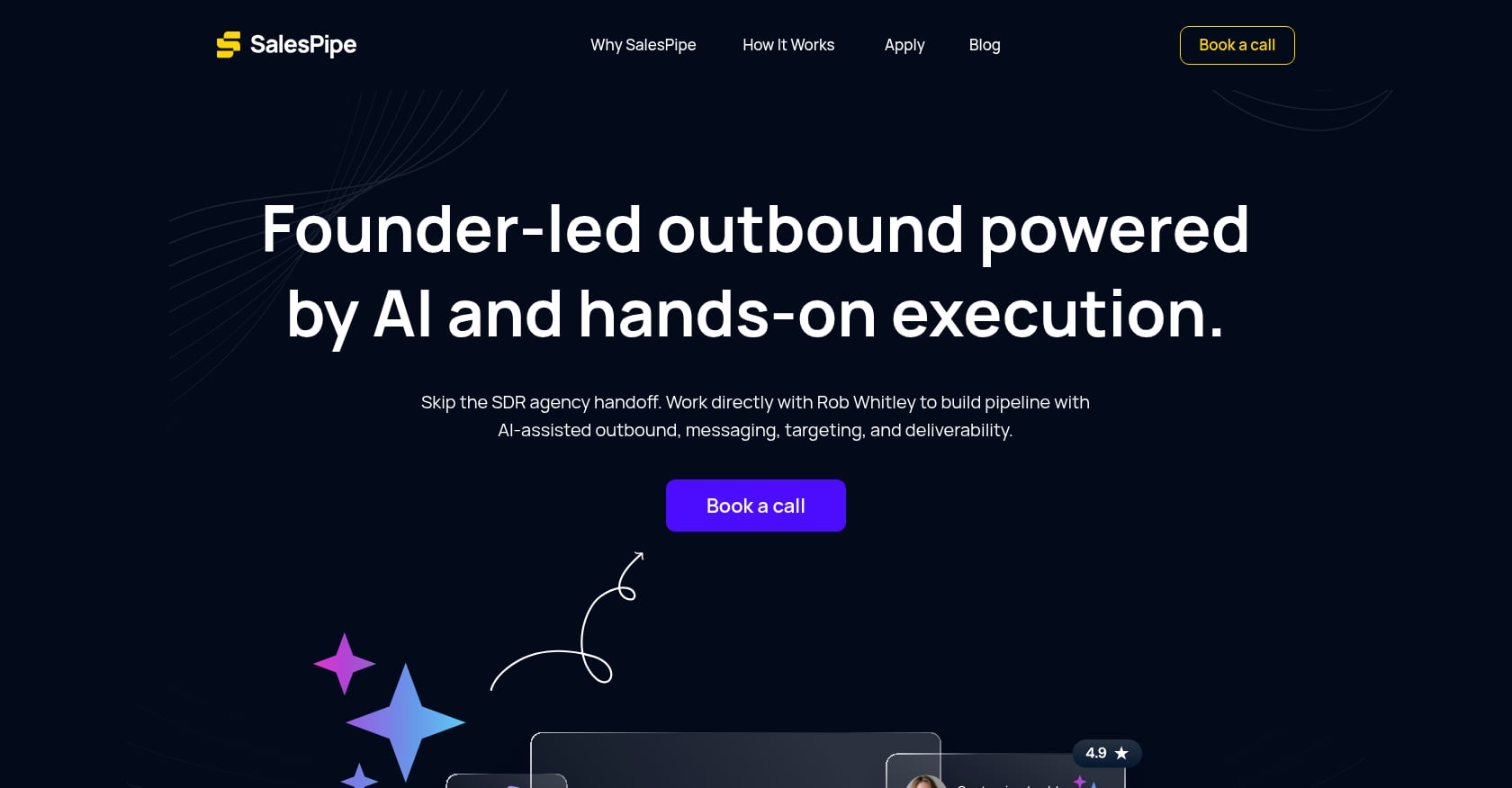
Best for: B2B tech and SaaS teams that want pipeline now without hiring SDRs or managing a tool maze.
SalesPipe isn’t a tool. It’s a founder-led outbound service where clients work directly with Rob Whitley on ICP definition, messaging, infrastructure, cold email, LinkedIn outreach, deliverability, and qualified meeting generation. The AI is in the execution layer: research, personalization, and operational workflows all get AI-powered leverage, but the strategy and judgment come from an experienced operator.
Pricing: Customized and scope-based. Engagements typically start with a pilot and continue month-to-month. No free trial.
Key features:
Direct access to a senior outbound operator (not passed to junior staff)
AI-powered research, personalization, and operational automation
Full technical setup: domains, inboxes, warming, tooling, deliverability protection
Ongoing optimization across cold email and LinkedIn
Plugs into existing GTM workflows
Why this matters in 2026: Practitioners on Reddit’s r/SaaS consistently describe frustration with tool sprawl, SDR inconsistency, and the gap between buying a platform and actually generating meetings. One thread documenting “the real cost of every outbound stack I’ve tested” concluded that the hidden costs of DIY (time, ramp, failed experiments) often exceeded what a good operator would charge.
This is the gap SalesPipe fills. It’s the difference between owning a gym membership and having a trainer who shows up.
Tradeoffs:
Limited bandwidth compared to large agencies (founder-led means capacity is finite)
Bespoke pricing requires a conversation, not a self-serve checkout
Legacy site language may still reference older SDR marketplace positioning
If you want to understand whether this model fits your team, you can apply directly or review the FAQ for common questions about the engagement.
2. Clay + Claygent
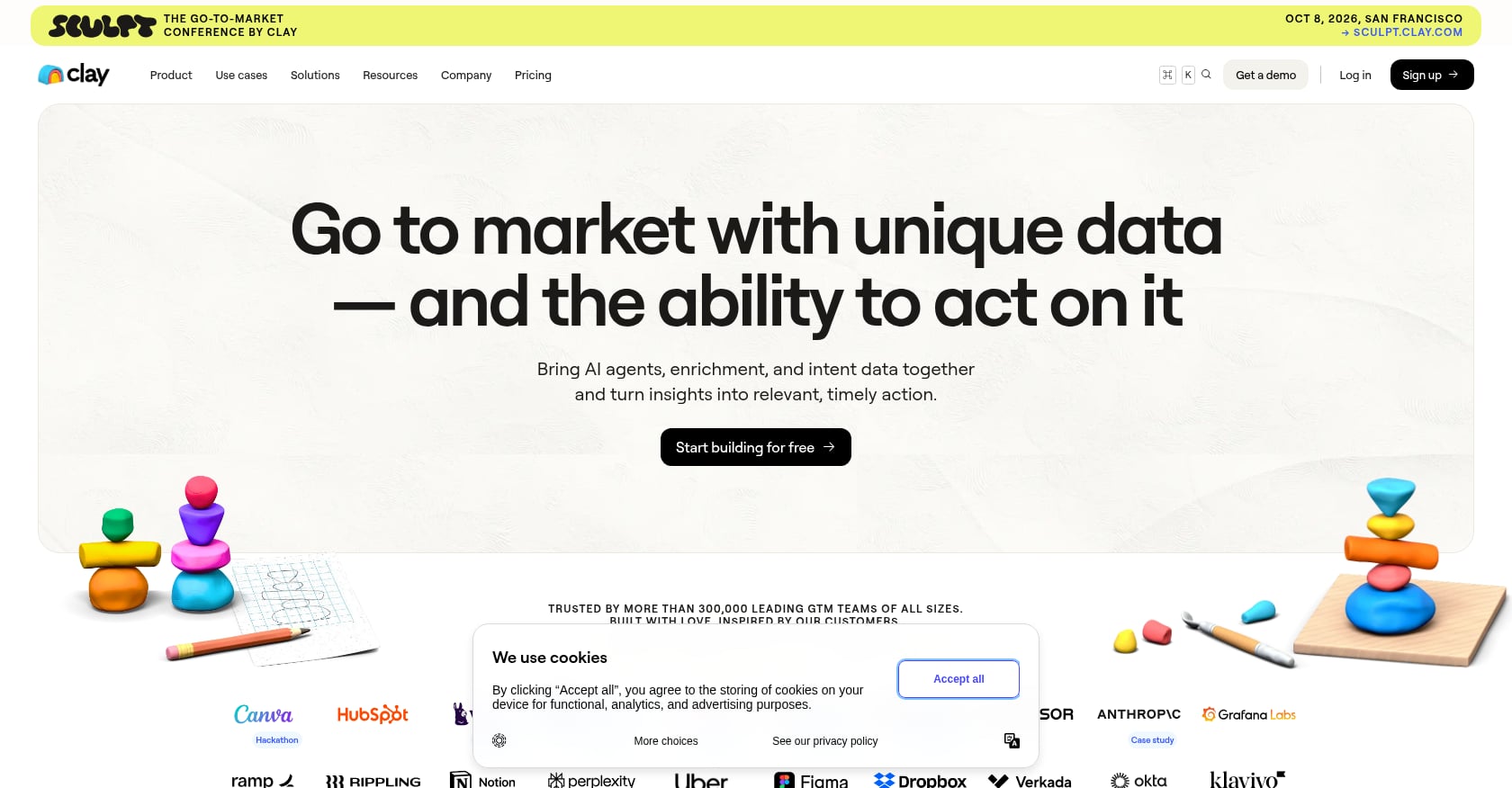
Best for: Teams needing high-signal prospect lists and AI-driven research that feeds real personalization.
Clay aggregates over 100 data providers, offers waterfall enrichment, web scraping, and an AI research agent (Claygent) that can pull specific talking points per account. It’s become central to many AI-assisted outbound sales stacks, sitting upstream of sequencers.
Pricing: Clay’s March 2026 pricing overhaul introduced separate “Data Credits” and “Actions” metering. Data costs dropped, but workflow, AI, and API calls are now metered independently. Multiple independent analyses detail the cost drivers and scenarios.
Key features:
100+ data providers with waterfall enrichment logic
Claygent for AI-powered account and contact research
CRM syncs and workflow automation steps
Web scraping and custom data pulls
Tradeoffs:
Cost unpredictability under heavy agent/workflow usage
Steep learning curve for non-technical users
Some teams on Reddit’s r/gtmengineering report shifting orchestration to n8n or Make while keeping Clay purely for enrichment to manage costs
User perspective: On r/UseApolloIo, a practitioner noted that Clay’s new pricing “forced me to rethink my entire stack,” but acknowledged the enrichment depth remains hard to replace.
3. Instantly.ai
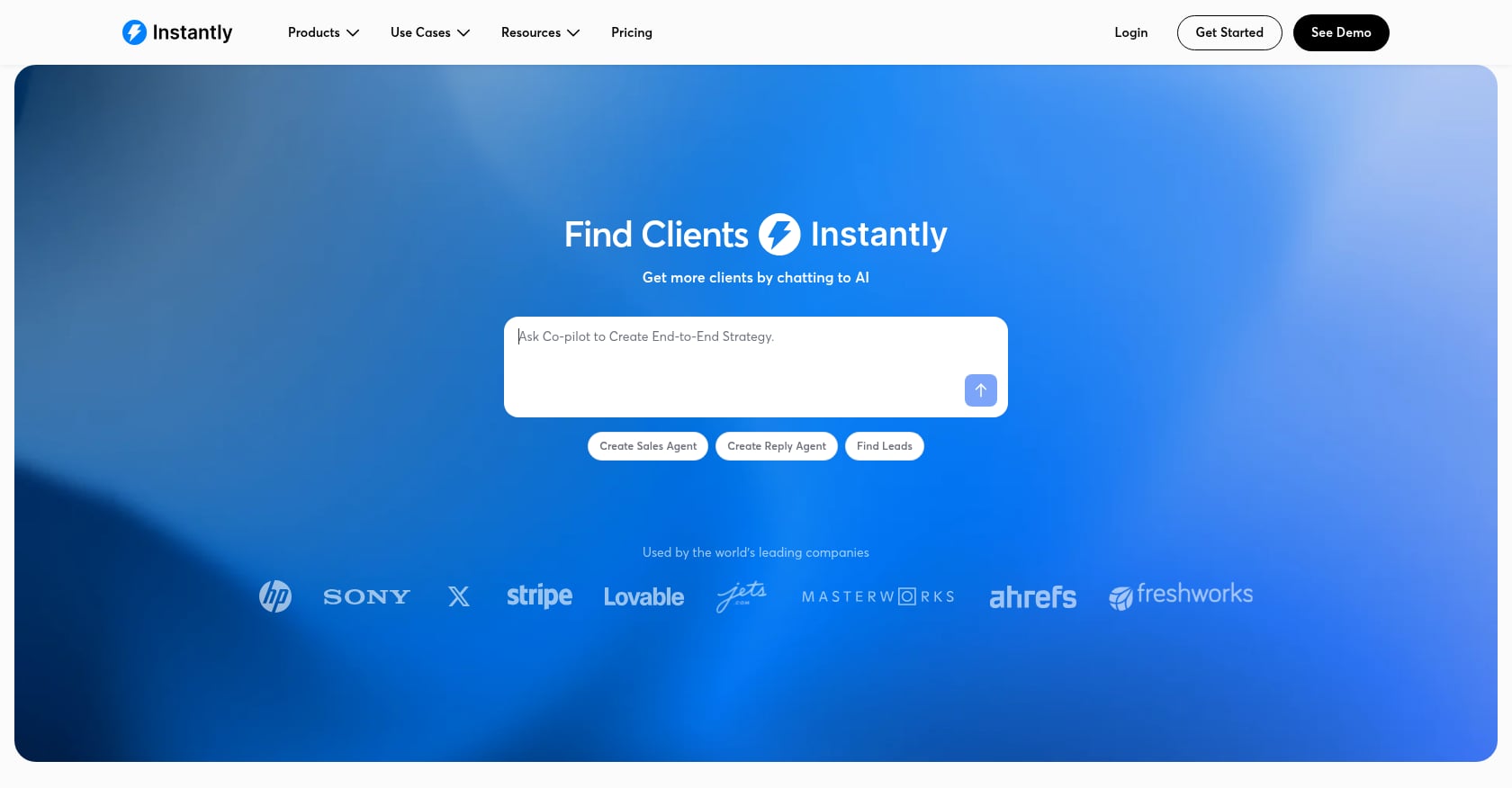
Best for: Agencies and lean teams running high-volume cold email at the lowest possible seat cost.
Instantly built its reputation on volume economics: connect many inboxes, send a lot of emails, pay relatively little per seat. It remains one of the most widely used sequencers in AI-assisted outbound sales, especially among solo operators and agencies.
Pricing: Growth annual plans start around $37.60/mo, scaling to roughly $358/mo on higher tiers as of April 2026, per independent pricing analyses.
Key features:
Multi-inbox sending infrastructure
High-volume sequencing with deliverability tooling
Built-in warmup (with caveats, see below)
Lead management and basic analytics
Tradeoffs:
Reports of features being removed or shifted between tiers without much warning
Warmup quality and settings have been inconsistent, according to practitioner threads
Deliverability risk is high if you’re not independently managing list quality and domain health
User perspective: Multiple threads on r/coldemail describe Instantly as a solid budget tool, but emphasize that “the tool doesn’t save you if your lists and infrastructure are bad.”
4. Smartlead.ai
Best for: Operators who prioritize built-in warmup and multi-inbox scale with agency-friendly controls.
Smartlead competes directly with Instantly but differentiates on unlimited warmup across plans, unlimited inbox connections, and white-label agency features.
Pricing: Smartlead’s help center details current plan differences. Independent reviews break down inclusions and limitations by tier.
Key features:
Unlimited warmup included on plans
Unlimited inbox connections
Master inbox for managing replies across accounts
Sub-sequences with conditional branching
Built-in email validation in the sending flow
Tradeoffs:
Warmup scores are directional, not gospel. Practitioners on Reddit recommend ramping conservatively regardless of what the dashboard says.
“2M verified” database claims should be verified with secondary tools
Some users switching from Instantly report a learning curve on inbox management
5. Reply.io
Best for: Teams running coordinated multichannel outbound (email, LinkedIn, calls, SMS) from a single platform.
Reply.io has expanded beyond email sequencing into a full multichannel platform with an AI SDR tier. For teams that want one pane of glass across all outbound channels, it’s a serious contender.
Pricing: Independent breakdowns detail four tiers (Email, Multichannel, AI SDR, Agency) with per-seat dynamics. Be cautious about older pricing quotes floating around. Costs climb meaningfully on the AI SDR tier.
Key features:
Email + LinkedIn + calls + SMS sequencing in one tool
Inbox warmup and deliverability analytics
AI drafting assistance and “AI SDR” automated workflows
CRM integrations and reporting
For teams adding LinkedIn to their outbound motion, our guide on LinkedIn prospecting tactics covers what works alongside tools like Reply.
Tradeoffs:
Per-seat costs escalate quickly, especially with AI/voice add-ons
The AI SDR tier’s value depends heavily on how much automation you actually use
Multichannel complexity means more configuration and maintenance
6. Lemlist
Best for: Teams that differentiate through creative, personalized assets in email and social outreach steps.
Lemlist was early to personalized images and videos in cold email. Its conditional branching, custom variables, and lemwarm deliverability system make it a strong choice for teams that invest in creative outreach.
Pricing: Current tiers are reflected on G2. Third-party guides detail the credits model covering enrichment, verification, and AI features. Costs scale per seat.
Key features:
Conditional branching sequences
Personalized images and video embeds
Lemwarm deliverability warmup system
Domain and inbox setup helpers
Tradeoffs:
Per-seat pricing gets expensive at scale. One Reddit reviewer after 6 months praised deliverability results but flagged cost as a real concern.
The built-in database is not a core reason to buy. Use dedicated enrichment tools for data.
Image/video personalization requires creative investment to work well
For practical tips on writing emails that perform well inside any sequencer, see our breakdown of how to write a cold email that gets replies.
7. Apollo.io
Best for: Startups and SMB teams wanting a single subscription for B2B data plus basic outreach.
Apollo’s appeal is convenience. It bundles a large contact database, enrichment, basic email sequences, and a dialer into one platform. With roughly a 4.7/5 rating on G2 across 9,000+ reviews, it’s one of the most popular tools in B2B sales.
Pricing: Free tier available for basic access. Paid plans scale based on credits and seat count. G2 and independent breakdowns estimate credit economics.
Key features:
Large B2B contact and company database
Enrichment and basic verification
Email sequencing and task management
Dialer add-ons for call-based outreach
Tradeoffs:
Data accuracy is the persistent concern. Practitioners on r/growmybusiness report variable bounce rates and recommend layering external verification for critical campaigns.
Sequences are functional but basic compared to dedicated tools
Credit consumption can surprise teams that enrich aggressively
8. Lavender
Best for: Sales teams standardizing what “good email” looks like and upleveling junior reps fast.
Lavender is an AI email coach, not a sequencer. It scores your emails in real time inside Gmail or Outlook, offering specific suggestions to improve readability, personalization, and reply likelihood. It’s trained on sales email performance data.
Pricing: Plans start around $29/user according to TrustRadius, with team tiers priced higher.
Key features:
Real-time email scoring and coaching inside your inbox
Personalization and readability suggestions
Sales-specific AI training (not generic writing assistance)
Team analytics and benchmarking
Lavender published a benchmark report analyzing 231,818 cold emails, which remains one of the better data sets for understanding what moves reply rates.
Tradeoffs:
Per-seat cost adds up if adoption is uneven across the team
Some practitioners compare it unfavorably to free LLM alternatives, though Lavender’s sales-specific scoring is the differentiator
It coaches writing but doesn’t handle targeting, timing, or deliverability
9. Aircall AI Voice Agent
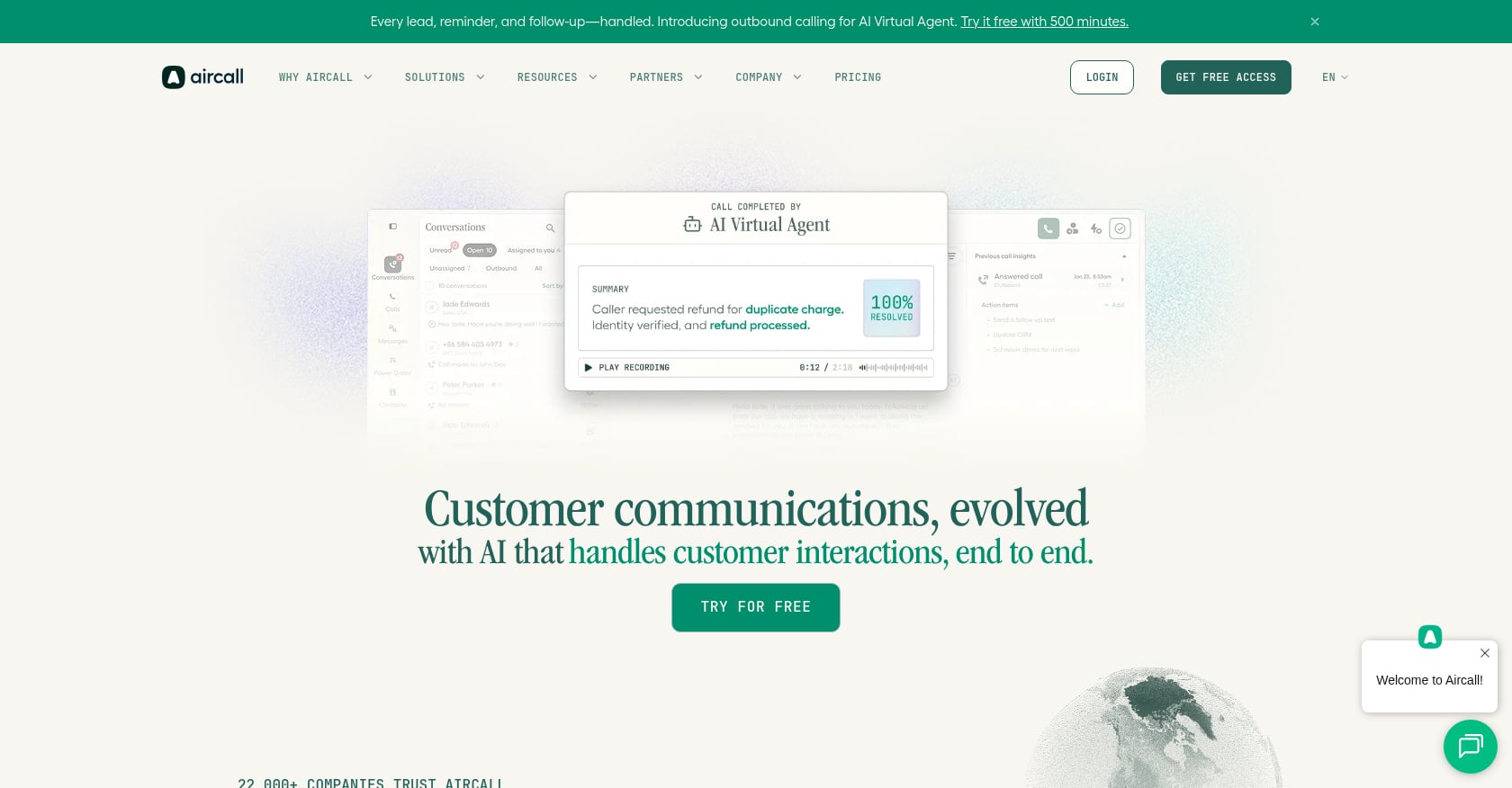
Best for: Teams adding voice touchpoints (speed-to-lead, after-hours follow-up) without hiring a dedicated call desk.
Voice is making a comeback in AI-assisted outbound sales, and Aircall’s AI Voice Agent handles outbound calls, qualification, basic objection handling, and CRM logging.
Pricing: Per-minute pricing for the AI Voice Agent, with base phone system plans starting around $30-50/user/month on annual contracts per TechRadar’s review. AI voice usage is additional.
Key features:
AI-driven outbound calling and qualification
CRM logging and call summaries
Power dialer and call analytics in the core platform
Integration with major CRMs and sales tools
Tradeoffs:
Voice quality and latency matter enormously. Test before committing to volume.
The real metric, as discussed extensively on Reddit’s r/AIVoice_Agents, is cost per qualified conversation, not per-minute sticker price. Headline rates of $0.07-0.10/min often exclude LLM, TTS/STT, and telephony costs.
AI voice agents still struggle with nuance. They can qualify interest but can’t build the trust that closes a $30k deal.
10. G2 Buyer Intent
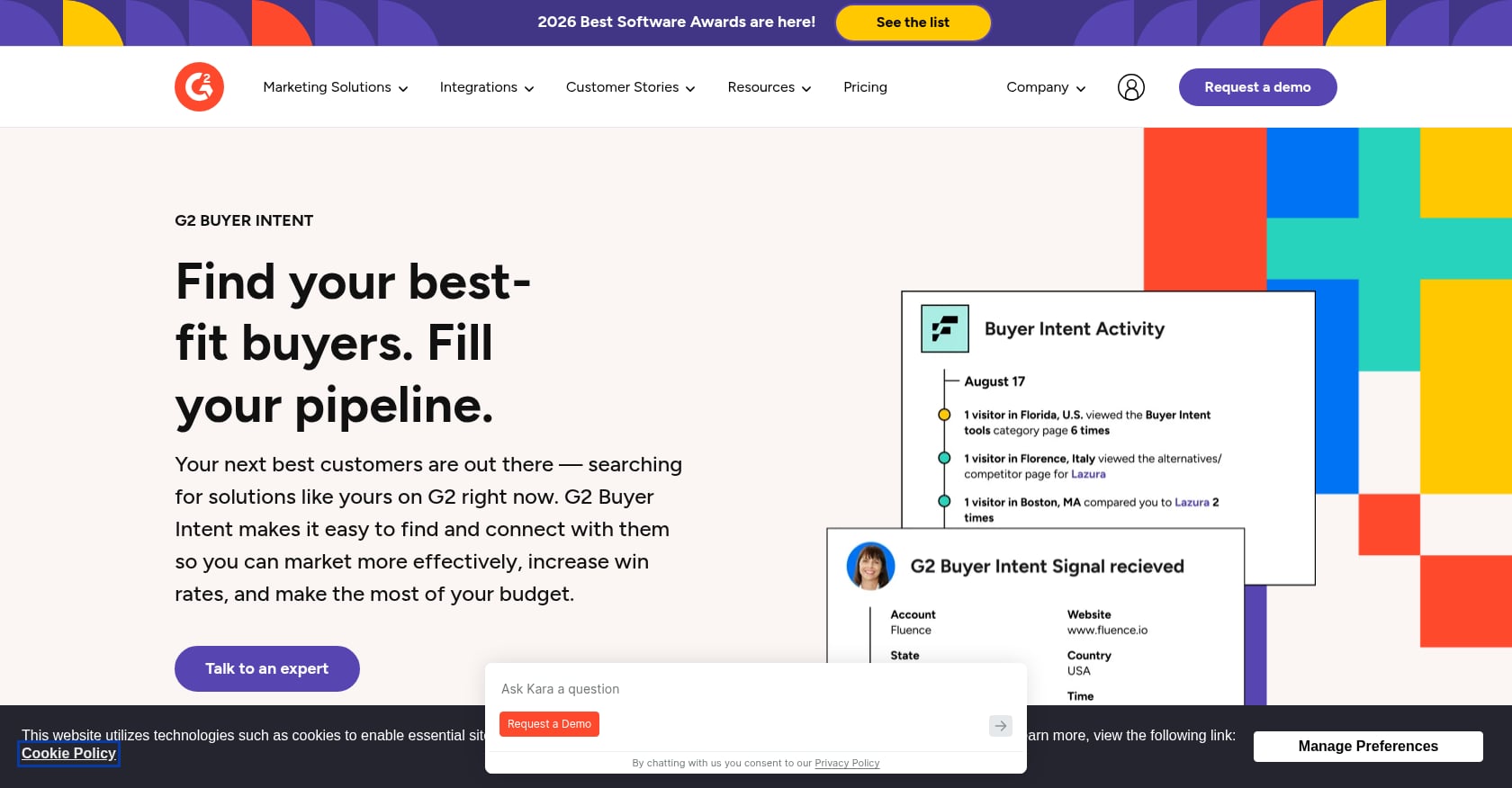
Best for: Mid-market and enterprise teams layering intent data to raise reply conversion and protect deliverability by narrowing sends.
G2 Buyer Intent gives you signal data on which accounts are actively researching your category (or competitors) on G2. Pairing intent signals with your outbound sequences means you’re reaching out to accounts that already have the problem on their mind.
Pricing: G2’s official pricing guide shows brand/buyer-intent packages starting around $299/mo, with higher tiers adding broader intent coverage and integrations.
Key features:
Visitor-level and category-level intent signals
ICP filters for targeting
Integrations with sales engagement and CRM platforms
Account-level research activity tracking
Tradeoffs:
Value depends on how much relevant traffic G2 sees in your category
Requires orchestration discipline to act on signals quickly
Intent data is directional, not deterministic. It narrows your list but doesn’t guarantee interest.
11. DIY Agentic Stack
Best for: Technical startups with engineering bandwidth that want to avoid platform margins and tailor every step of their outbound workflow.
The DIY approach typically combines an orchestration layer (n8n, Make), an LLM (OpenAI), telephony (Twilio), and your CRM. It gives you maximum control but comes with real maintenance burden.
Pricing: Community consensus on Reddit clusters around $0.07-0.30/min for voice agents depending on what’s bundled. Orchestration-only platforms advertise low rates, but LLM, TTS/STT, and telephony costs sit on top.
Key features:
Full ownership of prompts, logic, data flows, and infrastructure
No vendor lock-in on any single component
Ability to deeply customize research, outreach, and qualification workflows
Pair with PostHog or similar for analytics
Tradeoffs:
Build and maintain complexity is non-trivial. What works in a weekend demo breaks under production load.
Hidden costs in API tokens, telephony minutes, and failed experiments
No accountability partner. When results stall, you troubleshoot alone.
Test rigorously for latency, handoff quality, and compliance before scaling
What Good Looks Like in 2026: Reply-Rate Reality and the Levers That Move Numbers
Most AI-assisted outbound sales benchmarks you’ll find online are cherry-picked. Here’s what the data actually says.
Multiple sources from 2025 and 2026 place average cold email reply rates between roughly 3% and 3.5%, with massive variance by industry, list size, and targeting quality. Top performers are outliers, and almost always, they earned those numbers through better targeting and timing rather than better copy.
Treat 3% as a sanity baseline. If someone promises you 15% reply rates out of the gate, ask them what list size and segment they’re working with.
The levers that actually move results in 2026:
List quality and signals. Targeting accounts showing hiring patterns, tech changes, funding rounds, or category research intent dramatically improves reply rates. AI is excellent at detecting and aggregating these signals.
Research depth per contact. Having one or two specific, relevant talking points per prospect (not “I noticed your company does X”) creates the kind of messages that earn replies. This is where AI research agents shine.
Domain and inbox health. Authentication, warmup, complaint monitoring, and volume pacing are table stakes. One bad week of spam complaints can tank months of infrastructure work.
Timing and channel mix. Email-only outbound underperforms multichannel. Adding LinkedIn and, where appropriate, voice touchpoints increases the chances of reaching prospects where they’re paying attention.
AI writing is the weakest lever. This is counterintuitive given all the marketing around AI-generated emails, but practitioner after practitioner confirms it. The AI-written email is the commodity. The signal that made you send it to that person, at that time, about that specific topic, is the differentiator.
For a complete framework on structuring your outreach program from scratch, our cold outreach guide walks through the full process.
30-Day AI-Assisted Pilot: A Practical Blueprint
This is the blueprint an experienced operator would follow to test AI-assisted outbound sales in your business. It’s also, roughly, how SalesPipe approaches new engagements.
Week 1: Infrastructure and Compliance
Register new subdomains for outbound (don’t send from your primary domain).
Set up dedicated mailboxes with proper SPF, DKIM, and DMARC authentication.
Configure one-click unsubscribe per RFC 8058.
Connect Google Postmaster Tools and define complaint rate guardrails (under 0.1% is the target).
Begin warming inboxes. Plan for at least 2 weeks of warmup before any live sends.
Week 2: ICP and Signal-Driven List Building
Define your ideal customer profile with specificity: company size, industry, tech stack, recent triggers.
Use enrichment tools (Clay, Apollo, or similar) plus manual checks to build a 500 to 1,000 contact list.
Prioritize contacts tied to recent signals: new hires in relevant roles, funding announcements, technology changes, or content engagement.
Verify every email address with a secondary tool. Bounces kill deliverability.
Week 3: Research at Scale, Not Copy at Scale
Assign AI agents to produce one or two specific talking points per contact based on their company’s recent activity, publicly stated priorities, or role-specific challenges.
Build sequences across email and LinkedIn. If applicable, add a voice agent step for speed-to-lead scenarios.
Keep emails short. Three to five sentences. One clear question or CTA. No walls of text.
Week 4: Measure and Tune
Read reply quality, not just open rates. Positive replies and booked meetings are the metrics that matter.
Monitor complaint rates daily. If complaints spike above 0.1%, pause and diagnose immediately.
Prune low-engagement segments. Continuing to send to people who aren’t engaging will drag your domain reputation down.
Document what worked by segment, signal type, and channel to inform the next month’s iteration.
If you’d rather have someone run this pilot for you (with accountability for the outcome), that’s exactly what SalesPipe does. You can apply here to start a conversation.
When to Pick SalesPipe vs. a Tool Stack
This is the honest breakdown.
Pick a DIY tool stack when:
You have a full-time operator (or team) dedicated to outbound
Your engineering team can build and maintain integrations
You want granular control over every workflow step
Your budget favors tools over services, and you have the time to absorb the learning curve
Pick SalesPipe when:
You need pipeline now and don’t have months to ramp an internal team
You’ve tried tools but lack the bandwidth to run them consistently
You want senior-level accountability for outbound results, not a junior SDR reading a script
Deliverability and infrastructure setup feel like a minefield you’d rather not navigate alone
You’ve been burned by an agency that sold strategy and delivered mediocrity
The core difference isn’t tools versus service. It’s whether you’re buying components or buying an outcome. SalesPipe is an outbound engine where a founder-operator uses AI to multiply output while maintaining the quality and judgment that tools alone can’t provide.
For context on how this compares to traditional SDR outsourcing models, our piece on outsourced SDR as the future of outbound sales explains the evolution, and our explainer on what an outbound SDR actually does clarifies the roles now that “AI SDR” has muddied the terminology.
FAQs
What is AI-assisted outbound sales?
AI-assisted outbound sales uses artificial intelligence to handle specific parts of the outbound process (research, data enrichment, personalization, sequencing, signal detection) while keeping humans in control of strategy, live conversations, and relationship building. It’s distinct from “AI SDR” products that claim full autonomy, because it acknowledges that judgment and trust still require a person.
Does AI-assisted outbound sales actually improve reply rates?
It can, but the improvement comes from better research and targeting, not from AI-written copy. Teams that use AI to identify the right accounts at the right time and produce relevant talking points consistently outperform teams that use AI purely to generate more emails faster.
What do Gmail and Yahoo’s bulk sender rules mean for outbound in 2026?
If you send 5,000+ messages per day to Gmail addresses, you must authenticate with SPF, DKIM, and DMARC, support one-click unsubscribe, and keep spam complaints below 0.3% (ideally under 0.1%). Violating these rules tanks your deliverability. Any AI-assisted outbound sales tool you use should support or integrate with these requirements. Google’s official guidelines have the full details.
How much does an AI-assisted outbound sales stack really cost?
It varies widely. A basic sequencer starts around $38/mo, but a realistic stack (sequencer + enrichment + verification + warmup + domains + inboxes) runs $500 to $2,000+/mo before factoring in the time cost of managing it all. Voice AI adds $0.07 to $0.30/min on top. A founder-led service like SalesPipe bundles execution and expertise into a scope-based engagement, which often competes favorably when you account for the true total cost of DIY.
Should I build my own AI outbound agent stack?
Only if you have dedicated engineering bandwidth, tolerance for ongoing maintenance, and a clear understanding of the compliance requirements. The flexibility is real, but so is the complexity. Most teams are better served starting with proven tools or a managed service and building custom only where they’ve identified a specific edge.
What’s the difference between an “AI SDR” and AI-assisted outbound?
An “AI SDR” implies a fully autonomous agent replacing a human salesperson. AI-assisted outbound uses AI for research, enrichment, workflow automation, and first-touch drafting while keeping human operators in the loop for strategy, quality control, and conversations. The latter consistently produces better outcomes in practice, based on both Salesforce’s adoption data and practitioner reports across Reddit and operator communities.
How long does it take to see results from an AI-assisted outbound pilot?
Plan for 30 days minimum. The first two weeks are infrastructure and list building. Live sends typically start in week three, with meaningful data on reply quality and segment performance by week four. If you’re working with an experienced operator, the ramp is faster because they’ve already made the mistakes you’d spend weeks discovering.