How One Outbound Operator Can Outperform a Team (2026 Guide)
How One Outbound Operator Can Outperform a Team in 2026: own targeting, data, messaging, and deliverability with AI. Learn when to hire and when not.
TL;DR
One outbound operator can outperform a team when outbound success depends more on system quality than headcount. A senior operator who owns the full outbound engine (targeting, data, messaging, deliverability, sequencing, and iteration) and uses AI for low-leverage tasks can produce better pipeline than several junior SDRs executing a broken playbook. This is not anti-team. It is anti-premature team. Once the motion is proven, scaling with people makes sense.
The old formula for B2B outbound was simple: want more pipeline? Hire more SDRs. That formula is breaking down.
Salesforce’s latest State of Sales report shows sales professionals spend only 40% of their time actually selling, with 60% going to planning, data entry, training, tool switching, and other non-revenue work. Scale that inefficiency across five reps and you get a team that burns budget without producing proportional results.
Meanwhile, practitioners on Reddit report the same pattern from the buyer side. One founder described spending $20K on SDRs over six months before realizing the real problem was not the reps but the system behind them: poor lists, generic copy, broken deliverability, and no one able to diagnose which part was failing. That thread captures what many B2B leaders are discovering. Outbound failure is usually a system problem, not an effort problem.
This article explains what an outbound operator is, why one person with the right experience and AI stack can outperform a larger team, when the model works, and when you still need a team.
What is an Outbound Operator? [Direct Answer]
An Outbound Operator is a senior GTM (Go-to-Market) specialist who owns the entire outbound sales system—from technical infrastructure and signal-led targeting to AI-assisted messaging and deliverability. Unlike a traditional SDR (Sales Development Representative) who executes a pre-set playbook, an operator architects and iterates on the playbook itself. By using an integrated AI stack for low-leverage research and data enrichment, a single operator can produce higher-quality pipeline than a traditional five-person SDR team.
What Does “One Outbound Operator Can Outperform a Team” Actually Mean?
The short answer: one outbound operator can outperform a team by owning the entire outbound system and using AI to multiply execution. Instead of splitting outbound across SDRs, managers, copywriters, RevOps, list builders, and separate tools, the operator runs one tight loop. Choose the right accounts. Write relevant messaging. Protect deliverability. Launch multi-channel outreach. Handle replies. Learn from results. Improve the next cycle.
The comparison is not “one person vs many people.” It is one accountable system owner vs many disconnected executors.
This does not mean teams are obsolete. It means headcount is no longer the default answer to an outbound problem. If the playbook is unproven, one senior operator usually creates more learning and less waste than several junior reps running in different directions.
What Is an Outbound Operator?
An outbound operator is a senior, hands-on person who designs, launches, and improves outbound pipeline generation. They sit between GTM strategy and SDR execution.
Unlike a traditional outbound SDR who works inside a playbook, the operator builds and improves the playbook itself.
A strong outbound operator usually owns:
ICP definition. Determining exactly who to target and why.
Account and contact targeting. Building focused lists based on signals, not just titles and company size.
Data enrichment. Validating contacts, adding context, filling gaps.
Cold email infrastructure. Domains, inboxes, SPF, DKIM, DMARC, warm-up, sending limits.
Deliverability management. Monitoring inbox placement, bounce rates, spam complaints, and domain reputation.
Messaging and email sequences . Writing, testing, and refining outreach across cold email and LinkedIn.
Reply handling. Triaging responses, managing objections, routing qualified conversations.
CRM hygiene. Keeping data clean so reporting is trustworthy.
Performance reporting. Tracking what matters, not just what is easy to count.
Weekly iteration. Using results to improve targeting, messaging, and channel mix.
Landbase’s outbound operations playbook defines this operational layer as the infrastructure behind SDR productivity: list building, contact qualification, territory assignment, CRM data management, cadence design, and performance reporting. That framing supports the core argument here. If outbound performance depends on the operating layer, then a senior operator who owns that layer can be more valuable than adding more reps on top of a weak foundation.
Why a Single Operator Can Beat a Larger SDR Team
Understanding how one outbound operator can outperform a team requires looking at the mechanism, not just the claim. There are five structural reasons.
One Owner Reduces Handoff Loss
Traditional outbound often splits work across many people. The founder defines the market. RevOps sets up tools. The SDR manager sets activity goals. Junior SDRs send messages. An agency writes copy. A data vendor provides lists. An AE handles replies. Nobody owns the whole system.
Each handoff introduces lag, inconsistency, and accountability gaps.
A practitioner thread on Reddit captured this well. One poster framed the core question about outbound agencies as whether the partner owns outbound end-to-end (research, copy, deliverability, booking) or just handles cold email and targeting while the client holds the hard parts. The real question is not whether outbound is outsourced or in-house. The real question is who owns the system.
Senior Judgment Beats Junior Activity
Junior SDRs can execute tasks. But outbound typically fails upstream, in places junior reps cannot diagnose.
Wrong ICP. Weak offer. Generic copy. Bad data. Damaged domain reputation. Poor segmentation. No reply analysis.
A Reddit discussion about a founder doing outbound themselves after $20K in SDR spend captured the issue clearly: if nobody can diagnose whether a 0.8% reply rate campaign has a list problem, a copy problem, or a deliverability problem, nobody can tell whether the SDR is underperforming or the system is broken.
One experienced operator can diagnose and fix the system. A junior team can only report activity numbers.
AI Removes Non-Leverage Work
AI is most useful when it handles the repetitive, data-heavy tasks that eat up selling time. Research. Enrichment. Account summarization. First-draft personalization. Signal tracking. Sequence variants. CRM updates. Reply classification.
McKinsey’s 2025 State of AI survey found that 88% of organizations now use AI in at least one business function, with revenue gains from AI most commonly reported in marketing and sales. Salesforce reports that 92% of sales professionals with AI agents say AI benefits prospecting, and high performers are 1.7x more likely than underperformers to use prospecting agents.
The operator advantage is clear. One person who knows how to direct AI tools can cover the research, enrichment, and drafting work that previously required multiple team members.
A LinkedIn post by Ankit Modi describes this shift directly: AI took over research, enrichment, signal tracking, and sequencing logic, while humans moved up to ICP definition, offer positioning, message judgment, and human-feeling follow-up. Modi’s core claim aligns with this entire model: one strong operator with the right AI stack can outperform five junior SDRs.
Faster Feedback Loops Improve Everything
A team can generate more raw activity. A strong operator can generate faster learning.
The operator sees which segment replies, which titles ignore outreach, which message triggers objections, which signals correlate with meetings, which inboxes are getting placement, and which channels produce quality conversations. Because one person holds all of that context, the loop from observation to improvement is tighter.
Landbase’s outbound operations guide argues that strong teams treat every campaign as an experiment: hypothesis, execution, measurement, and refinement. That is exactly the advantage of an operator-led model, compressed into one feedback loop instead of being spread across departments.
Deliverability Is Too Technical to Leave Unmanaged
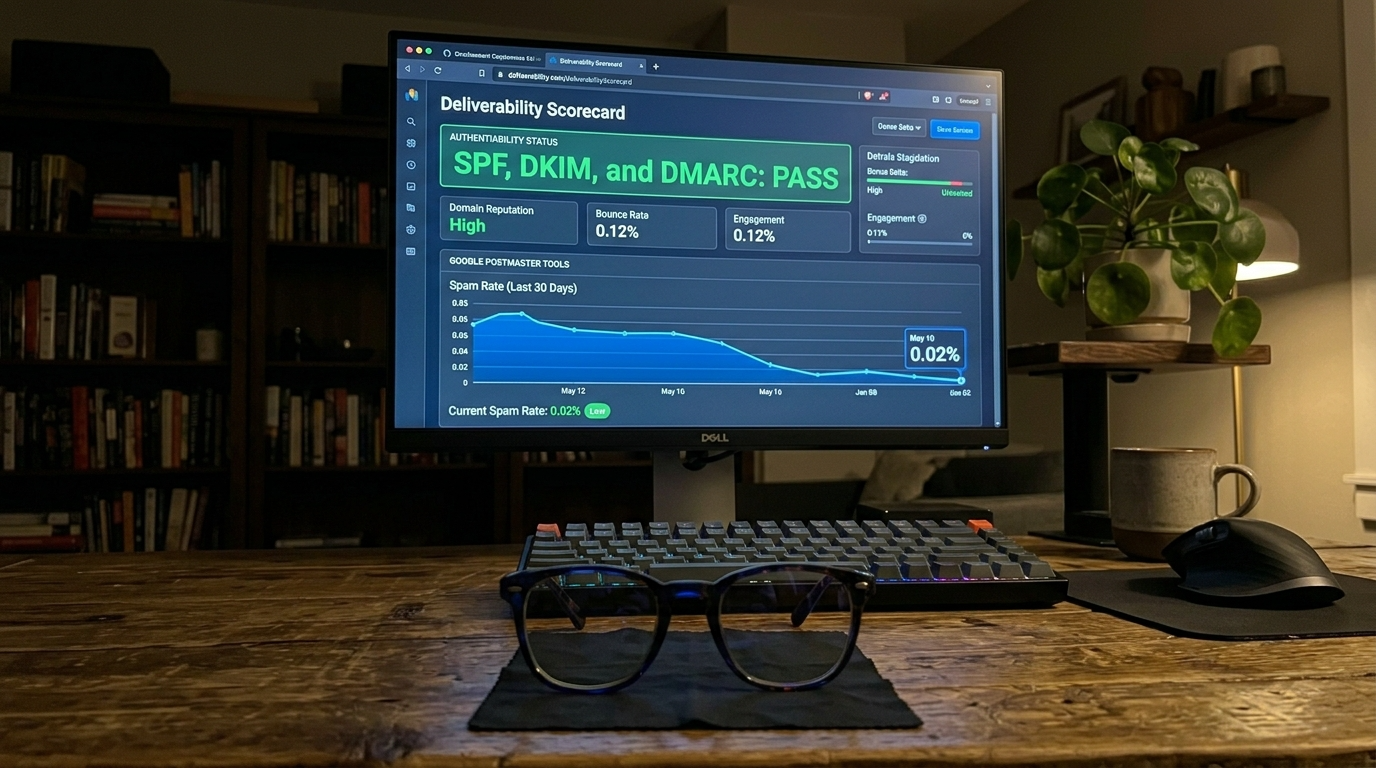
This is the most underestimated factor. Modern outbound depends on technical infrastructure and sender reputation.
Google now requires all senders to Gmail personal accounts to meet baseline requirements including SPF or DKIM authentication, valid DNS, TLS, and spam rates below 0.30%. Bulk senders (5,000+ daily messages to Gmail) must set up SPF, DKIM, DMARC, From-domain alignment, and one-click unsubscribe for marketing messages. Yahoo enforces similar rules, warning that non-compliant mail may go to spam or be rejected entirely.
Community discussions reinforce that SPF, DKIM, and DMARC are no longer enough by themselves. Practitioners on Reddit troubleshooting deliverability drops point to sender reputation, engagement rates, complaint rates, inbox-level volume, and Google Postmaster Tools as important variables.
Many SDRs are measured on meetings and activity, but the real constraint is often invisible: the inbox. If the operator owns infrastructure and deliverability, they can prevent a campaign from failing before the message is ever read. A junior team often cannot.
The 2026 Outbound Infrastructure Checklist
To outperform a team, the operator must maintain a perfect technical reputation. Copy and paste this stack into your SOP:
Authentication: 100% alignment on SPF, DKIM, and DMARC (p=quarantine or p=reject).
Protocol Compliance: Verified BIMI (Brand Indicators for Message Identification) for visual trust in the inbox.
Spam Ceiling: Maintain a Google Postmaster spam rate below 0.1% (well under the 0.3% hard limit).
Volume Throttling: Limit sending to 30-50 messages per inbox/day using a distributed secondary domain strategy.
Signal Monitoring: Integration of real-time intent signals (e.g., job postings, funding, tech-stack shifts) to replace "blast" lists.
The Operator Leverage Stack
Here is a framework for understanding how one outbound operator can outperform a team. It is not about working harder. It is about compounding leverage at every step.
1. Targeting leverage. Better account selection reduces wasted outreach. Fewer, better-fit prospects beat massive generic lists.
2. Message leverage. Better problem framing increases replies without increasing volume. This requires understanding the buyer, not just using a template.
3. Technical leverage. Better deliverability increases the percentage of messages that reach the inbox. Every point of improvement multiplies downstream results.
4. Workflow leverage. AI handles repetitive research, enrichment, drafting, and routing. The operator focuses on decisions, not data entry.
5. Judgment leverage. The operator decides what to test, stop, change, and scale. Junior reps execute. The operator architects.
6. Learning leverage. One owner sees the full feedback loop and improves faster. A fragmented team sees only their own slice.
The key line: an SDR team scales labor. An outbound operator scales judgment.
A five-person SDR team sending generic emails to weak-fit accounts can produce more activity but less pipeline. A single operator targeting one tight segment with high-quality data, correct infrastructure, and signal-led messaging can create fewer touches but more relevant conversations.
Operator vs SDR vs SDR Team vs Agency vs AI SDR
One of the most common points of confusion in this space is the difference between all the options. Here is a clear breakdown.
| Model | What it is | Strength | Weakness | Best fit |
|---|---|---|---|---|
| Outbound SDR | Individual rep who prospects and books meetings | Human touch, calling, persistence | Needs playbook, coaching, tools, ramp | Proven motion with clear ICP |
| SDR team | Multiple SDRs plus manager and process | Coverage and scale | Expensive, slower, more management, more variance | Mature outbound motion |
| Outbound agency | External team running campaigns | Speed, infrastructure, less hiring | Quality varies, junior execution risk, weaker company context | Need pipeline fast, playbook partly known |
| AI SDR tool | Software automating research, outreach, replies | Cheap scale, always-on workflows | Can become spam, weak judgment, trust risk | Narrow tasks, warm signals, high supervision |
| Outbound operator | Senior person who owns the whole outbound engine | Accountability, strategy + execution, fast iteration, AI leverage | Less raw bandwidth than a team | Early-to-mid stage B2B, unproven or underperforming outbound |
Astra GTM’s comparison of outbound agencies vs in-house SDRs makes a useful point: agencies can go live in under two weeks, while an SDR hire may take 30 to 60 days to recruit and onboard and longer to ramp. But neither comparison addresses the third option, a senior operator who owns both strategy and execution.
Prospeo’s guide on building outbound sales teams argues that hiring SDRs before a repeatable playbook exists is a common early-stage mistake. The rep has no ICP definition, no targeting criteria, no “what great looks like” library, and no clear outreach methods to execute. This is exactly the gap the operator model fills.
For more on how the outsourced SDR model compares, and whether outsourced SDRs actually work, those guides provide additional context.
The Economics: Why Headcount Is No Longer the Default Lever
The numbers help explain why one outbound operator can outperform a team in practice, not just in theory.
SDR Productivity Baselines
Operatix, drawing on experience across 500+ B2B SaaS campaigns, says an outbound SDR should produce about 15 meetings per month with a 20% dropout rate, resulting in roughly 12 meetings attained. Blossom Street Ventures summarizes Bridge Group survey data across 406 B2B businesses showing median raw pipeline generated per SDR of $3M per year, with average quotas of 19 meetings set, 12.5 semi-qualified opportunities, and 10.5 fully qualified opportunities per month.
Those numbers look reasonable in isolation. But they assume a functioning system behind the rep.
Ramp and Tenure Drag
The same Bridge Group data shows average SDR ramp time of 3.1 months, average tenure of 1.8 years, and typical SDR experience of just 1.2 years. That leaves roughly 17 months of full productivity before the rep moves on and the cycle restarts.
And an SDR team is not just salary. It requires recruiting, onboarding, coaching, data, tools, management, QA, replacement hiring, enablement, pipeline review, and deliverability monitoring.
Tool Sprawl
Salesforce reports that sales teams use an average of eight tools, and 42% of reps are overwhelmed by too many of them. Tech silos can delay or limit AI initiatives and create friction at every step of the outbound workflow.
One operator can outperform a team when the team is buried in tool sprawl and fragmented workflows. The tool stack is not the moat. The operator is.
The New Outbound Math
The old outbound math: more SDRs equals more pipeline. The modern math: better system equals better conversion at every step. If five SDRs spend most of their time researching, logging, switching tools, and working poor-fit accounts, the team is scaling waste. One operator who improves targeting, deliverability, and reply quality can create more useful pipeline with less activity.
| Metric (2026 Averages) | 5-Person Junior SDR Team | 1 Senior Outbound Operator |
| Median Annual Salary | $275,000+ (Base) | $120,000 - $160,000 |
| Ramp Time | 3.1 Months (per rep) | < 2 Weeks |
| Time Spent Selling | 40% (60% on admin/tools) | 85% (AI-automated admin) |
| Primary Output | Activity Volume (Emails/Dials) | Pipeline Quality (Qualified Ops) |
| System Ownership | Fragmented (Manager/Ops/SDR) | Unitary (Single System Owner) |
| Tech Compliance | High Risk (Manual DNS/SPF) | Automated (DMARC/BIMI Aligned) |
Why Outbound Teams Often Underperform
This is not an anti-team argument. It is a diagnosis of the common failure modes that make teams underperform, and that an operator model can avoid.
Failure 1: Scaling Activity Before Message-Market Fit
Standard SDR quota guidance suggests 10 to 15 appointments per month for SDRs and 15 to 20 for BDRs. But quotas only work when the market, offer, and motion are clear.
A Reddit thread on outbound options for SaaS founders warned that hiring internally before understanding message-market fit can burn budget quickly. If nobody has validated whether the target market responds to the core problem framing, adding more reps just speeds up the burn.
Failure 2: Chasing Vanity Metrics
Many outbound teams track emails sent, calls made, LinkedIn touches, opens, and activities logged.
Modern outbound should prioritize positive reply rate, conversations started, meetings held, qualified opportunities, and pipeline created. MarketBetter’s 2026 outbound strategy guide specifically warns against vanity metrics and recommends tracking positive replies, conversations, meetings, show rate, and pipeline.
Failure 3: Nobody Owns Diagnosis
When reply rates drop, is it a list quality problem? A subject line issue? An inbox reputation issue? A copy relevance problem? A sending volume issue? The wrong persona?
A senior operator is valuable because they can diagnose the system across all these variables. A junior team may only report that “numbers are down.”
Failure 4: Losing Buyer Context
Gartner reports that the typical buying group for a complex B2B solution involves six to ten decision makers, each bringing independently gathered information. An outbound operator can design campaigns around buying committees, not just one persona. A junior SDR team may simply email titles from a list.
Failure 5: More People Creates More Noise
Before a playbook is mature, variation creates noise rather than insight. Different SDRs interpret ICP differently, rewrite messaging inconsistently, manage different inboxes with different behavior, take different approaches to follow-up, write different CRM notes, and hand off to AEs differently. One operator creates a cleaner feedback loop.
Signal-Led Targeting: The Key to Operator Leverage
One outbound operator can outperform a team most clearly when targeting is the primary constraint. And it usually is.
Good outbound signals include funding rounds, new executive hires, technology changes, job postings in relevant departments, competitor engagement, expansion into new markets, product launches, compliance shifts, and negative reviews of incumbent tools.
MarketBetter recommends scoring leads based on signal density: firmographic fit plus behavioral signal plus contextual trigger. That approach dramatically reduces wasted outreach.
A SaaS founder on Reddit described building outbound lists based on specific signals like hiring patterns, tech stack, and campaign-specific relevance. The poster warned against buying 10,000 leads and blasting them, noting that giant generic lists can burn a domain quickly.
A Hacker News founder building social-intent outbound made a related argument: cold outreach is broken when it interrupts strangers, while the better approach is to find people already asking for help and engage at the right moment. The performance claims should be treated carefully, but the underlying insight is strong. Intent beats interruption.
This is where the operator model shines. One person tracking signals across a tight ICP can identify better timing and better accounts than five reps working off a static list. For a deeper look at how cold outreach systems work in practice, that guide covers the mechanics.
What AI Should Handle, and What the Operator Should Keep
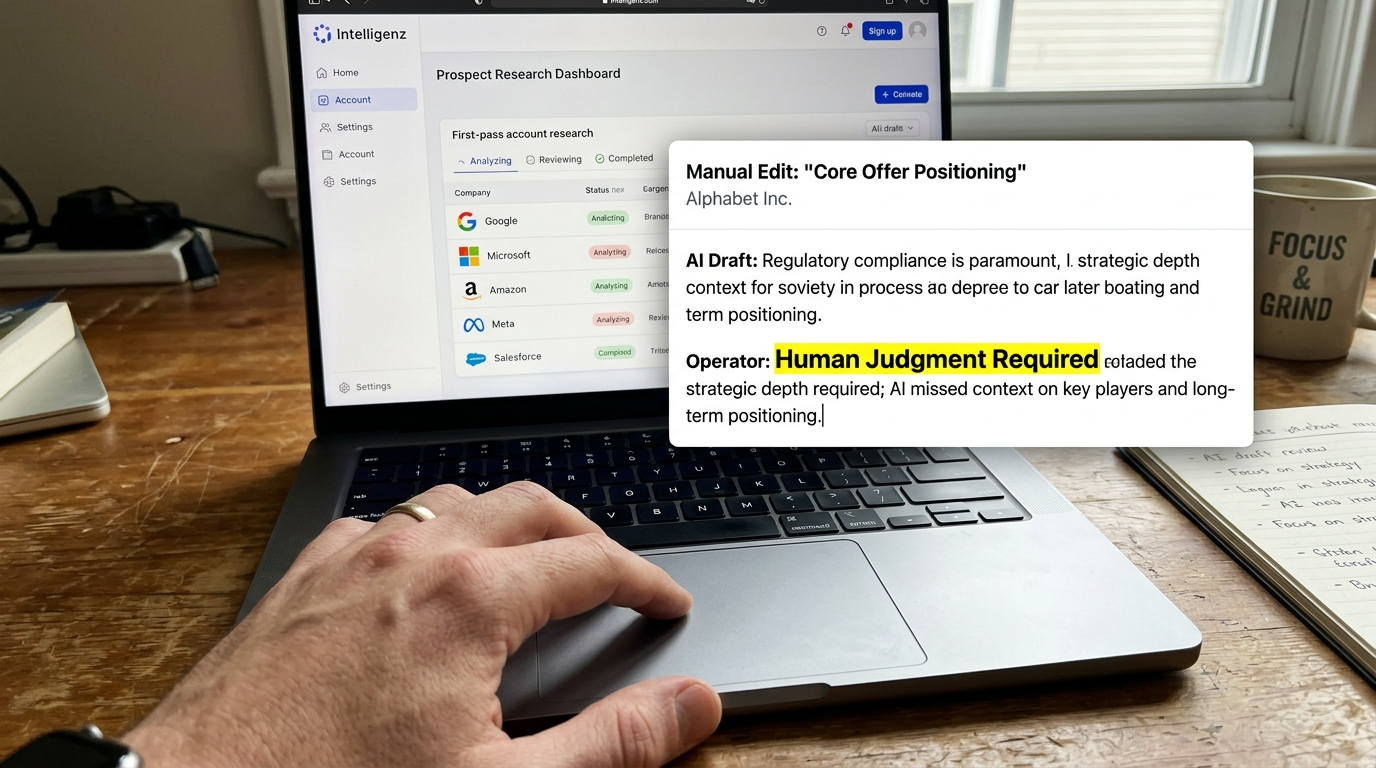
AI is the leverage, not the strategist. This distinction matters because the market is flooded with overblown claims about AI replacing human sales work entirely.
AI should handle:
First-pass account research
Data enrichment
Signal collection and monitoring
Company summaries and technology lookups
Draft personalization
Sequence variants
CRM activity logging
Lead prioritization and scoring
Reply classification
Meeting reminders and scheduling prompts
QA checklists
Humans should own:
ICP definition
Offer positioning
Message judgment and final copy
Account strategy for high-value targets
Sensitive or complex replies
Objection handling in real conversations
Disqualification decisions
Stakeholder mapping
Executive-level communication
Closing
Gabe Larsen made a useful distinction on LinkedIn: AI is strong for hot and warm leads, especially real-time intent signals, but cold, classic outbound is not automatically solved by AI, particularly when data is bad and email tools create spam.
And Hacker News discussions provide an important counterpoint. One commenter framed AI cold email tools as a force multiplier for spam, which is a trust risk any operator must take seriously. Technical buyers in particular will punish obvious automation.
The operator decides who to target, why now, what problem to lead with, how much personalization is worth it, when to stop, and how to protect the brand. AI helps the operator move faster through research, enrichment, drafting, routing, and analysis. The human judgment is what separates a good operator from an AI SDR tool. For guidance on the messaging side specifically, this guide on how to write a cold email covers the craft behind effective outreach.
When One Operator Is the Better Choice
One outbound operator is usually better than a team when:
The company is early or mid-stage.
ICP is narrow or still needs refinement.
The outbound motion is not yet proven.
The founder or GTM leader needs pipeline quickly without a long hiring cycle.
The company cannot afford a full SDR team.
The team has been burned by generic SDR agencies.
Deliverability, messaging, and targeting are the real bottlenecks.
The company needs senior judgment, not just more activity.
The sales cycle requires quality meetings, not raw appointment volume.
The company wants a system it can later internalize.
This aligns with what practitioners report across Reddit and LinkedIn. Many buyers are not looking for “more SDRs.” They are looking for ownership of the outbound system. The question is not whether to outsource or build in-house. The question is who owns the hard parts.
If your outbound problem is not “we need more SDRs” but “we need a better outbound system,” SalesPipe is built around that model: direct access to a senior outbound operator who defines the ICP, builds the infrastructure, runs campaigns, protects deliverability, and improves the motion over time.
When You Still Need a Team
A team may be the better choice when:
ICP and messaging are already validated.
There are multiple territories or verticals requiring coverage.
Phone-heavy outbound requires high daily call volume.
Multiple AEs need dedicated SDR coverage.
Enterprise account development requires multi-threaded outreach across large buying committees.
The company has SDR management and enablement already in place.
There is enough volume to justify specialized roles.
The company wants to build long-term internal sales talent.
Astra GTM makes a similar observation: agencies win on speed and capital efficiency earlier, while in-house teams make more sense at scale when ICP, motion, and AE coverage are proven.
The operator model is not anti-team. It is anti-premature team. The right sequence is usually: a senior operator proves the motion, then the company decides whether to keep the operator model, add internal reps, or build a hybrid system. For context on the benefits of outsourcing sales operations during that transition, that guide covers the tradeoffs.
Activity-Led Outbound vs Architecture-Led Outbound
This comparison captures the difference in philosophy:
| Activity-led outbound | Architecture-led outbound |
|---|---|
| More SDRs | Better system owner |
| More emails | Better segmentation |
| More calls | Better timing |
| Generic templates | Signal-led messaging |
| Opens and sends tracked | Positive replies and qualified meetings tracked |
| Tool sprawl | Integrated workflow |
| SDR manager diagnoses late | Operator iterates weekly |
| Volume creates pipeline | Precision creates pipeline |
When you understand the distinction, it becomes obvious how one outbound operator can outperform a team running activity-led outbound. Architecture beats activity when the system is the bottleneck.
How to Measure Whether the Operator Is Outperforming
Do not measure by activity. Measure by outcomes and learning.
Output Metrics
Meetings booked and held
Show rate
Qualified opportunities created
Pipeline accepted by sales
Closed-won revenue from outbound
Efficiency Metrics
Cost per meeting held
Cost per qualified opportunity
Operator hours per qualified opportunity
Time from launch to first meeting
Time from launch to first qualified opportunity
Quality Metrics
Positive reply rate
Reply-to-meeting conversion
Meeting-to-opportunity conversion
Average deal size
No-show rate
Disqualification rate
System Health Metrics
Inbox placement rate
Bounce rate
Spam complaint rate
Domain reputation
Valid email rate
Learning Metrics
Number of segments tested
Number of message hypotheses tested
Time to identify best-performing segment
Objections captured and categorized
New account insights generated
Salesforce reports that high performers focus on data hygiene and tech consolidation to improve AI outcomes. Tracking system health, not just activity, is what separates operators from traditional SDR management.
The Outbound Operator Scorecard
A strong outbound operator should be able to answer these twelve questions at any point:
Who exactly are we targeting?
Why would they care right now?
What signal says this account is worth contacting?
What problem are we leading with?
Which channel fits this buyer?
How are inboxes configured and monitored?
What is our safe sending volume?
What counts as a positive reply?
What objections are we seeing?
Which segment should we double down on?
Which segment should we stop targeting?
What did this campaign teach us?
If a team of five SDRs cannot answer these questions consistently, and one operator can, the operator will outperform the team. The competitive advantage is not bandwidth. It is clarity.
Example: How One Operator Replaces a Five-Person Workflow
This is a hypothetical but realistic comparison, not a case study.
A five-person SDR team might divide work like this:
Rep 1 researches accounts manually.
Rep 2 cleans and verifies lists.
Rep 3 sends cold email sequences.
Rep 4 works LinkedIn prospecting.
Rep 5 follows up on warm replies.
A manager reviews dashboards and coaches.
A single outbound operator with AI compresses that workflow:
AI researches accounts and flags buying signals.
Operator reviews ICP fit and approves targeting.
AI drafts message variants based on account context.
Operator edits positioning and finalizes copy.
AI prepares multi-channel sequences.
Operator monitors deliverability and adjusts volume.
AI categorizes replies by intent.
Operator handles nuanced responses and adjusts the next campaign based on what was learned.
The operator sees the whole picture. The team sees slices. That is why Salesforce’s finding that reps spend 60% of time on non-selling work is so relevant. Much of that overhead disappears when one person with AI support runs a tight system.
Closing the 2026 'Impact Gap'
The "Impact Gap" is the distance between sales activity and actual revenue. In 2026, Gartner reports that 80% of B2B deals go to the vendor that the buyer contacts first.
A traditional team often loses this race due to "Handoff Loss"—the lag time between an SDR booking a meeting and an AE conducting discovery. The Outbound Operator closes this gap by:
Prioritizing Speed-to-Lead: Using AI agents to classify intent in seconds.
Contextual Hand-offs: Delivering a full "intelligence brief" on the buying committee to the AE, reducing the 13.4 content pieces a buyer typically consumes before a sale.
Bottom Line
One outbound operator can outperform a team when outbound needs better judgment, better infrastructure, and faster learning more than it needs more hands. Teams still matter once the motion is proven. But if the system is unclear, a senior operator with AI leverage can get to signal faster, protect the brand, and create better pipeline with less waste.
The best sequence for most B2B companies: start with one senior operator who proves the motion. Then decide whether to scale with more people, keep the operator model, or build a hybrid.
Want to see whether one senior outbound operator can replace or supplement your SDR team? Apply to work with SalesPipe. You work directly with a founder-level outbound operator who handles ICP definition, messaging, outbound infrastructure, deliverability, and qualified meeting generation. If you have questions before applying, the SalesPipe FAQ covers the most common ones.