Human and AI Outbound: 4 B2B Patterns That Win in 2026
Human and AI Outbound wins in 2026: deliverability-first, signal-triggered, multichannel playbooks with human-in-the-loop QA. Get the checklist.

TL;DR
Human and AI outbound is a hybrid approach to B2B outbound sales where AI handles high-volume programmable work (research, enrichment, drafting, sequencing, reply triage) while a human operator owns strategy, quality control, nuanced conversations, and continuous improvement. This model exists because fully autonomous AI agents consistently underperform when deployed without guardrails, and pure human teams can’t match the speed and signal detection that AI enables. With Gmail and Yahoo enforcing strict deliverability standards since 2024, the teams winning at outbound are small, senior, and running tight human-in-the-loop systems rather than blasting volume or trusting a single tool to do everything.
2026 Strategy Takeaway: The "Spray and Pray" era is officially over. Success now requires Small Batches (<50 recipients) and Signal-Triggered timing. Teams that implement a Human-in-the-loop system see up to 12% reply rates, while autonomous bots are increasingly filtered by ISP-level AI firewalls.
What is the Human and AI Outbound Model?
Human and AI Outbound is a B2B sales strategy that combines AI's speed with human judgment. In this model, AI automates high-volume tasks like signal detection, data enrichment, and initial drafting, while humans own strategy, nuanced objection handling, and relationship building. This hybrid approach solves the 2026 deliverability crisis by prioritizing precision over volume.
What Is Human and AI Outbound?
Human and AI outbound is a human-in-the-loop approach to B2B outbound where AI handles the programmable, high-volume work (account research, data enrichment, first-pass drafting, sequence orchestration, reply classification, and buying-signal detection) while a human outbound operator owns ICP definition, offer design, messaging strategy, quality assurance, nuanced conversations, and ongoing optimization. BCG frames this as a spectrum, from augmented to assisted to autonomous, and recommends calibrating AI autonomy based on deal size and complexity while keeping purposeful human oversight wherever judgment and relationships matter.
The short version: AI does the heavy lifting. Humans make the decisions that matter.
This is not the same as buying an “AI SDR” tool and letting it run. It’s not the same as hiring a team of junior reps and handing them a dialer. It sits between those two extremes, and it’s where the best outbound results are happening right now.
If you want to understand the traditional SDR role this model builds on, see our breakdown of what an outbound SDR actually does.
Why Human and AI Outbound Matters Right Now
Three forces converged to make this model not just useful but necessary.
Deliverability Got Harder
In February 2024, Gmail enforced new requirements for bulk senders: strong email authentication (SPF, DKIM, DMARC), one-click unsubscribe for commercial email, and a spam-rate threshold that most practitioners peg at 0.3%. Yahoo followed with parallel enforcement in mid-2024, including one-click unsubscribe and a complaint feedback loop.
These aren’t suggestions. They’re enforced rules that directly affect whether your emails reach inboxes. Many outbound teams saw performance swings tied more to sender reputation and compliance than to copy changes. The bottleneck shifted from “what you say” to “whether anyone sees it.”
A human and AI outbound model addresses this directly. AI monitors reputation signals and manages infrastructure. Humans make the judgment calls about volume, timing, and when to pull back.
Reply Rates Dropped
Belkins published a study of 16.5 million cold emails across 93 domains and found an average reply rate of 5.8%, down from 6.8% the year before. Smaller, targeted sends (50 recipients or fewer) outperformed. Emails of 6 to 8 sentences did better than shorter or longer ones. And adding a third follow-up actually reduced replies while increasing spam complaints.
The data is clear: volume-based outbound is losing. Precision-based outbound is winning.
Single-Channel Is Dead
Practitioners on Reddit report that single-channel outbound no longer produces reliable results. The consensus in multiple threads is that multichannel sequences, email plus LinkedIn plus well-timed follow-ups triggered by live signals, outperform cold blasts by a wide margin. One thread put the difference at several-fold higher reply rates when signal-based timing was used versus cold list sends.
This is exactly the environment where human and AI outbound thrives. AI can monitor signals across channels and orchestrate sequences. Humans pick the angle and decide what matters.
For a broader view of multichannel tactics, our guide on LinkedIn prospecting covers the other half of a modern outbound motion.
What AI Does Well vs. What Humans Must Own
The most common mistake teams make is drawing the line in the wrong place. Give AI too much autonomy and quality tanks. Keep too much in human hands and you can’t scale. Here’s where the line should sit.
Delegate to AI
Account and contact research from multiple data sources, news monitoring, hiring signals, intent data, enrichment, and deduplication
Drafting first-pass emails and DMs, generating A/B test variants, and orchestrating multi-channel sequences within predefined guardrails
Reply classification (positive, negative, out-of-office, unsubscribe), meeting scheduling, CRM logging, and alerting humans to high-intent moments
Deliverability monitoring, including spam rate tracking via Google Postmaster Tools, bounce management, and domain health checks
Keep in Human Hands
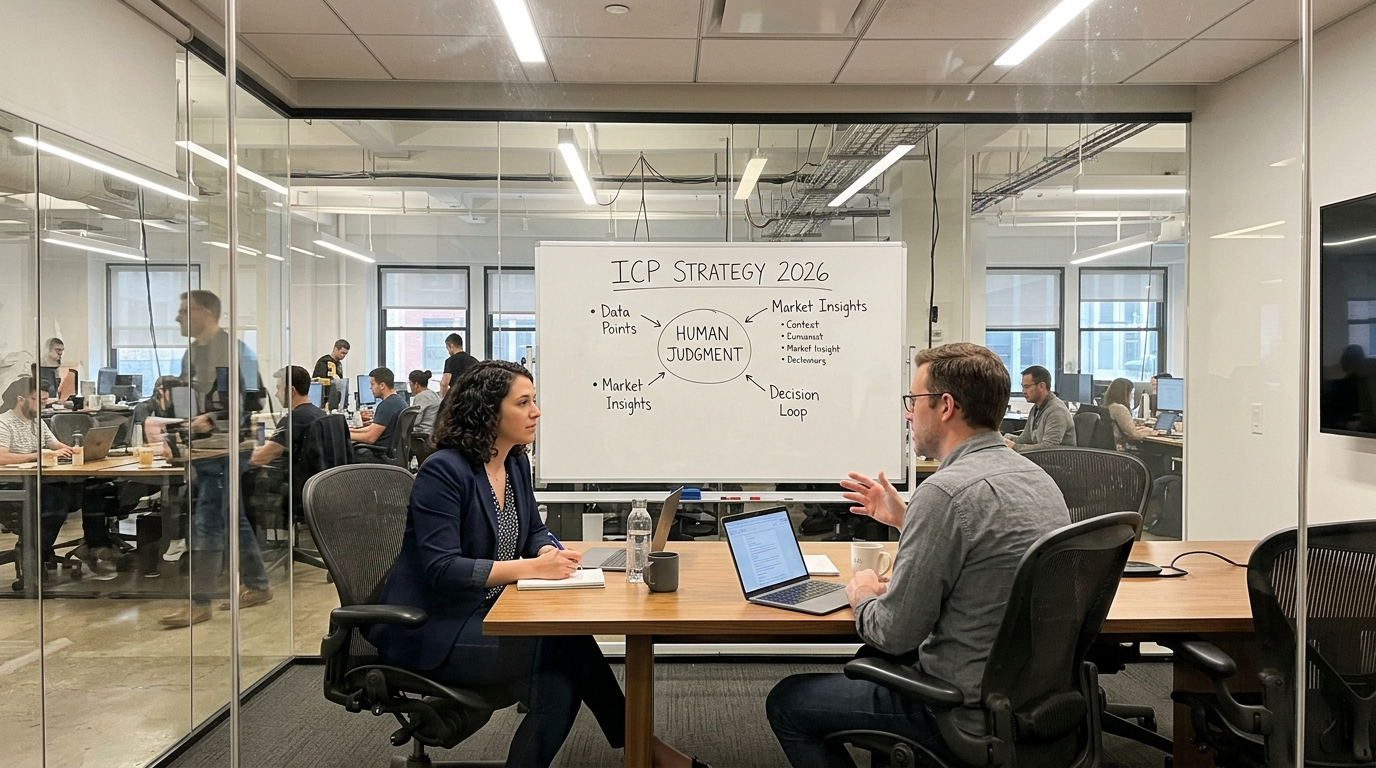
ICP definition, offer design, and message-market fit. AI can’t tell you who your best customer is or what pain they care about. That’s strategy, not automation. For context on how BDR and SDR roles traditionally handle this, the fundamentals still apply even in a hybrid model.
Brand voice and quality control. Generic AI tone is one of the most frequently cited reasons for poor conversions in practitioner communities. Humans set the bar and approve high-value sends.
Nuanced objection handling and live discovery. When a prospect asks a hard question or raises a real concern, that conversation needs a person.
Deciding which signals matter. AI can surface 50 buying signals a day. A human decides which three are worth acting on.
Continuous improvement. Reviewing what’s working, adjusting targeting, rewriting messaging, and tightening the system over time.
The guardrail is simple: human-in-the-loop policies consistently outperform fully autonomous setups. Practitioners on Reddit’s r/AI_Agents shared a telling case where a client’s AI sales agent booked zero meetings in two months because it was given too much autonomy without human checkpoints. The fix wasn’t better AI. It was breaking the workflow into narrow tools with human review at each step.
Patterns That Work in 2026
Based on current benchmarks and practitioner reports, four patterns define effective human and AI outbound today.
Small Batches Over Mass Sends
The Belkins data is unambiguous: campaigns targeting 50 or fewer recipients outperformed larger sends. This makes sense. Smaller sends mean more personalization, better targeting, and lower risk to domain reputation. AI makes small-batch outbound economically viable by handling the research and personalization work that would otherwise require a large team.
Signal-Triggered Timing
Imagine AI flags a VP of Operations posting on LinkedIn about an ERP rollout. A human reviews it, approves a short, outcome-specific opener with a clear CTA, and AI schedules the send and logs CRM notes. Practitioners in outbound communities report reply rates of 8 to 12% on signal-triggered sends versus roughly 0.5% on cold lists without triggers.
The signal is the advantage. AI finds it. The human decides what to do with it.
Multichannel by Default
Email alone doesn’t cut it anymore. The winning motion combines email, LinkedIn, and sometimes other channels, with each touchpoint informed by what happened on the previous one. AI handles the orchestration. Humans set the rules and handle conversations once they start.
For the tactical side of building these sequences, our cold outreach guide walks through the mechanics step by step.
Fewer Follow-Ups, Higher Quality
The old playbook of 7 to 10 touch sequences is dying. Belkins found that a third follow-up actually increased spam complaints and reduced replies. Many teams are winning with one strong initial email plus one or two well-timed follow-ups, then moving on. If you want to understand how sequences work and where the diminishing returns kick in, see our explanation of what an email sequence is.
Deliverability Checklist for Hybrid Outbound
None of the strategy above matters if your emails don’t reach inboxes. This checklist is non-negotiable for any team running a human and AI outbound motion.
SPF, DKIM, and DMARC configured and aligned for every sending domain. This is a baseline requirement under Gmail’s 2024 rules.
List-Unsubscribe and List-Unsubscribe-Post headers (per RFC 8058) on all commercial email. Both Gmail and Yahoo enforce one-click unsubscribe.
Spam complaint rate below 0.1%, never exceeding 0.3%. Monitor this through Google Postmaster Tools. The spam rate metric measures the percentage of delivered inbox messages that recipients manually mark as spam.
Hard bounce rate below 2%. Validate email addresses before sending. Stale lists are one of the fastest ways to burn a domain.
Domain reputation monitoring through Google Postmaster Tools and your ESP’s reputation dashboard. Check weekly at minimum.
Separate sending domains from your primary corporate domain. If a sending domain gets flagged, your main domain stays clean.
Warm-up new domains gradually. Don’t start a new domain at full volume. Ramp over 2 to 4 weeks.
A common misconception: “We send low volume, so the rules don’t apply to us.” Wrong. Gmail and Yahoo formally target bulk senders (5,000 or more messages per day), but misconfigured authentication and poor reputation hurt small senders too. Compliance is table stakes regardless of volume.
Tooling and Process: Narrow Agents vs. Autonomous AI SDRs
The debate over whether AI can “replace” SDRs generates strong opinions and no consensus. It’s worth understanding both sides.
SaaStr has taken the position that much of outbound SDR work can be automated if you invest heavily in orchestration, training data, and ongoing human oversight. Their framing: treat it like building a machine, not flipping a switch. The emphasis on “ongoing human oversight” matters. Even the strongest automation advocates acknowledge that AI without rigor underperforms.
The counter-signal from practitioners is equally clear. Communities repeatedly report that monolithic “do-everything” AI agents fail where narrow, specialized tools with human checkpoints succeed. The pattern that works: break the outbound job into discrete steps (research, drafting, sending, reply handling, scheduling), use the best tool for each step, and insert human review at critical junctures.
| Feature | Fully Autonomous AI SDR | Human + AI Outbound (Recommended) |
| Strategy & ICP | Static / Pre-programmed | Dynamic / Human-refined |
| Deliverability | High risk (Volume focused) | Low risk (Reputation managed) |
| Reply Quality | Generic / Repetitive | Nuanced / Brand-aligned |
| Meeting Conversion | Lower (Lacks empathy) | Higher (Human-led discovery) |
| Scale | Unlimited | Optimized for Quality |
The H-AI Ladder: A Maturity Framework

Here’s a practical way to think about increasing AI autonomy over time.
Level 1: Assisted Research and Drafting. AI gathers signals and drafts messages. A human approves every send and runs all conversations. This is where most teams should start. If you’re writing cold emails with AI assistance, our guide on how to write a cold email covers the fundamentals that a human should still control.
Level 2: Orchestrated Multichannel. AI sequences email and LinkedIn based on live triggers and predefined rules. A human sets the rules, reviews samples regularly, and handles all positive replies. The AI has more autonomy but operates within clear boundaries.
Level 3: Agentic Triage at Scale. AI qualifies replies, schedules meetings, and updates the CRM. A human steps in for edge cases, complex objections, and all strategic accounts. This is where BCG’s “autonomous” tier lives, and it should be reserved for high-volume, lower-complexity motions.
Upgrade gates: Only move up a level when your deliverability health is strong (spam rate below 0.1%), positive-reply ratios are stable, show rates hold, and meeting-to-opportunity conversion stays on target. If any metric drops below your threshold, step back down and tighten human review.
Metrics That Define Success
The right human and AI outbound operation tracks metrics at every stage of the funnel.
Deliverability Metrics
| Metric | Target | Red Line |
|---|---|---|
| Spam complaint rate | Below 0.1% | Never exceed 0.3% |
| Hard bounce rate | Below 2% | Above 5% = stop and clean |
| Domain reputation | “High” in Postmaster | Any drop = investigate |
Top-of-Funnel Metrics
| Metric | Benchmark |
|---|---|
| Overall reply rate | 3 to 6% (Belkins avg: 5.8%) |
| Targeted micro-send reply rate | Can exceed 8% with signals |
| Positive reply ratio | Track as % of total replies |
| Booked meeting rate | Segment by channel and signal type |
Down-Funnel Metrics
| Metric | What to Watch |
|---|---|
| Show rate | Are meetings actually happening? |
| Meeting-to-opportunity conversion | Quality of meetings, not just quantity |
| Cost per qualified meeting | Compare AI-assisted vs. previous model |
Use your own baselines for down-funnel metrics. Vendor claims about meeting generation vary wildly and should be treated as marketing, not benchmarks.
Two Mini-Plays: Human and AI Outbound in Action
Play 1: Signal-Triggered Outreach
AI monitors LinkedIn and news sources for buying signals. It flags a VP of Operations at a target account who just posted about evaluating new supply chain software. The AI drafts a two-sentence opener referencing the post, connecting it to a relevant outcome, with a short CTA.
A human reviews the draft, adjusts the tone, and approves the send. AI schedules the email for that morning, queues a LinkedIn connection request for the next day, and logs everything in the CRM. If there’s no reply within 3 days, AI sends one follow-up. If there’s still no reply, it moves on.
This play consistently produces reply rates of 8 to 12% in practitioner reports, compared to sub-1% on cold lists without triggers.
Play 2: Reply Triage
Outbound is running. Replies start coming in. AI classifies each reply into categories: “book now” (clear interest), “needs qualification” (interested but unclear fit), and “needs AE” (complex, high-value, or sensitive).
For “book now” replies, AI sends a scheduling link and handles the back-and-forth. For “needs qualification,” AI asks a short qualifying question from a human-approved list. For “needs AE,” a human responds within an hour with a personalized message.
This triage pattern keeps response times fast (AI handles the easy ones in minutes) while ensuring that every important conversation gets human attention.
Build Your Human and AI Outbound Engine
The gap between teams that struggle with outbound and teams that thrive isn’t budget or headcount. It’s operating model. The teams winning in 2026 are small, senior, and running tight human-in-the-loop systems with AI handling the volume work and humans owning the decisions.
If you want a founder-led, AI-powered outbound engine that covers ICP definition, messaging, infrastructure, deliverability, and qualified meeting generation, apply to work with SalesPipe. You’ll work directly with an experienced outbound operator, not a junior team, to build and run the kind of human and AI outbound system this article describes.
Related articles
8 Best Fractional Outbound Operator Picks for 2026
Compare 8 ways to hire a Fractional Outbound Operator in 2026—costs, models, pros/cons, and best fits for B2B startups. Get the right fit.
1 Person Outbound Team in 2026: Model, Costs & Playbook
Learn how a 1 person outbound team works in 2026—from costs and stack to workflows and when it makes sense. Build pipeline with lean, AI-powered outbound.
Founder-Led Outbound With AI in 2026: 7-Step GTM Playbook
Learn founder-led outbound with AI to build pipeline fast. 7-step 2026 playbook, 2024 deliverability rules, and tools to book meetings—start now.
AI-Powered Outbound for SaaS: The 2026 Complete Guide
Learn how AI-powered outbound for SaaS works in 2026: deliverability, signals, sequencing, and measurement. Build a lean, operator-plus-AI engine.