Outbound Operator for SaaS Startups: 2026 Top 5 Picks
Learn how an Outbound Operator for SaaS Startups builds pipeline fast—strategy, deliverability, multichannel execution. See 2026’s top 5 and choose yours.

In the fast paced world of B2B SaaS, sustainable growth is everything. While inbound marketing builds a solid long term foundation, many startups need pipeline now. Relying solely on referrals or content marketing can be too slow when you have aggressive revenue targets. This is where a proactive, expert led outbound strategy becomes a critical lever for growth.
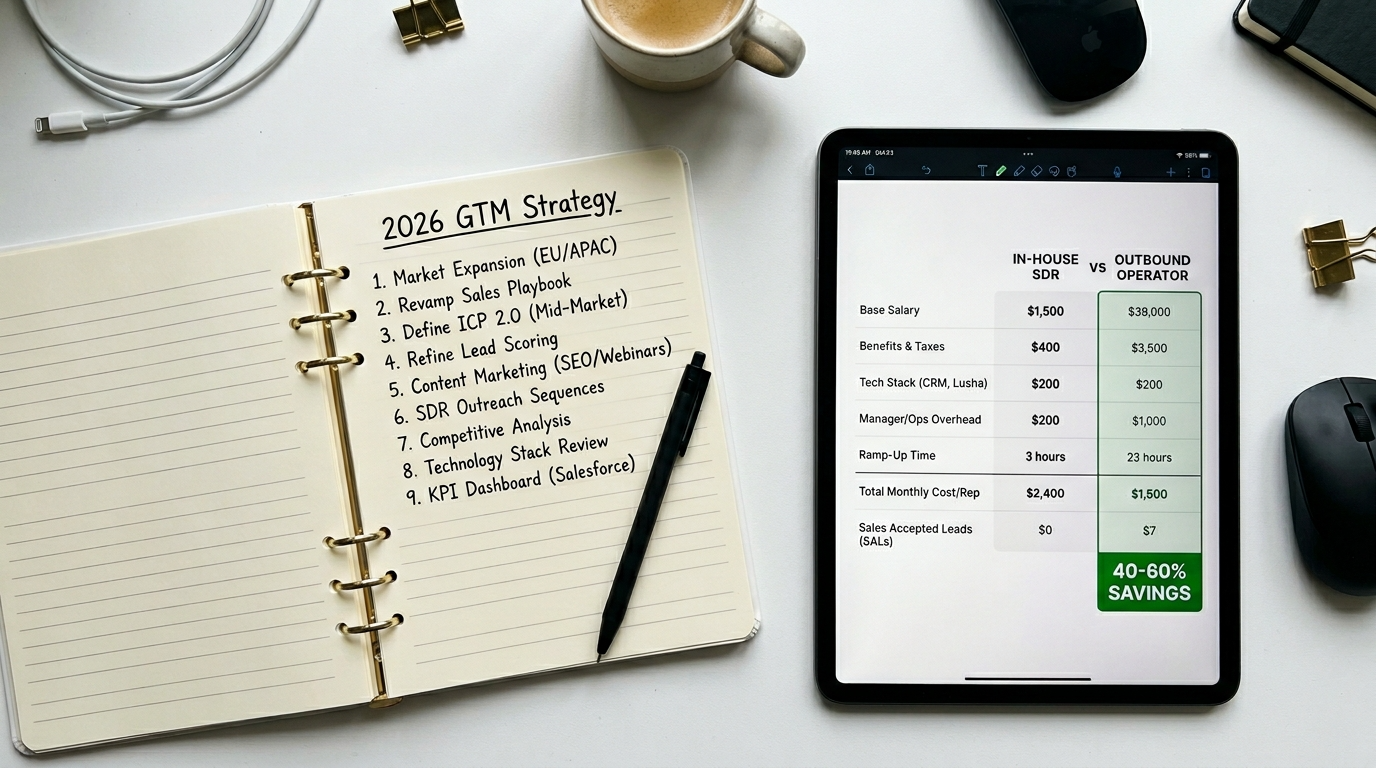
Direct Answer: What is an Outbound Operator for SaaS? An outbound operator for SaaS is a senior-level strategic partner who builds and manages a startup’s entire pipeline generation system. Unlike traditional lead gen agencies, they function as an "SDR-as-a-Service," combining ICP strategy, technical deliverability (SPF/DKIM/DMARC), and AI-driven multichannel execution to book qualified meetings. In 2026, the average cost of an outbound operator ranges from $5,000 to $10,000 per month, providing a 40-60% cost saving compared to hiring an in-house SDR team.
But building an in house sales development team is expensive, slow, and often fails. The total cost for a single in house Sales Development Representative (SDR) can exceed $125,000 annually when you factor in salary, benefits, tools, and management. This reality has fueled the rise of the outbound operator for SaaS startups, a modern alternative to traditional sales teams.
What is an outbound operator for SaaS?
An outbound operator for SaaS is more than just a freelancer who sends cold emails. They are a strategic partner who builds, manages, and executes your entire outbound pipeline generation system. Unlike a large agency that might pass your account to a junior team member, an outbound operator is typically a senior, hands on expert who integrates directly with your go to market (GTM) motion.
This role combines three key functions:
Consultant: They help you define your Ideal Customer Profile (ICP), craft compelling messaging that resonates with specific pain points, and design the overall outreach strategy.
Technologist: They build the necessary infrastructure, including domain setup, inbox warming, deliverability monitoring, and integrating tools like CRMs and sales engagement platforms.
Executor: They are the ones in the trenches, running multichannel outreach campaigns, A/B testing messages, and booking qualified meetings for your founders or account executives.
The value of a skilled outbound operator for SaaS startups is their ability to act as a force multiplier, often using AI and automation to achieve the output of a small team without the associated headcount and overhead.
| Feature | In-House SDR (Junior) | Outbound Operator (Senior) |
| Annual Cost | $125,000+ (Salary + Tax + Tech) | $60,000 - $90,000 (Flat Fee) |
| Ramp-Up Time | 3 - 4 Months | 2 - 4 Weeks |
| Strategic Depth | Low (Execution only) | High (GTM & Messaging strategy) |
| Tech Management | Requires Sales Ops Manager | Included (Self-managed stack) |
| Risk | High (Churn & Hiring overhead) | Low (Month-to-month flexibility) |
Outbound vs. inbound for SaaS: when to use which
Inbound and outbound are two sides of the same coin, both essential for a balanced GTM strategy. The key is understanding when to deploy each.
Inbound marketing is about attracting customers who are already looking for a solution. They find you through your blog, SEO, or social media. Inbound leads cost an average of 61% less than outbound leads.
Outbound marketing is about proactively contacting potential customers who fit your ICP but may not be actively searching for a solution yet. You are creating demand, not just capturing it.
| Factor | Inbound Marketing | Outbound Marketing |
|---|---|---|
| Buyer Intent | High (Actively searching) | Low to Medium (Problem unaware) |
| Lead Quality | Often higher, more educated | Variable, requires strong qualification |
| Speed to Results | Slower ( Often 6+ months for SEO) | Faster (Can generate meetings in weeks) |
| Scalability | Compounding, scales over time | Linear, scales with activity |
| Best For | Building brand, long term growth | Kickstarting growth, market validation |
For early stage SaaS companies, outbound is often the fastest way to get direct market feedback, generate initial traction, and secure critical early revenue. While inbound leads from demo requests can convert at around 30% on average for B2B SaaS demo-to-close (closed-won deals divided by demos delivered within 90 days), outbound helps fill the pipeline when organic traffic is still low.
Lay the GTM foundation before you launch

A successful outbound campaign doesn’t start with a mass email blast. It starts with a strong foundation. SaaS companies with robust GTM strategies can grow faster than their peers. An experienced outbound operator will ensure these core components are in place before any outreach begins.
Key Foundational Pillars:
Ideal Customer Profile (ICP): Moving beyond basic firmographics (company size, industry) to understand the specific pain points, goals, and buying triggers of your best potential customers. A poorly defined ICP is a primary reason even the best SDRs fail.
Compelling Messaging: Crafting a value proposition that clearly articulates how you solve a critical problem for your ICP. This isn’t just a list of features, it’s a story about outcomes.
Technical Infrastructure: This is a crucial and often overlooked step. It involves setting up separate sending domains, configuring SPF, DKIM, and DMARC records to authenticate your emails, and slowly “warming up” your inboxes to build a positive sender reputation. Poor deliverability means your emails land in spam, making your entire effort invisible.
A Defined Process: Mapping out the entire workflow, from lead sourcing and list building to the sequence of touches and the criteria for handing a qualified lead over to the sales team.
For startups needing to move quickly, a founder led service like SalesPipe can help establish this GTM foundation and launch your outbound engine in a fraction of the time it would take to build internally.
Execution playbook for SaaS outbound
With a solid foundation, the focus shifts to execution. A modern outbound playbook is multichannel and highly personalized. Campaigns that use three or more channels can achieve a 287% higher purchase rate than single channel strategies.
A typical execution playbook run by an outbound operator for SaaS startups includes:
Targeted List Building: Creating highly segmented lists of contacts who precisely match the defined ICP.
Multichannel Sequencing: Engaging prospects across different platforms. While cold email remains a workhorse, LinkedIn prospecting is a powerful channel for B2B engagement. Adding LinkedIn to the mix is a common practice for any serious outbound operator for SaaS startups.
Personalization at Scale: Generic emails have a reply rate below 9%, but campaigns with advanced personalization can achieve a 17% response rate. An operator uses AI and smart tooling to personalize messages with relevant details about the prospect’s company, role, or recent activity without spending hours on manual research for every contact.
Continuous A/B Testing: Systematically testing different subject lines, messaging hooks, and calls to action to optimize performance over time.
Qualification, handoff, and what ‘good’ looks like
Booking a meeting is not the end goal, booking a qualified meeting is. A strong outbound operator establishes clear B2B lead qualification criteria with the founding team. This ensures that the person showing up for the demo actually has the problem you solve and the authority to influence a purchase.
The handoff process is equally important. The founder or AE receiving the meeting should have all the context they need from the operator’s initial conversations. A smooth handoff prevents the prospect from having to repeat themselves and creates a seamless buying experience.
So, what does “good” look like?
Consistency: A predictable flow of qualified meetings booked each month.
Quality: Low no show rates and positive feedback from the sales team on lead quality.
Learning: The operator provides insights from the front lines, helping to refine messaging, pricing, and even the product roadmap based on real market feedback.
How to evaluate a SaaS-specialized outbound operator
Choosing the right partner is critical. Not every self proclaimed “outbound expert” has the strategic and technical depth to deliver results for a SaaS company.
Here are key areas to evaluate:
SaaS Experience: Have they worked with B2B tech or SaaS companies before? Do they understand the business model, sales cycles, and the specific challenges of the industry?
Strategic Depth: Ask them to walk you through their process. Do they start with ICP and messaging, or do they jump straight to talking about email volume? A true operator focuses on strategy before tactics.
Technical Acumen: Do they proactively bring up email deliverability, domain setup, and inbox warming? If they don’t mention SPF, DKIM, and DMARC, they lack the technical skills to protect your domain and ensure your messages get delivered.
Execution Model: Crucially, who will be doing the actual work? With many agencies, you speak with a senior person during the sales process but your account is managed by a junior employee. A founder led model, where you work directly with the principal, offers greater accountability and expertise. This is a core differentiator for services like SalesPipe.
Transparency and Reporting: How will they measure success and communicate progress? Look for a partner who tracks metrics beyond just meetings booked, including open rates, reply rates, and deliverability scores.
Pricing models and success metrics
Pricing for an outbound operator can vary, but it generally falls into a few categories:
Monthly Retainer: A fixed fee for a defined scope of work. This is common for founder led and consultative services.
Pay Per Meeting: You pay a set price for each qualified meeting booked.
Hybrid Model: A combination of a lower monthly retainer plus a performance bonus for meetings booked or deals closed.
When comparing costs, it’s important to weigh it against the fully loaded cost of an in house SDR, which has a Total loaded cost: $100,000 to $130,000 annually. An experienced operator can often deliver superior results for a fraction of that cost, with no long term commitment.
Key Success Metrics:
Beyond “meetings booked”, a sophisticated outbound operator for SaaS startups will track:
Positive Reply Rate: How many prospects respond with interest?
Meeting Quality Score: How many booked meetings are accepted as qualified by the sales team?
Pipeline Influence: How much potential revenue did the outbound efforts generate?
Inbox Placement Rate: What percentage of emails are landing in the primary inbox vs. spam?
Best Outbound Operator for SaaS Startups: Top 5
Transitioning from founder-led sales to a scalable outbound engine requires a partner that understands the nuances of the SaaS buyer journey. The following five operators have established themselves as leaders in the space by offering specialized SDR talent and data-driven strategies designed to accelerate pipeline growth for software startups. Each of these agencies provides the technical infrastructure and market expertise needed to turn cold prospects into high-value demo opportunities.
1. SalesPipe
Best for: U.S.-based B2B SaaS startups that want senior-led outbound to generate qualified meetings without hiring SDRs. If you value speed, precision, and keeping your domain safe, this is a founder-on-the-field model built for you.
A founder-led, AI-powered outbound engine that replaces the churny SDR-agency playbook.
SalesPipe keeps strategy and execution close to the metal. You work directly with founder Rob Whitley, combining AI-driven research and personalization with expert-led LinkedIn and cold email outreach. The team handles the unglamorous but essential bits: domain provisioning, inbox warming, and deliverability safeguards, so messaging and targeting can iterate quickly without risking reputation. The engagement plugs neatly into your existing GTM stack and reporting rhythms, favoring swift feedback loops over bloated handoffs.
What you’ll get
Sharp ICP definition and segmentation, with AI-enriched, verified prospect data.
Multichannel messaging across cold email and LinkedIn with tailored personalization.
Full technical setup: domains, inbox warming, and deliverability protection.
Senior-led campaign execution with rapid A/B testing and iteration.
Performance reporting and RevOps hygiene for clean AE handoffs.
Proof / results
Workboard: Multiple closed deals and enterprise pipeline expansion via focused outbound.
Zanoma: Technical B2B services translated into highly qualified leads.
Refer: Rescued deliverability and boosted reply rates through strategy tuning.
2. Outbound Sales Pro
Best for: Seed to Series B B2B SaaS teams in North America that need fast, compliant multichannel outbound to land net-new logos within weeks, not months.
Dedicated SDR pods + proprietary deliverability (Parakeet) = speed-to-first meeting with scale and control.
Outbound Sales Pro operates like an in-house engine: dedicated SDR pods pair human judgment with AI research, then execute across email, LinkedIn, and phone. Their deliverability rigor stands out: SPF/DKIM/DMARC governance, Postmaster monitoring, and a custom Parakeet setup to keep inbox placement high. Expect a 2–3 weeks to first campaigns, then weekly test-and-learn cycles informed by real market responses. A 60-second SLA for website visitor follow-up captures intent in the moment. Pricing typically starts around $6.5k per SDR, with native Salesforce/HubSpot integration for clean ops.
What you’ll get
ICP and target account selection with verified, enriched lead data.
End-to-end email ops: domain warming, copy, reply handling, and routing.
LinkedIn sequences plus parallel-dialer phone outreach by trained SDRs.
Real-time visitor identification with instant Slack alerts and routing.
Weekly reporting, experimentation, and native Salesforce/HubSpot sync.
Proof / results
Enterprise AI SaaS: 12 to 16 highly qualified meetings per month.
Website identification: 60-second SLA drives 35% conversion to meetings.
Performance: Reply rates 4.5x above industry average; 50%+ open rates.
3. Belkins
Best for: Seed to Series B B2B SaaS with $10K+ ACVs targeting North America/EMEA and seeking a fast, full-service path to pipeline.
High-touch pods, 14-day onboarding, and a 90-day pilot designed to hit traction by month one.
Belkins assembles specialist pods (researchers, copywriters, deliverability pros) to run multichannel plays across email, LinkedIn, and calling. They plug directly into your CRM and build Looker-powered reporting for transparency. Onboarding lands in two weeks; from there, the first 90 days focus on rapid learning and compounding traction. As a HubSpot Solutions Partner, they bring deep RevOps support, while spintax and intent signals drive personalization at scale without burning your domains. Starter plans often begin near $5,000/month with appointment guarantees.
What you’ll get
ICP/TAM definition with manual research and contact verification.
Domain provisioning, inbox warming, and ongoing deliverability monitoring.
Omnichannel sequences across email, LinkedIn, and intent-based calling.
CRM integration (HubSpot specialty) with Looker Studio dashboards.
A/B testing, weekly syncs, and structured AE handoffs.
Proof / results
Terrascope: 125 meetings via 4-stage omnichannel programs.
Sustainability SaaS: 56 opportunities and $2.2M in influenced pipeline.
JourneyDXP: 126 appointments over 17 months; 19,390 total leads generated.
4. Leadium
Best for: North American SaaS teams at $1M to $15M ARR that prioritize flexibility (month-to-month), fast launch (7 to 10 days), and US-based SDRs.
Boutique feel, enterprise rigor: month-to-month agility with SDRs embedded in your Slack and CRM.
Leadium builds managed SDR squads that move quickly ( appointment-setting in as little as 7 to 10 days) while keeping governance tight inside your toolchain. A 100% US-based team runs orchestrated email, LinkedIn, and phone plays, with persona-specific messaging refined through constant A/B tests. They cap new onboardings monthly to preserve quality and provide robust deliverability management so scale doesn’t tax your domain reputation. Expect bi-directional CRM integration and real-time Slack visibility for every touch.
What you’ll get
ICP definition and persona mapping with test-driven messaging.
Data enrichment from 20+ sources and continuous verification.
Coordinated email, LinkedIn, and cold calling sequences.
Domain/DNS setup, inbox warming, and deliverability safeguards.
Bi-directional Salesforce/HubSpot integration and live Slack reporting.
Proof / results
Rackspace: $4M pipeline; Achieved a 35% increase in booked meetings.
PayEm: 14 appointments per month; 22% call-to-meeting conversion.
5. SalesRoads
Best for: US B2B SaaS at $1M to $20M ARR looking for predictable, phone-first appointment setting backed by transparent pricing and tight process.
Phone-first precision, transparent pricing (~$9,950 per 4 weeks), and a Day-16 launch to get calls rolling fast.
SalesRoads assigns a dedicated SDR, a Sales Ops specialist, and a Director of Client Success to each program. They build a Demand Generation Playbook, enrich leads with AI-assisted research, and launch live calls by Day 16, augmented by personalized emails. The cadence favors quality conversations over spray-and-pray, supported by robust deliverability infrastructure and seamless CRM integrations. Weekly reporting and call recordings create a reliable loop for learning and improving conversion.
What you’ll get
Demand Generation Playbook with ICP and custom messaging.
AI-assisted data sourcing and hand-verified contacts.
Proactive calling plus personalized email outreach.
Advanced email infrastructure with domain warming and protection.
Native Salesforce/HubSpot integration and detailed weekly reporting.
Proof / results
Körber Supply Chain: 246 appointments; $6.2M pipeline.
Bid Retriever: 1,164 appointments culminating in acquisition.
Implementation checklist: 5 must-ask questions before you sign
Before you partner with an outbound operator, make sure you have clear answers to these five questions.
- Who, specifically, will be managing our account and executing the campaigns?
*This clarifies whether you’ll be working with a senior expert or a junior account manager.
- What is your detailed process for defining our ICP and developing messaging?
*This reveals their strategic capabilities and ensures they don’t use a one size fits all approach.
- How do you handle the technical setup for email deliverability?
*This is a critical diligence step. They should confidently explain their process for domain setup, warming, and monitoring.
- What does the onboarding process look like and how long until the first campaigns go live?
*This sets clear expectations for ramp up time. A good operator can often get started within 2-4 weeks.
- How will we communicate and what will your reporting look like?
*This ensures alignment on communication frequency and the metrics that matter most to your business.
Getting answers to these questions will help you find a true partner, not just a vendor. To see how an experienced operator answers these questions, consider exploring a founder led outbound service.
Common pitfalls to avoid
Many startups get burned by their first foray into outbound. Here are the common mistakes to avoid:
Treating it like a commodity: Choosing the cheapest provider often leads to generic, spammy outreach that can damage your brand reputation.
Having an unclear ICP: Sending messages to everyone is sending a message to no one. Without a tight ICP, your outreach will be irrelevant.
Ignoring the technical foundation: Skipping proper domain and inbox setup is the number one reason outbound campaigns fail before they even start.
Setting unrealistic expectations: Outbound is a system that requires testing and refinement. You won’t get 50 qualified meetings in the first month. It’s about building a predictable and scalable engine over time.
Hiring a junior team too early: Many startups hire inexperienced SDRs without the proper leadership, training, or processes in place, leading to high turnover and poor results.
Conclusion
For SaaS startups needing to generate pipeline efficiently, the outbound operator for SaaS startups model offers a powerful alternative to the high cost and risk of building an in house team. By partnering with a senior, hands on expert who combines strategy, technology, and execution, you can build a scalable outbound engine faster and more effectively. This approach allows founders to focus on closing deals and building the product, confident that their pipeline is in experienced hands. The right outbound operator for SaaS startups doesn’t just book meetings, they build a GTM asset that fuels predictable growth.
Ready to build a powerful outbound engine? Learn more about how a founder led outbound operator for SaaS startups can help at SalesPipe, or apply to work with SalesPipe to get started.